Key points
- Webb's mid-infrared data on Cassiopeia A support a shell merger inside the original star, possibly hours before it exploded.
- One reverse-shocked region held mostly silica dust; another was dominated by carbon dust.
- The Green Monster is rich in complex magnesium silicates and came from material the star shed before exploding.
- The results were published in The Astrophysical Journal Letters, with Tea Temim of Columbia University as lead author.
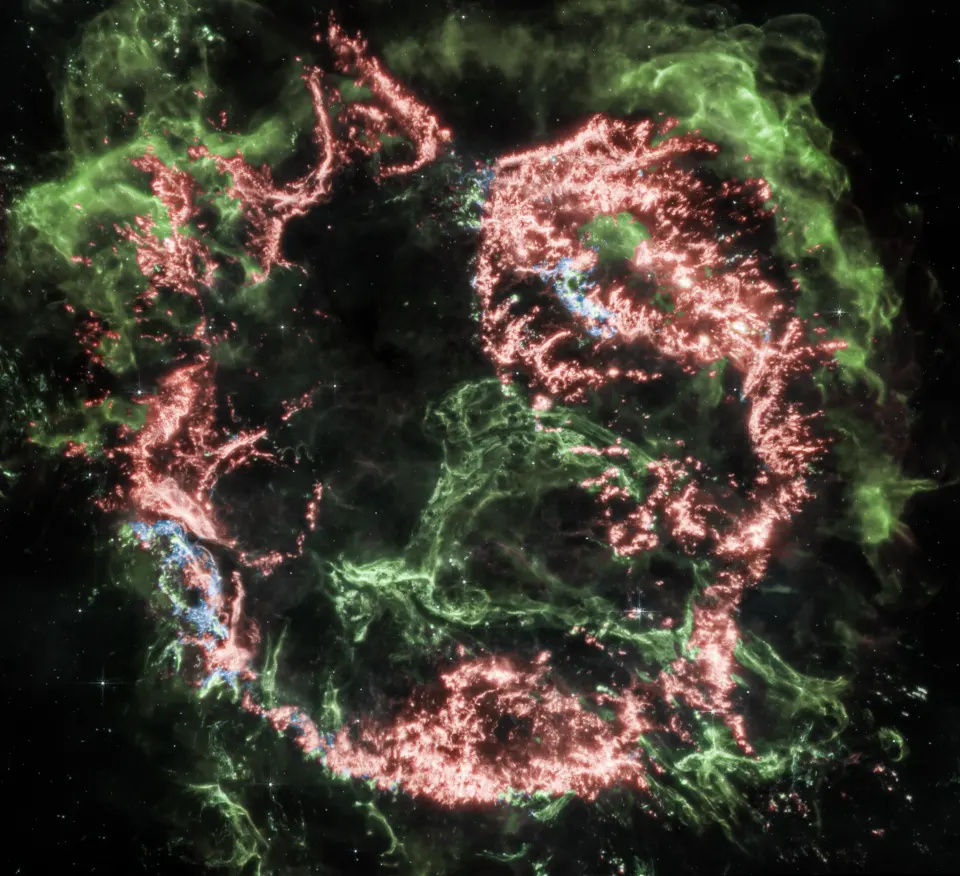
The dust left behind by the exploded star that became Cassiopeia A (Cas A) still carries clues about how that star was built. Using NASA's James Webb Space Telescope, a team led by Tea Temim of Columbia University found evidence of a shell merger, in which layers deep inside a star mix together. Their mid-infrared data support a scenario where this happened possibly just hours before the explosion. The findings appear in The Astrophysical Journal Letters.
As massive stars age, they fuse ever-heavier elements in their cores while lighter elements burn in surrounding layers, building up nested shells. A supernova scatters these elements into space, where some condense into dust grains that gather into clumps. Webb could pick out and analyze individual clumps, each roughly the size of a solar system, and read their chemistry.
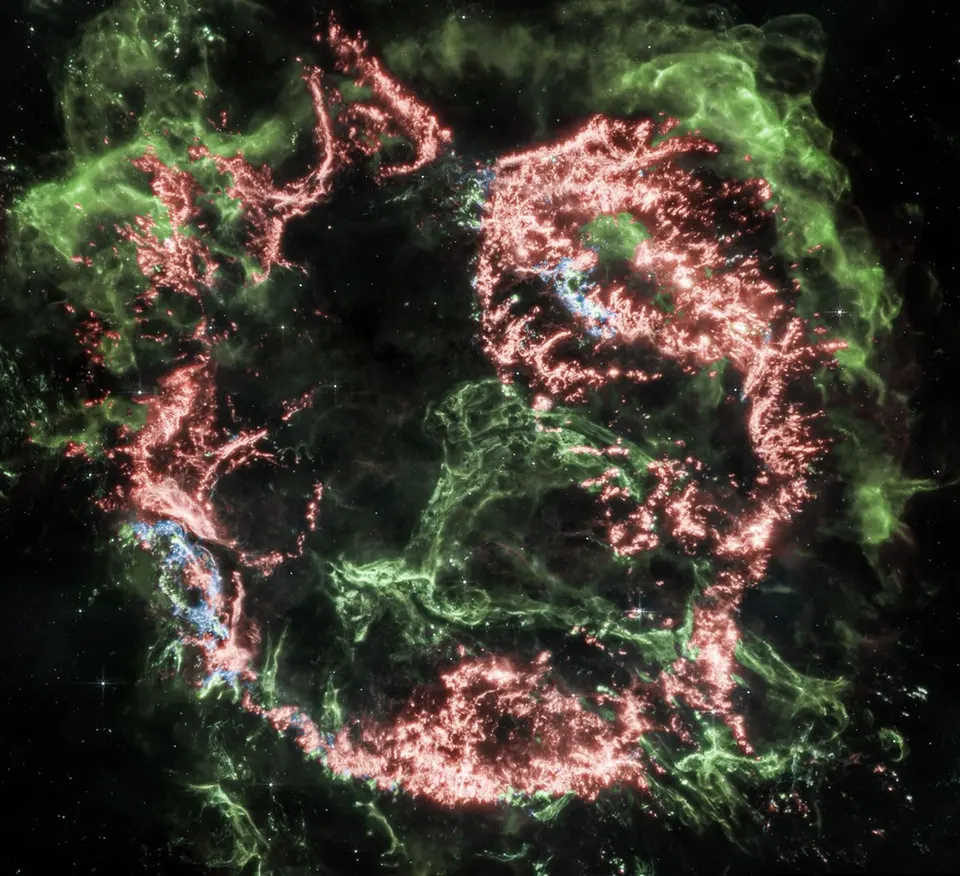
Earlier observations from NASA's now-retired Spitzer Space Telescope pointed the team toward three regions. Two lie where an inward-moving shock wave slams into outflowing debris: one held mostly silica dust, the other mainly carbon dust. The third, a structure Webb previously found and nicknamed the Green Monster, is rich in complex magnesium silicates and formed from material the star shed before it blew up.
Combined with X-ray data from NASA's Chandra X-ray Observatory and the JAXA-led XRISM mission, Webb's remnant-wide dust map indicates the merger was already in progress very shortly before the explosion, with its signatures spread across much of Cas A. Co-author Dan Milisavljevic of Purdue University says understanding this process is key to explaining which elements supernovae release to enrich future stars and planets.
Why it matters
According to NASA and ESA, the work gives astronomers a new method for inferring characteristics of an exploded star's structure from the dust in its supernova remnant. Co-author Dan Milisavljevic says understanding the merger process is key to explaining which elements a supernova releases into the galaxy.
What we don't know yet
The exact timing is uncertain. Taken together, the Webb, Chandra and XRISM observations indicate the merger was already in progress very shortly before the explosion, but the Webb data are described only as supporting a scenario in which the change happened possibly hours beforehand.
Terms in this story
- Supernova remnant
- The expanding cloud of gas and dust left after a massive star explodes.
- Shell merger
- A process in which separate element-burning layers inside a star mix together before it explodes.
- Reverse shock
- A shock wave that travels inward through a remnant and collides with debris moving outward from the explosion.
Sources and verification
- NASA’s Webb Shows How Supernova Dust Chronicles Star Evolution - NASA Science
- Webb shows how supernova dust chronicles star evolution - Dust formed after the supernova shows how changes within a soon-to-explode star influenced the elements it released
DexScience articles are produced with AI assistance and an automated fact-check against the linked sources. Spotted an error? Tell us and we will correct it openly.