Key points
- NOIRLab calls the image the best, most detailed view yet of supernova remnant SNR G295.5+09.7.
- The 570-megapixel Dark Energy Camera on the Blanco 4-meter Telescope in Chile took the picture.
- The remnant lies almost 6800 light-years away in Centaurus, in the Milky Way's Carina–Sagittarius arm.
- A neutron star left behind by the explosion sits inside the nebula's outer shell.
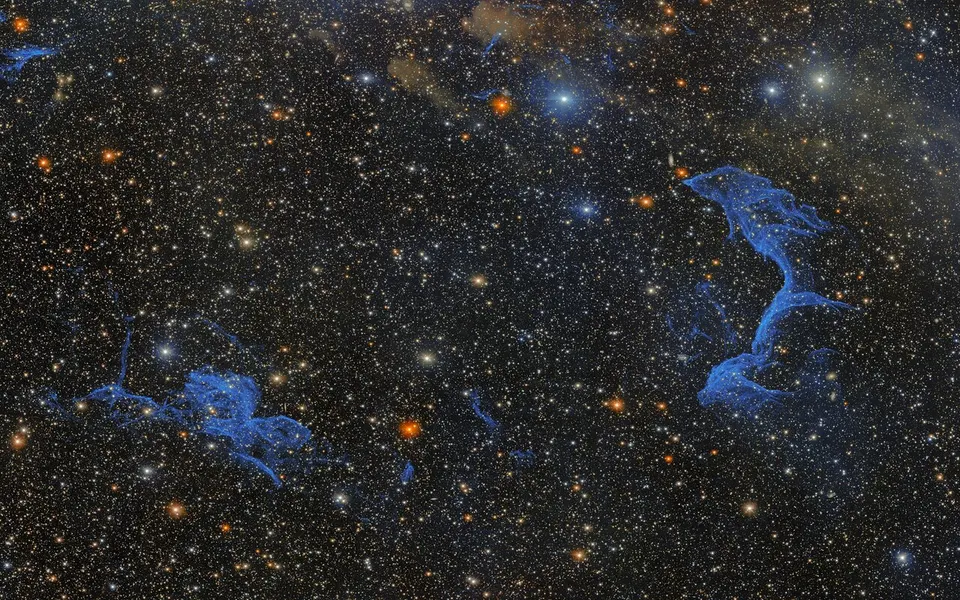
NSF NOIRLab has released what it calls the best, most detailed view so far of supernova remnant SNR G295.5+09.7, the glowing debris of an exploded star. It is nicknamed the Betta Fish Nebula because its blue, ribbon-like strands look like the flowing fins of the colorful aquarium fish. According to NOIRLab, the nebula may never have been imaged by a professional observatory before.
The picture comes from the 570-megapixel Dark Energy Camera (DECam). The U.S. Department of Energy built the camera, and it is mounted on the NSF Víctor M. Blanco 4-meter Telescope at Cerro Tololo Inter-American Observatory in Chile. NOIRLab took the image for its Legacy Imaging Program, which sets aside telescope time specifically to make color images for the public.
The remnant formed when a star many times the mass of our Sun exploded as a supernova. The outer layers it threw off slammed into the surrounding interstellar gas and made it glow, producing the blue ribbons seen today. The star's core collapsed into a neutron star, which now sits inside the nebula's outer shell. NOIRLab notes that these extremely dense objects pack about 1.4 times the Sun's mass into a ball 20 kilometers (12 miles) across.
The nebula lies almost 6800 light-years away in Centaurus, a constellation visible from the Southern Hemisphere, and sits within the Milky Way's Carina–Sagittarius arm. Thousands of stars from that arm fill the background, along with hazy brown interstellar clouds and, hidden among the stars, galaxies beyond our own.
Why it matters
According to NOIRLab, this is the most detailed view yet of the remnant and possibly the first image of it taken by a professional observatory. It shows what is left after a massive star explodes.
What we don't know yet
This is a public-outreach image released by NOIRLab, not a research result. NOIRLab says only that the nebula may not have been imaged by a professional observatory before.
Terms in this story
- Supernova remnant
- The expanding cloud of gas and debris left behind after a star explodes.
- Neutron star
- The extremely dense, collapsed core that can remain after a massive star explodes as a supernova.
- Interstellar medium
- The thin gas and dust that fill the space between stars.
Sources and verification
DexScience articles are produced with AI assistance and an automated fact-check against the linked sources. Spotted an error? Tell us and we will correct it openly.