Key points
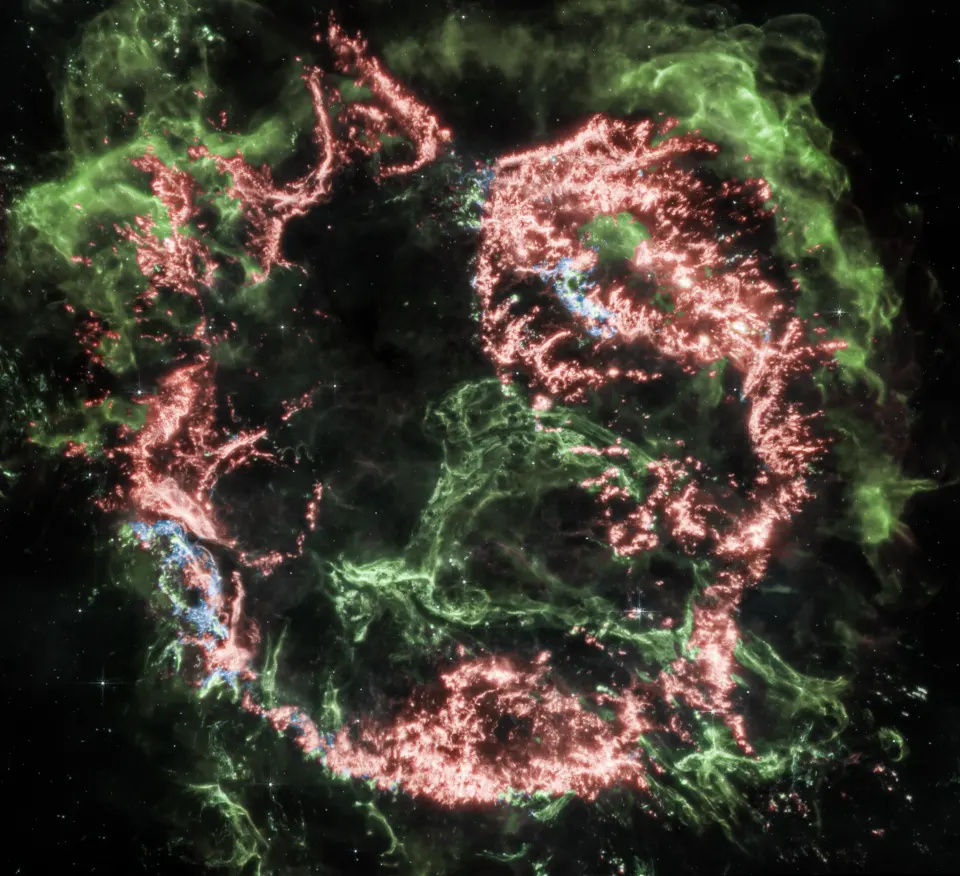
- NASA released a high-resolution, mid-infrared Webb image of the hot dust in Cassiopeia A on Nov. 23, 2026.
- According to NASA, the dust's composition gives clues to the structure of the original star.
- The Webb data support a scenario in which the star's interior changed dramatically, possibly just hours before it exploded.
- NASA says material in remnants like Cas A will eventually seed new generations of stars and planets.
NASA's James Webb Space Telescope has produced a sharp new mid-infrared picture of the hot dust inside Cassiopeia A, or Cas A, the debris left behind when a massive star exploded. According to NASA, which released the image on Nov. 23, 2026, the chemical makeup of that dust offers hints about how the original star was structured.
The most intriguing part concerns timing. The agency says Webb's data support a scenario in which the star's interior went through a dramatic change, possibly only hours before the star died. NASA describes this as a scenario the data support, not as a settled conclusion.
Supernova remnants like Cas A are the leftover gas and dust clouds that linger after a massive star blows apart. NASA notes that this material will eventually help seed new generations of stars and planets. Mid-infrared light lies beyond what human eyes can see, and it is well suited to picking up the glow of warm dust.
The image credits list Tea Temim (Columbia University), Rick Arendt (UMBC) and Dan Milisavljevic (Purdue University), alongside NASA, ESA, CSA and STScI. Joseph DePasquale (STScI) processed the image. The release does not explain how the researchers worked out the star's final hours from the dust.
Why it matters
According to NASA, the dust in Cas A holds clues to how the original star was structured. That could show what happened inside a massive star in its last hours before it exploded.
What we don't know yet
NASA says only that the Webb data support a scenario of dramatic interior change, possibly within hours of the explosion. The release does not explain the analysis behind that interpretation.
Terms in this story
- Supernova remnant
- The expanding cloud of gas and dust left behind after a massive star explodes.
- Mid-infrared
- A range of light with longer wavelengths than the eye can see, given off by warm objects such as heated dust.
Sources and verification
DexScience articles are produced with AI assistance and an automated fact-check against the linked sources. Spotted an error? Tell us and we will correct it openly.