Key points
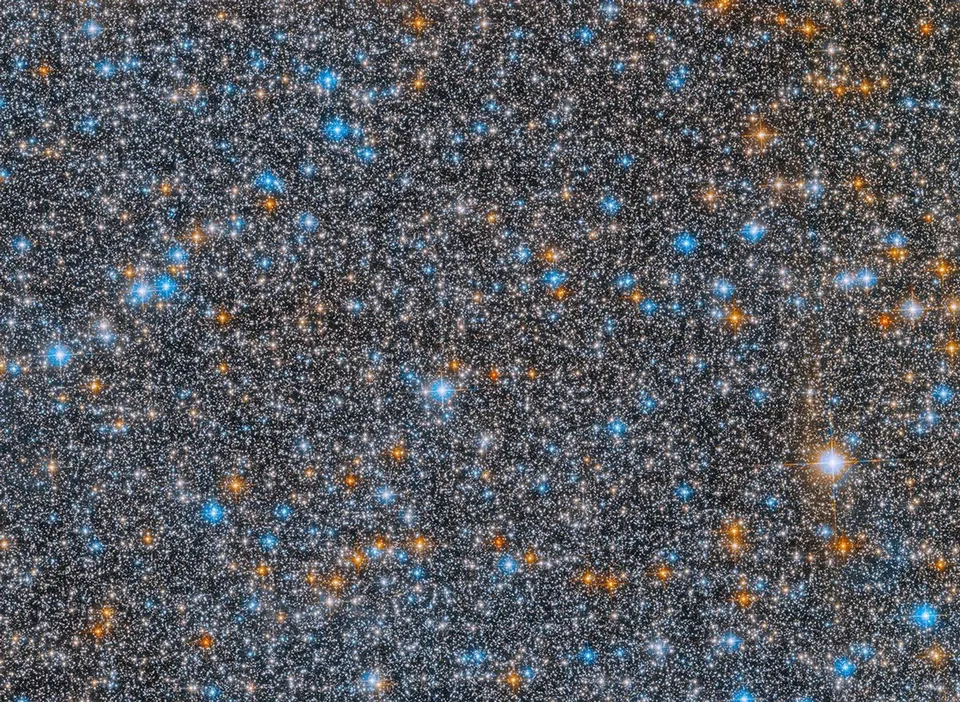
- Hubble imaged a star-packed patch of sky toward the Milky Way's galactic bulge.
- The bulge accounts for nearly one-quarter of the Milky Way's stellar mass, according to NASA.
- Hubble used wavelengths that overlap with Roman's: the reddest visible light and the near-infrared.
- The data come from Hubble observing program 17776, credited to S. Terry of the University of Maryland.
NASA has released new Hubble Space Telescope images of a crowded patch of sky toward the Milky Way's galactic bulge. The bulge is the dense, roughly spherical swarm of stars that surrounds the middle of our galaxy's disk. According to NASA, the images belong to a survey that will help astronomers make sense of future observations from the Nancy Grace Roman Space Telescope. Roman will study the stars in this busy region and search it for exoplanets, which are planets orbiting other stars.
NASA says the bulge accounts for nearly one-quarter of the Milky Way's stellar mass. Because it is relatively close, astronomers can pick out individual stars there. That isn't possible in the bulges of distant galaxies, where the stars blur into a single glow. Roman will observe mostly in near-infrared light plus some visible light, so Hubble pointed at the region in matching wavelengths: the reddest visible light and the near-infrared.
A key goal for Roman is catching microlensing. This small-scale form of gravitational lensing happens when the mass of a nearer star bends and brightens light from a more distant star lined up behind it. The way that light changes can reveal clues about the foreground star and any planets it has. Hubble is recording what the stars look like before any lensing happens. Months or years from now, when Roman catches a lensing event, researchers can compare the two sets of data, which should make the event easier to interpret.
The observations come from Hubble program 17776, credited to S. Terry of the University of Maryland. NASA says the program was designed to support Roman's search for exoplanets, black holes and neutron stars. It adds to earlier Hubble surveys of the bulge, including the Sagittarius Window Eclipsing Extrasolar Planet Search (SWEEPS), which looked at 180,000 stars there.
Why it matters
NASA says Hubble's measurements of these stars will help researchers interpret the microlensing events Roman records later, which could reveal planets in the crowded center of our galaxy.
What we don't know yet
These are preparatory observations. Their main payoff depends on Roman observing microlensing events in the same region, which NASA says could happen months or years from now.
Terms in this story
- Galactic bulge
- A dense, roughly spherical crowd of stars surrounding the center of a galaxy's disk.
- Microlensing
- A small-scale form of gravitational lensing in which a nearer star's mass bends and magnifies light from a more distant star behind it.
- Near-infrared
- Light with wavelengths just longer than red light, which human eyes can't see.
Sources and verification
DexScience articles are produced with AI assistance and an automated fact-check against the linked sources. Spotted an error? Tell us and we will correct it openly.