Key points
- NGLR-1 is a single cube corner retroreflector, 10cm in diameter, placed on the lunar surface.
- Stations at Apache Point Observatory, Wettzell and Grasse supplied the laser ranging data analyzed.
- The team reports clearly better time-of-flight precision than the legacy Apollo and Lunokhod arrays.
- The authors see similar promise for ESA's MPAc retroreflector, due to launch in early 2027.
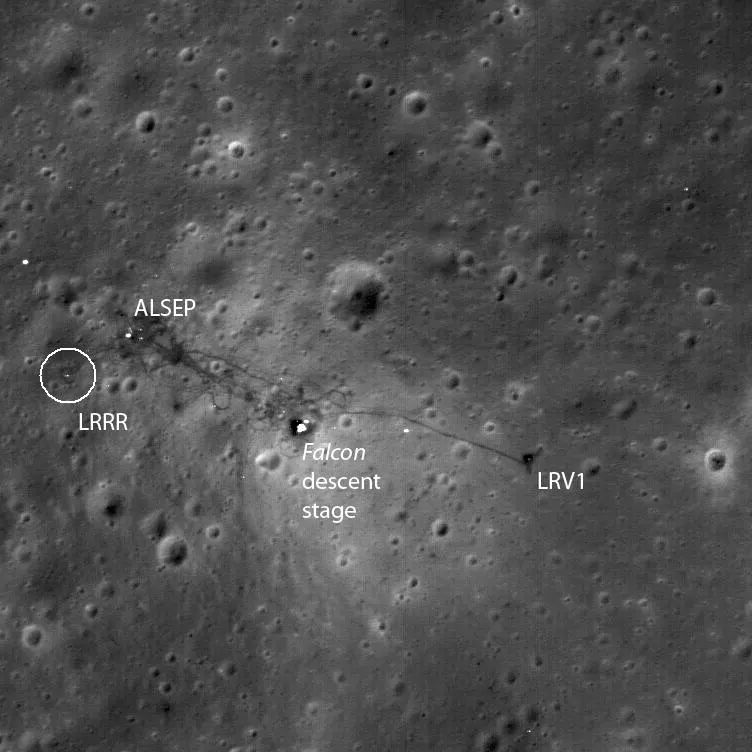
A single, oversized mirror on the Moon is sending back sharper laser echoes than the older reflector arrays left by the Apollo and Lunokhod missions, according to an early analysis posted to arXiv. The study has not yet been peer-reviewed. It examines data from NGLR-1 (Next Generation Lunar Retroreflector-1), which the authors describe as the first single 10cm-diameter cube corner retroreflector deployed on the lunar surface.
Lunar laser ranging, done since 1969, works by timing how long laser pulses take to bounce off reflectors on the Moon and come back to Earth. Those timings feed research on Earth-Moon motion, the Moon's interior and tests of general relativity. With the older arrays, the Moon's slow rocking motions, called librations, smear out the returning pulses, and that keeps precision at the centimeter level. A single large reflector is meant to stop that spreading and bring measurements down to millimeters.
The team ran the analysis with the Planetary Ephemeris Program (PEP), a software package for modeling solar system motion. They looked at individual range measurements, normal points, residuals and scatter recorded at Apache Point Observatory, Wettzell and Grasse. They report that NGLR-1 measures pulse travel time much more precisely than the legacy arrays.
The researchers say the results look promising for ESA's MPAc (MoonLIGHT with Pointing Actuators) retroreflector, which is due to launch in early 2027. They add that reflectors like these could lead to more demanding tests of gravity theories and better studies of the Moon's structure and shape.
Why it matters
According to the authors, moving lunar laser ranging from centimeter to millimeter precision could sharpen tests of general relativity and alternative gravity theories and improve lunar geophysics and geodesy.
What we don't know yet
This is a preprint that has not been peer-reviewed. It is an early analysis of NGLR-1 data, and the benefits for MPAc are still projections until it launches and returns data.
Terms in this story
- Retroreflector
- A mirror arrangement that sends light straight back toward wherever it came from.
- Libration
- A slight apparent rocking of the Moon as seen from Earth, which slowly changes the angle of objects on its surface.
- Normal point
- A single representative value made by combining many individual laser range measurements taken over a short period.
Sources and verification
DexScience articles are produced with AI assistance and an automated fact-check against the linked sources. Spotted an error? Tell us and we will correct it openly.