Key points
- The NGVS imaged 104 square degrees of the Virgo cluster in four bands with MegaCam on the Canada–France–Hawaii Telescope.
- The 1985 Virgo Cluster Catalog is complete only to a g-band magnitude of about 16.5, the team finds.
- Of 996 NGVS members with measured velocities, only 10 (1%) fell outside the adopted Virgo boundary.
- The team modeled 897 galaxies with its Typhon code and 3423 with GalFit, and 631 were analyzed with both.
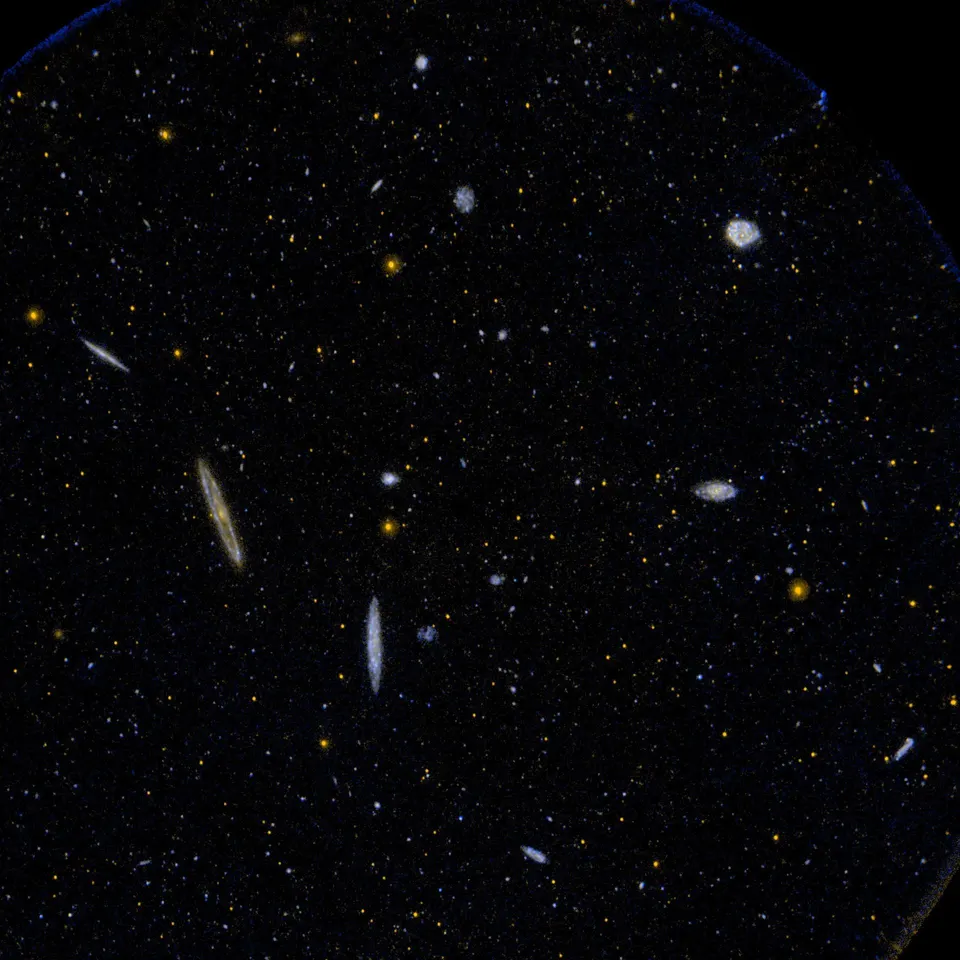
Astronomers with the Next Generation Virgo Cluster Survey (NGVS) have published a deep catalog of galaxies in the Virgo cluster, which they describe as the most massive grouping of galaxies in the local Universe. The work appears in The Astrophysical Journal Supplement Series. The team says a reliable catalog is a basic need, not just bookkeeping, because many surveys at other wavelengths depend on optical catalogs for galaxy masses, shapes and cluster membership.
For close to forty years, the standard reference has been the Virgo Cluster Catalog (VCC) from 1985. It lists 2096 galaxies, and 1851 of them are counted as certain or probable members. The new analysis finds the VCC is complete only to a g-band magnitude of about 16.5. That means it misses many faint galaxies. The NGVS used the MegaCam instrument on the Canada–France–Hawaii Telescope to image 104 square degrees out to the cluster's virial radius, roughly the edge of its gravitationally bound region, in the u*, g, i and z bands.
The researchers checked how many listed galaxies truly belong to the cluster. Of 996 NGVS members with measured velocities, only 10 (1%) fell beyond the adopted Virgo boundary. They argue this indicates high purity, at least for galaxies brighter than g ∼ 18.
To measure galaxy brightness and structure, the team used its own code, Typhon, for brighter, more complex galaxies and the GalFit program for fainter ones. They ran 631 galaxies through both methods to check that the two approaches agree.
Why it matters
Many studies of Virgo, from X-ray to radio, depend on optical catalogs for context and targets. A deeper, cleaner census supports work on how dense environments shape galaxies.
What we don't know yet
Very few of the fainter galaxies have spectroscopic data, and the authors say a large spectroscopic program would be needed to confirm membership at faint magnitudes.
Terms in this story
- Galaxy cluster
- A large group of galaxies held together by their combined gravity.
- Magnitude
- A measure of brightness on a scale where larger numbers mean fainter objects.
- Virial radius
- An approximate boundary marking the region where a cluster's matter is gravitationally bound and settled.
Sources and verification
DexScience articles are produced with AI assistance and an automated fact-check against the linked sources. Spotted an error? Tell us and we will correct it openly.