Key points
- T Coronae Borealis, 3,000 light-years away, erupts roughly every 80 years; its last nova was seen in 1946.
- In a shock-driven scenario, gamma rays look detectable but neutrinos would be very hard to catch.
- If magnetic reconnection operates, predicted neutrino flux rises just above the sensitivity of the KM3NeT detector.
- With both processes at work, neutrinos may arrive some 9 to 10 hours ahead of gamma rays.
When the star system T Coronae Borealis finally erupts, a burst of neutrinos might reach Earth hours before the light show begins. That is one prediction from simulations by Prantik Sarmah of the Chinese Academy of Sciences, Sovan Chakraborty and Xilu Wang, published in The Astrophysical Journal Letters. A summary written for astrobites and reposted by AAS Nova, a service of the American Astronomical Society, highlights the work.
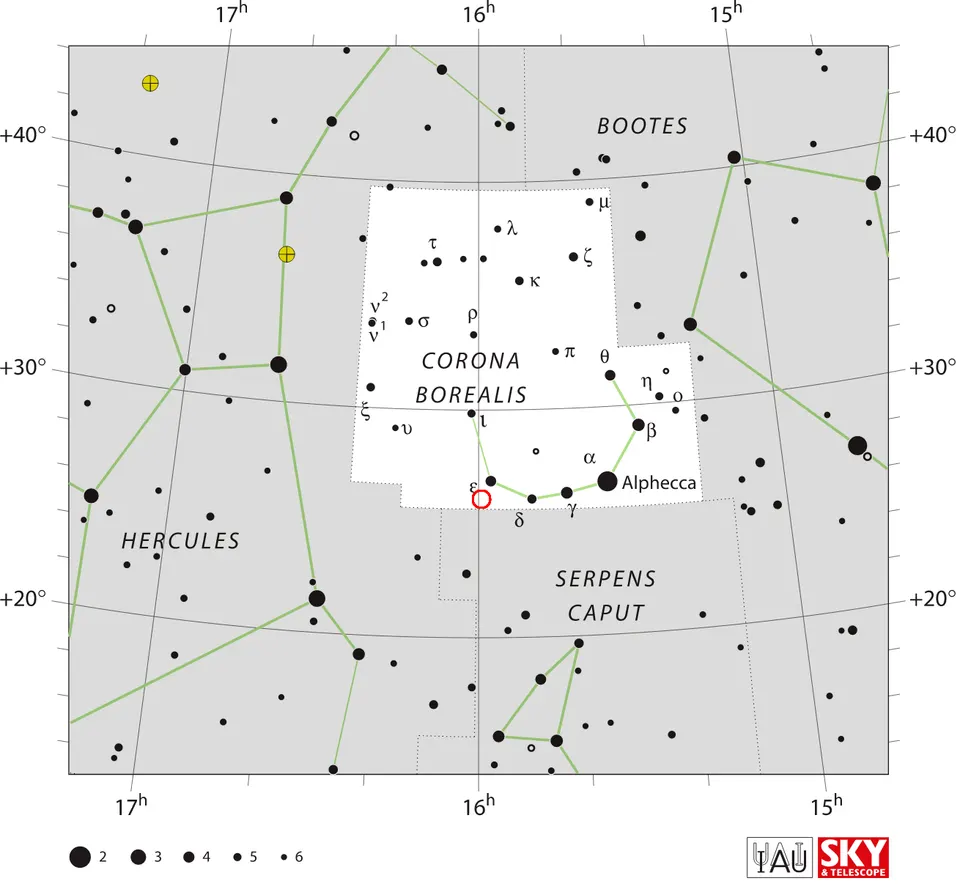
T CrB, nicknamed the Blaze Star, sits 3,000 light-years away. It is thought to pair an aging red giant with a white dwarf that pulls material off its companion until that material ignites in a thermonuclear outburst called a nova. The system does this roughly every 80 years. The last nova was seen in 1946, and predicted dates in early 2024, 2025 and mid-2026 have all passed quietly.
The researchers modeled two ways the eruption could accelerate particles. In the first, debris thrown off by the white dwarf crashes into protons in the red giant's wind. In that case gamma rays should be easy to detect, but neutrinos, which are ghostly particles that rarely interact with matter, would be very difficult. In the second, tangled magnetic fields near the white dwarf energize protons. Gamma rays from that process would be trapped, but neutrinos could escape, with a predicted signal just above the sensitivity of the KM3NeT detector. To check their approach, the team first reproduced gamma rays observed from RS Ophiuchi, a similar system that erupted in 2021.
The magnetic scenario requires a very strong white dwarf magnetic field, and evidence for fields that strong in such systems is lacking, the summary notes. The models also carry large uncertainties. Even so, a detection or a non-detection could help show which process is at work.
Why it matters
The two particle-acceleration processes leave different signatures, so neutrino and gamma-ray observations of T CrB could show which one, if either, drives the outburst. An early neutrino signal could also give telescopes time to turn toward the system.
What we don't know yet
The neutrino-friendly magnetic reconnection scenario needs a very strong white dwarf magnetic field, and evidence for fields that strong in recurrent nova systems is lacking. The models also carry large uncertainties that could mean the neutrinos are actually suppressed.
Terms in this story
- Recurrent nova
- A star system in which a white dwarf repeatedly erupts after collecting gas from a companion star, with outbursts recurring over decades.
- Neutrino
- A nearly massless subatomic particle that rarely interacts with matter, letting it escape dense environments.
- Magnetic reconnection
- A process in which magnetic field lines break and rejoin, releasing stored energy that can speed up particles.
Sources and verification
DexScience articles are produced with AI assistance and an automated fact-check against the linked sources. Spotted an error? Tell us and we will correct it openly.