Key points
- X-ray spectra of classical T Tauri stars show a soft X-ray excess and low electron density inferred from helium-like oxygen, O VII.
- The team's model adds charge exchange between hot shocked plasma and cold infalling gas as a reverse shock moves up the stream.
- With charge exchange included, O VII densities match neon diagnostics, and accretion rates match optical measurements.
- A laboratory analog formed two dense clumps, which the team calls the core and the shell, and its spectra showed charge exchange happening.
A research team reporting in Science Advances offers an explanation for a puzzle about classical T Tauri stars. When these stars are studied in X-rays, the oxygen emission points to surprisingly low gas densities and low rates of infalling material. The team combined a theoretical model with a laboratory experiment and concludes that a process called charge exchange is responsible.
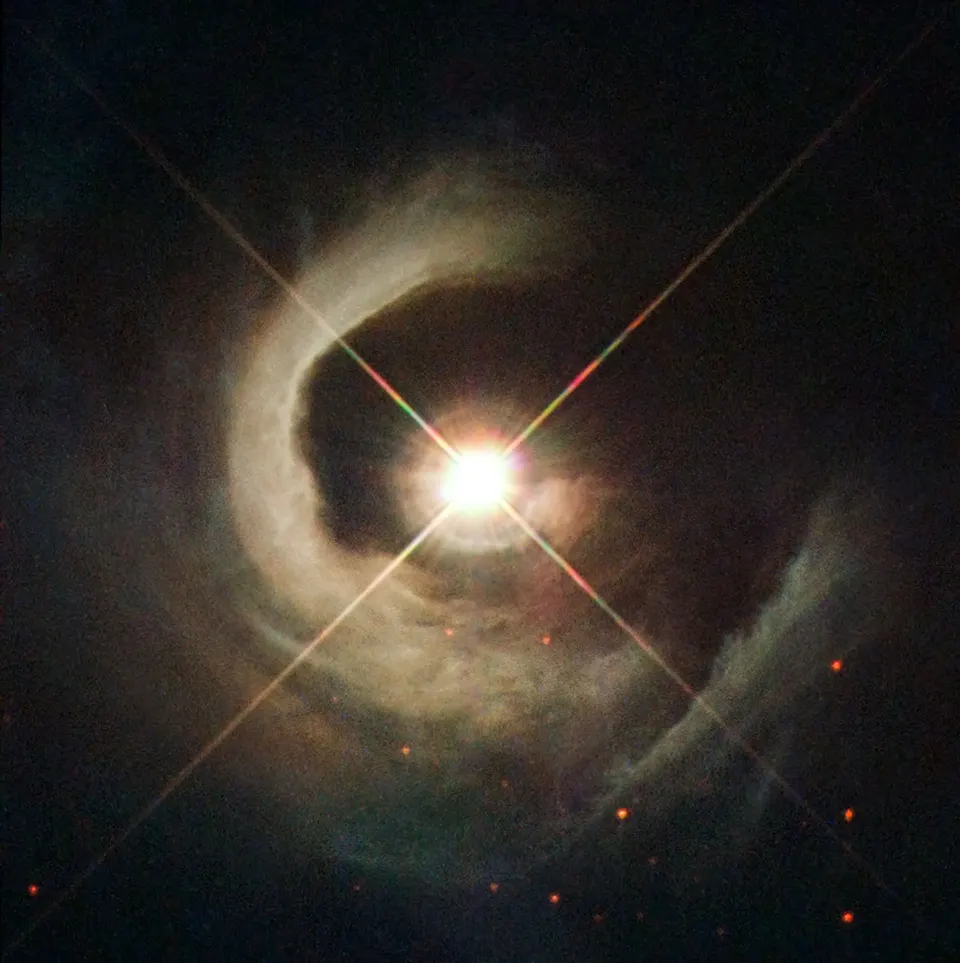
Classical T Tauri stars are young stars that are still pulling in material from their surroundings. Where that infalling gas hits the star, it forms a shock that glows in X-rays. Readings from helium-like oxygen, written O VII, have suggested low electron densities in this hot gas. The team's model keeps the standard accretion shock picture but adds one step: as a reverse shock travels back up the incoming stream, the hot gas behind the shock trades energy with the cold material still falling in. In charge exchange, an electron jumps from one atom or ion to another. Once the researchers included this process, densities inferred from O VII lined up with those from helium-like neon and with standard model predictions. Accretion rates based on O VII also agreed with optical results.
To test the idea, the team recreated a scaled-down version of an accretion shock in the lab. They relied on hydrodynamic similarity, the principle that flows at very different scales can behave alike. Two dense clumps appeared, which the researchers named the core and the shell. Their shapes resembled oscillations that heating and cooling instabilities are thought to drive in these stars. High-resolution spectra showed that charge exchange took place in the shocked region that was emitting X-rays.
According to the researchers, interactions between shocked gas and infalling gas, with charge exchange carrying away heat, explain the low O VII density problem.
Why it matters
The authors say their model makes oxygen-based X-ray measurements of T Tauri stars agree with neon diagnostics and with optical accretion rates, removing an apparent conflict between these measurements.
What we don't know yet
The experiment is a laboratory analog that relies on hydrodynamic similarity, so it shows only how scaled-down shocks behave. It does not directly observe the stars themselves.
Terms in this story
- Accretion shock
- The hot, compressed region that forms where gas falling onto a star slams into its surface.
- Charge exchange
- A process in which an electron moves from one atom or ion to another, which can change how hot gas emits light and cools.
- Reverse shock
- A shock wave that travels back into incoming material after a collision, rather than moving forward with it.
Sources and verification
DexScience articles are produced with AI assistance and an automated fact-check against the linked sources. Spotted an error? Tell us and we will correct it openly.