Key points
- XMM-Newton, NuSTAR and XRISM observed ESP 39607 at the same time in January 2026.
- The team found gas moving inward at 0.16 c. Their 2023 and 2024 observations had shown it at 0.15 c.
- Combining data from 2023 to 2026 gives a detection significance of 5.3σ.
- The inflow may deliver 0.3–1.4 solar masses of matter toward the black hole every year.
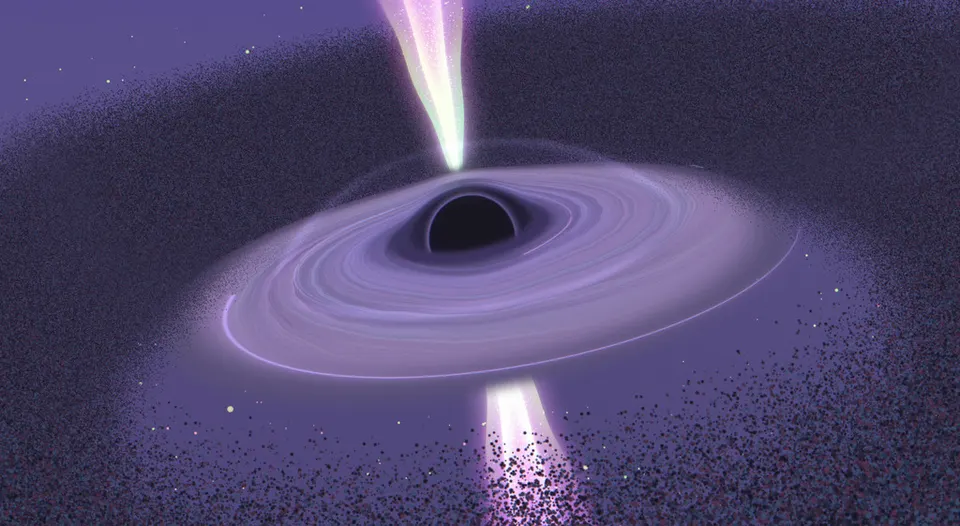
Astronomers have tracked gas falling toward the supermassive black hole in the galaxy ESP 39607 across observations spanning several years. The newest measurements put its speed at 0.16 c, where c is the speed of light. The team, led by Alessandro Peca of Eureka Scientific, Yale University and Diego Portales University, reports the result in The Astrophysical Journal. Many active galaxies push gas outward at high speed, but only a small handful show signs of ultra-fast inflows. Those signals are often weak and seldom recur in any one galaxy.
In January 2026, the researchers pointed three X-ray observatories at the galaxy at the same time: XMM-Newton, NuSTAR and XRISM. They detected two absorption features, at energies of 4.7 and 4.9 keV. These are dips in the X-ray light where gas soaks up radiation, and they match an inflow at 0.16 c. Observations from May 2023 and August 2024 had shown an inflow at 0.15 c. The team judged it unlikely that the detections are unrelated, and the combined data from 2023 to 2026 reach a significance of 5.3σ.
By the team's estimate, the inflow may deliver 0.3–1.4 solar masses of matter toward the black hole every year. That works out to somewhere from 20% to 100% of the black hole's estimated feeding rate, so this gas could power a substantial fraction of the active galactic nucleus's luminosity. Gas moving this fast should cross the observed region within days. That the signal has lasted for years suggests a large reservoir is refilling it. One possibility is that molecular gas clouds condense out of the galaxy's halo and rain down on its center.
The data also hint at another inflow, moving at 0.31 c, and at gas streaming outward at 0.08–0.12 c. Both findings are still tentative.
Why it matters
Ultra-fast inflows may be evidence that black holes can feed in ways other than through an orderly disk. A steady inflow like this one could help explain how active black holes take in material from their host galaxies.
What we don't know yet
The hints of an additional inflow (0.31 c) and an outflow (0.08–0.12 c) are still tentative. The idea that gas clouds rain down from the galaxy's halo is one possible explanation, not a confirmed one.
Terms in this story
- Active galactic nucleus
- A bright galaxy core powered by a supermassive black hole that is actively pulling in matter.
- Accretion
- The process by which a black hole gathers and takes in surrounding gas and other material.
- 5.3σ
- A statistical measure meaning the signal is very unlikely to be a chance fluctuation in the data.
Sources and verification
DexScience articles are produced with AI assistance and an automated fact-check against the linked sources. Spotted an error? Tell us and we will correct it openly.