Key points
- A star of about 0.7 solar masses merged with a supergiant on the outskirts of the Andromeda galaxy, according to a Nature paper.
- The merger took only seven orbits, about seven years. Previously known mergers of two smaller stars took thousands of orbits.
- The supergiant was seven times as massive as the Sun, 350 times its radius and 18,000 times brighter.
- Webb observed the system on Dec. 24, 2025, 47 days after the eruption peaked.
Astronomers have watched a star with a little less mass than the Sun spiral inward and fuse with a bloated supergiant on the edge of the Andromeda galaxy. The NASA-funded team reports the event in Nature and calls it a first of its kind. The researchers nicknamed the single star left behind Bao; its formal name is AT 2025abao. Follow-up data from NASA's James Webb Space Telescope let them piece together how the system looked before, during and just after the merger.
Lead author Viraj Karambelkar, a NASA Hubble Fellow at Columbia University, says mergers like this are very hard to catch as they happen because they are hard to predict. His team spotted something odd in 2023, kept watching, and saw the system erupt in 2025. According to Karambelkar, Webb's observations, made 47 days after the outburst peaked, were the earliest follow-up yet of an event of this type.
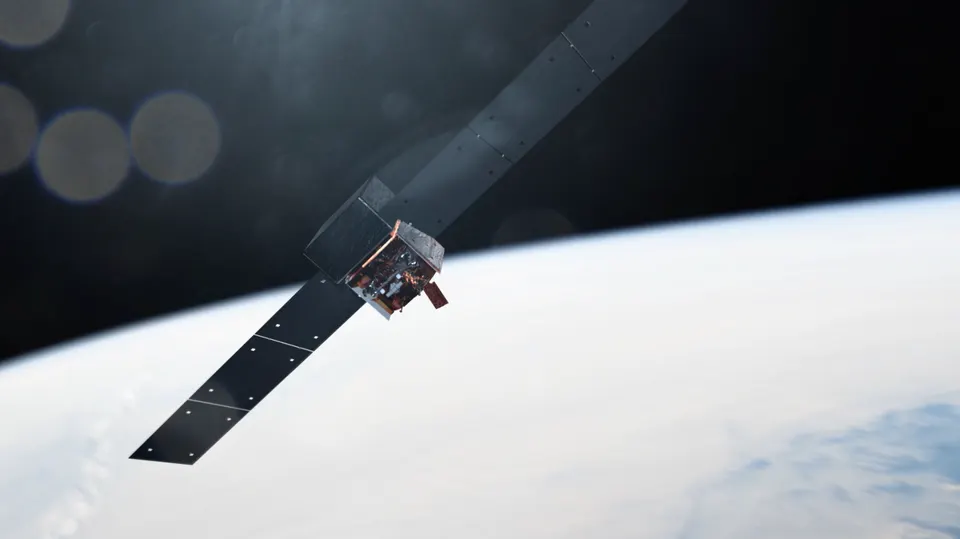
Many instruments tracked the system along the way. In February 2023, data from NASA's retired NEOWISE mission flagged Bao as an unusual variable star, meaning its brightness changed. Before 2018 it had shone steadily. In September 2024, the Wide-field Infrared Transient Explorer (WINTER) showed it starting to brighten and throw off dust. In July 2025, NASA's SPHEREx happened to catch it dimming quickly in visible light while getting brighter in infrared. The Zwicky Transient Facility recorded the eruption on Oct. 17, 2025. The Neil Gehrels Swift Observatory and the Gemini North telescope in Hawaii followed up in November, and Webb observed the system on Dec. 24, 2025.
The researchers explain the event as common envelope evolution. In this process, gas stripped from the larger star surrounds both partners in a shared outer layer. Co-author Kishalay De of Columbia says the companion first touched the giant's surface, which caused a slow brightening, and then kept peeling away the giant's outer layers as it orbited. Drag inside the envelope sapped the companion's orbital energy, and it sank inward. The whole process took about seven orbits. Co-author Nadia Blagorodnova of the University of Barcelona says the team had expected such a large star to take years to flare up. Instead, its brightness climbed to a peak within a week.
Radboud University doctoral student Karel Temmink led simulations that matched Webb's mid-infrared data on dust the giant had shed over centuries. The model shows that the primary star, dubbed Big Bao, had seven times the Sun's mass, 350 times its radius and 18,000 times its brightness. It also produced the first mass estimate for the companion, Little Bao: about 0.7 solar masses. One model result left room for Little Bao to escape, but further analysis showed it was pulled into Big Bao's core. De compares the collision to a bomb going off inside a living star.
The outcome is not always a merger. In other systems, both stars survive, lose a lot of mass and settle into tight orbits. Over time, such pairs may evolve into neutron stars and black holes, end in supernova explosions, emit gravitational waves or give rise to millisecond pulsars. Because the team followed Bao as it happened, they could measure how efficient the common envelope process was. In other cases, astronomers have had to work backward from events that may have taken place hundreds or even millions of years ago.
What the merged star looks like now will take future observations to find out. Karambelkar expects a wave of similar discoveries soon. NASA notes that the Galactic Bulge Time-Domain Survey planned for its Nancy Grace Roman Space Telescope will turn up a vast number of new transient events, which could be studied in the same way.
Why it matters
Because the team watched the merger as it happened, it could measure how efficient common envelope evolution is. Pairs of stars that survive this process can go on to form neutron stars, black holes, supernovae and sources of gravitational waves.
What we don't know yet
The researchers say it is not yet known what the merged star looks like now or how its mass will settle; only future observations can show that.
Terms in this story
- Common envelope evolution
- A stage in some binary star systems where gas from the larger star wraps around both stars, and the drag from that gas pulls the companion inward.
- Supergiant
- A very large, very bright star that has swollen to many times the Sun's size.
- Transient
- An astronomical object or event that changes in brightness over a short time, such as an eruption or explosion.
Sources and verification
DexScience articles are produced with AI assistance and an automated fact-check against the linked sources. Spotted an error? Tell us and we will correct it openly.