Key points
- A study in Nature Astronomy proposes that the Norma arm is a bar-driven, star-forming shock front, not a separate spiral arm.
- The researchers argue the bar's dust lanes reach the terminal curve near |ℓ| ≈ 20°, a region usually assigned to spiral arms.
- Their proposed bar has a ≈ 4.3 kpc and a pattern speed of Ω p ≲ 40 km s −1 kpc −1.
- The idea rests on a Milky Way-like simulation, checked against a second model tuned to galaxy NGC 4303.
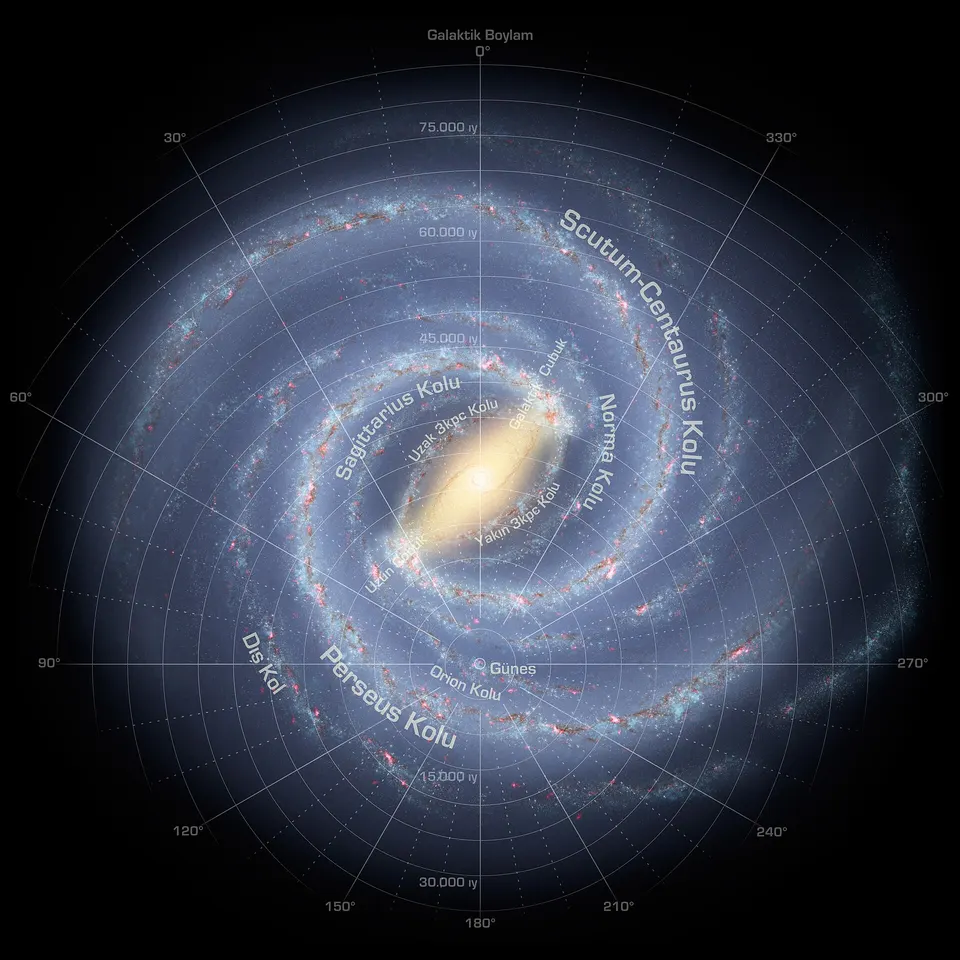
In a paper in Nature Astronomy, researchers propose that the Norma arm, a stretch of the Milky Way usually described as a spiral arm, is really a star-forming shock front created by the Galaxy's central bar. Earlier observations of masers, which are natural microwave-emitting sources, traced the Norma arm curving near the end of the bar.
Because we view our galaxy from the inside, astronomers map its gas by plotting sky position against velocity along the line of sight, which blends together structures at different distances. Using a simulation built to resemble the Milky Way, the team traced which real locations produce which features in those maps.
In the simulation, a feature called the second peak in these maps corresponds to where the bar's dust lane crosses the tangent-point circle, the set of points where sightlines just touch circular orbits around the Galactic Center. The same second peak appears in observed carbon monoxide data. That leads the team to place the bar's dust lanes farther out than usually assumed, near |ℓ| ≈ 20°, a region traditionally credited to spiral arms. A second simulation, tuned to the nearby galaxy NGC 4303, also let them locate the dust lanes from the second peaks.
The work bears on a highly debated question: is the Galactic bar short and fast, or long and slow? The team's proposed bar, with a ≈ 4.3 kpc and a pattern speed of Ω p ≲ 40 km s −1 kpc −1, fits the long, slow picture.
Citing earlier work, the authors note that strong, extended bars that are often classed as slow have the most star formation in the bar region, and that stars can also form along their dust lanes. They acknowledge that the measure used to label such bars slow is not always a good guide to pattern speed. Still, they say their proposed bar is consistent with these extended bars, supporting a picture in which a bar hosts star formation and may also help quench, or shut down, star formation in its host galaxy.
Why it matters
If the authors are right, part of the Milky Way's familiar spiral map is really bar structure, and the Galactic bar would be long and slow, a question the researchers describe as highly debated.
What we don't know yet
The result relies on simulations and on distance estimates from gas velocities, which the authors show can have large errors. They call for better gas-physics models and better ways to estimate distances where gas moves in non-circular paths.
Terms in this story
- Galactic bar
- An elongated concentration of stars across the center of some spiral galaxies, including the Milky Way.
- Pattern speed
- How fast a bar or spiral pattern rotates as a whole, which can differ from how fast individual stars orbit.
- Dust lane
- A band of dense gas and dust running along the edge of a galactic bar, where gas piles up in a shock.
Sources and verification
DexScience articles are produced with AI assistance and an automated fact-check against the linked sources. Spotted an error? Tell us and we will correct it openly.