Key points
- The team says this is the first time the South Pole Telescope has mapped large-scale radial motions using the kinetic Sunyaev-Zel'dovich effect.
- Combining three frequency bands, the galaxy-velocity correlation reached a signal-to-noise ratio of 11.2. The velocity power spectrum reached 8.1.
- The 220 GHz band alone picked up the velocities for the first time, with signal-to-noise values of 4.2, 3.1 and 3.8.
- With galaxy clustering added, the team limits local-type primordial non-Gaussianity to fNL = -20 (+40/-46) over about five percent of the sky.
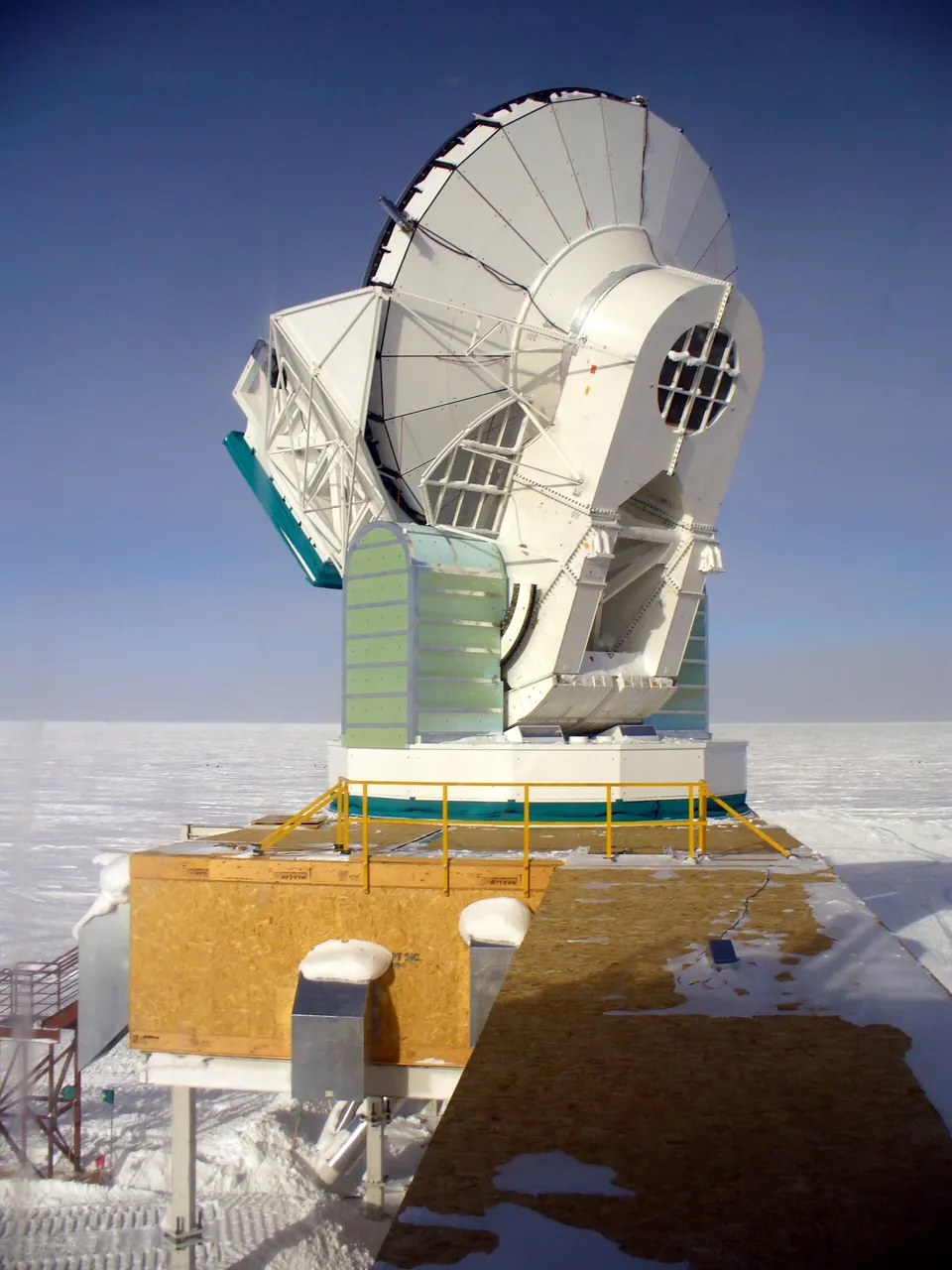
Astronomers have used the South Pole Telescope to map how matter across huge stretches of the cosmos is moving toward or away from Earth. They did it by reading a faint mark that those motions leave on the oldest light in the universe. The team says this is the first time the telescope has been used to rebuild this kind of large-scale velocity map. The results appear in a preprint posted to arXiv, which means they have not yet been peer-reviewed.
The method relies on the kinetic Sunyaev-Zel'dovich effect. The cosmic microwave background is the faint afterglow of the early universe, and its light passes through gas on its way to us. When that gas is moving along our line of sight, the light's temperature changes very slightly, and that tiny change carries information about the motion.
To draw out the signal, the researchers lined up SPT-3G D1 maps, recorded in three frequency bands (95, 150 and 220 GHz), against a catalog of luminous red galaxies taken from the DESI Legacy Imaging Surveys. Luminous red galaxies are bright, massive galaxies that serve as handy markers of where matter gathers. Using the extended galaxy sample and pooling all three bands, the team measured the link between galaxies and velocities with a signal-to-noise ratio of 11.2. A second measure, the velocity power spectrum, which describes how the motions vary from one scale to another, came in at 8.1.
The highest-frequency band stood out too. The team says the 220 GHz data revealed the velocities on their own for the first time. Two parts of the galaxy-velocity correlation, called the dipole and the monopole, gave detections of 4.2 and 3.1 respectively. The power spectrum in that band reached 3.8. When the researchers checked each frequency separately, the galaxy-velocity correlation gave consistent results.
Other sources of microwave light can contaminate measurements like these. The researchers modeled that contamination in the monopole and were able to pick out two contributions individually: one from the cosmic infrared background and one from the thermal form of the Sunyaev-Zel'dovich effect.
The velocity map also gave the researchers a way to test ideas about the infant universe. Over the roughly five percent of the sky observed by both SPT-3G and the DESI Legacy Imaging Surveys, the reconstructed velocities alone limit local-type primordial non-Gaussianity to fNL = -38 (+61/-61). Adding information from galaxy clustering narrows that to fNL = -20 (+40/-46).
Why it matters
The team says the velocities measured with the South Pole Telescope offer fresh limits on primordial non-Gaussianity, a property of the universe's earliest density ripples.
What we don't know yet
The study is a preprint and has not been peer-reviewed. The analysis covers only the roughly five percent of the sky where SPT-3G and the DESI Legacy Imaging Surveys overlap.
Terms in this story
- Kinetic Sunyaev-Zel'dovich effect
- A tiny temperature shift in cosmic microwave background light caused by gas moving toward or away from the observer.
- Signal-to-noise ratio
- A measure of how strongly a signal stands out above random fluctuations; higher values mean a more secure detection.
- Primordial non-Gaussianity
- Departures from purely random statistics in the density ripples of the very early universe, which can point to the physics of its earliest moments.
Sources and verification
DexScience articles are produced with AI assistance and an automated fact-check against the linked sources. Spotted an error? Tell us and we will correct it openly.