Key points
- Lijun Cai and collaborators simulated three CMEs launched one after another from a single region of the Sun.
- The shocks of the first, second and third CMEs reached 770, 2,480 and 3,230 kilometers per second.
- The first eruption cut the background plasma density by an order of magnitude, clearing a path for later ones.
- The CMEs merged where a thin current layer formed between them and their magnetic field lines rearranged.
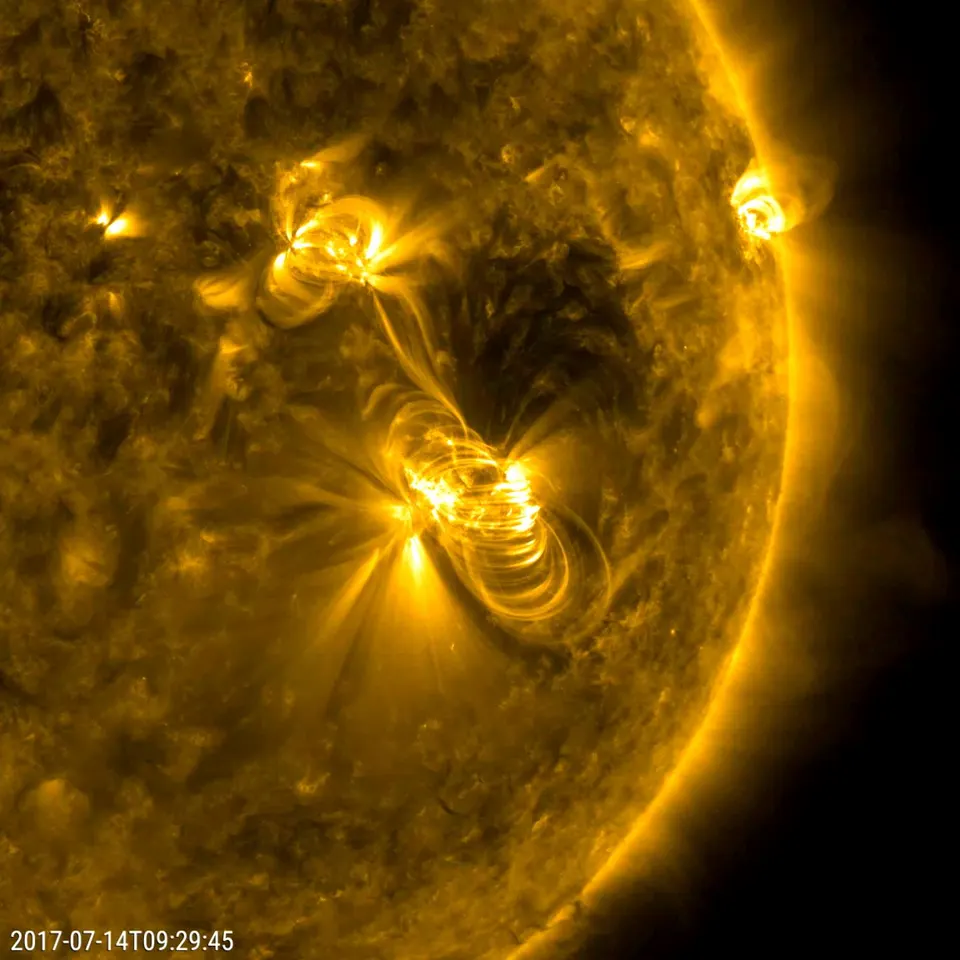
Sometimes the Sun throws out several clouds of plasma, one after another, and they can merge into one larger cloud on their way through space. Researchers call this cannibalism. A team led by Lijun Cai of the Harbin Institute of Technology has now simulated the whole sequence, from the first launch to the final merger, in global 3D models. The study appears in The Astrophysical Journal Letters, and the American Astronomical Society's AAS Nova summarized it. The topic matters because a merged eruption could hit harder than each eruption would alone.
These eruptions are called coronal mass ejections, or CMEs. They are tangled bundles of plasma and magnetic field. In the model, the team started three CMEs in quick succession from the same spot on the photosphere, the Sun's visible surface. Each one came from shearing: moving plasma dragged the anchor points of magnetic loops until enough energy built up to blow out. The first shock traveled at 770 kilometers per second, the second at 2,480 and the third at 3,230. The speed-up appears to be due to two factors, according to the study. The first CME left the corona about ten times less dense, so the later ones met less resistance. The later eruptions also released more magnetic energy.
When one CME caught the one ahead of it, a thin sheet of electric current formed between them. Inside that sheet, field lines from the two eruptions reconnected into a single structure, and their plasma mixed. Synthetic white-light images made from the simulation show all three CMEs merging.
Why it matters
According to the source, CMEs that merge may produce a stronger and more damaging event. Understanding why eruptions from the same region overtake one another and combine could therefore help assess space weather hazards.
What we don't know yet
The results come from simulations, and these ones do not yet follow the eruptions all the way to Earth. The team plans to extend the models from the Sun all the way to Earth to see how mergers change a CME's effects on our planet.
Terms in this story
- Coronal mass ejection (CME)
- A large eruption of plasma and magnetic field thrown out from the Sun's outer atmosphere into space.
- Magnetohydrodynamic simulation
- A computer model that tracks how electrically conducting gas, or plasma, moves together with magnetic fields.
- Magnetic reconnection
- A process in which magnetic field lines break and rejoin in a new arrangement, often releasing energy.
Sources and verification
DexScience articles are produced with AI assistance and an automated fact-check against the linked sources. Spotted an error? Tell us and we will correct it openly.