Key points
- ESA Member States selected Plasma Observatory as the agency's next medium-class mission, filling the M7 slot.
- Seven coordinated spacecraft will measure magnetic and electric fields and particles in seven places simultaneously.
- Selection followed a process that began with a December 2021 call drawing 27 proposals.
- Launch is provisionally foreseen for the late 2030s, after formal adoption and construction.
The European Space Agency has chosen a fleet of seven spacecraft as its next medium-class science mission. ESA's Member States selected Plasma Observatory, a mission designed to follow how energy from the Sun moves through Earth's magnetic shield across many scales of distance and time. According to ESA, it will be the first mission to track that flow across those scales. The decision ends a selection process that began in 2021, and launch is provisionally foreseen for the late 2030s.
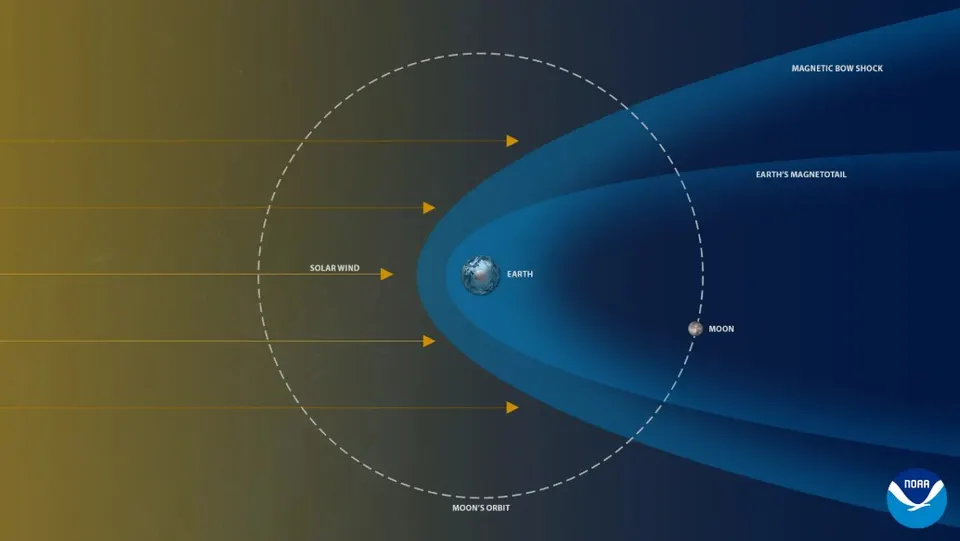
Plasma is a gas of charged particles. Some call it the fourth state of matter, after solid, liquid and gas. It is rare in everyday life on Earth, but ESA notes that it makes up 99% of the visible Universe, from the Sun and other stars to the solar wind, the stream of plasma the Sun constantly sends out. When that wind reaches Earth, the planet's magnetic field blocks much of its impact. The strongest encounters light up auroras. Occasionally, and at the extreme end, they can cause power outages in satellites and critical grid infrastructure.
Earlier missions, including ESA's Cluster, showed that solar wind plasma interacts with Earth's magnetic surroundings on scales from a few kilometers to tens of thousands of kilometers, and over times from milliseconds to minutes. Cluster, however, could study only one scale of space and time at once. Plasma Observatory is designed to measure magnetic fields, electric fields and particles in seven places simultaneously. Matt Taylor, ESA's Study Scientist for Plasma Observatory, says this should show how small, rapid events tie into much larger changes across key regions around Earth. He describes it as seeing the fine detail and the big picture together.
Taylor calls Earth's magnetosphere, the magnetic bubble surrounding the planet, a natural laboratory. It displays many kinds of plasma behavior and is the closest and most accessible place to study the range of scales on which plasma works. He says the physics learned there could also help scientists interpret phenomena around other stars that spacecraft cannot visit. ESA's Director of Science, Prof. Carole Mundell, says the mission builds on Cluster's results and will carry European leadership in heliophysics, the study of the Sun and its influence on space, into the next decade and beyond.
The road to this choice was long. ESA's December 2021 call for the M7 mission slot brought in 27 proposals. By November 2022, five concepts were left. Early design studies from January to September 2023 narrowed the field to three, which then went through a competitive industrial study lasting around 2.5 years. In June 2026, ESA proposed Plasma Observatory to its Science Programme Committee, which includes representatives from each of the agency's 23 Member States, and the committee has now formally selected it. Next comes formal adoption, the step that commits a mission to construction, and then building the spacecraft. Plasma Observatory will be the first mission of ESA's Voyage 2050 program.
ESA also announced the shortlists for its next missions. Four concepts are competing for the M8 medium-class slot: CALICO+, an orbiter and mini-lander for Ceres; FOSSIL, which would study the cosmic microwave background; PRIAMOS, a sample return from a primitive near-Earth asteroid; and SPARK, which would study solar flares. Three are competing for the F3 fast-class slot: GRINTA, MUSTI and SIRIUS. All seven will undergo initial studies during 2027. The fast-class pick is due in about a year, and the medium-class selection is expected in 2030.
Why it matters
According to ESA, plasma makes up 99% of the visible Universe, and energy transfer within it drives solar storms, auroras and satellite power outages. Measuring it at many scales at once could reveal how small events connect to large ones, which earlier single-scale missions could not do.
What we don't know yet
The mission has been selected but not yet formally adopted. It still has to pass that step and be built, and its late-2030s launch date is provisional.
Terms in this story
- Plasma
- An ionized gas of charged particles that responds strongly to electric and magnetic fields, often called the fourth state of matter.
- Magnetosphere
- The bubble of space around Earth shaped by the planet's magnetic field, which shields it from much of the solar wind.
- Solar wind
- The continuous stream of plasma flowing outward from the Sun.
Sources and verification
DexScience articles are produced with AI assistance and an automated fact-check against the linked sources. Spotted an error? Tell us and we will correct it openly.