Key points
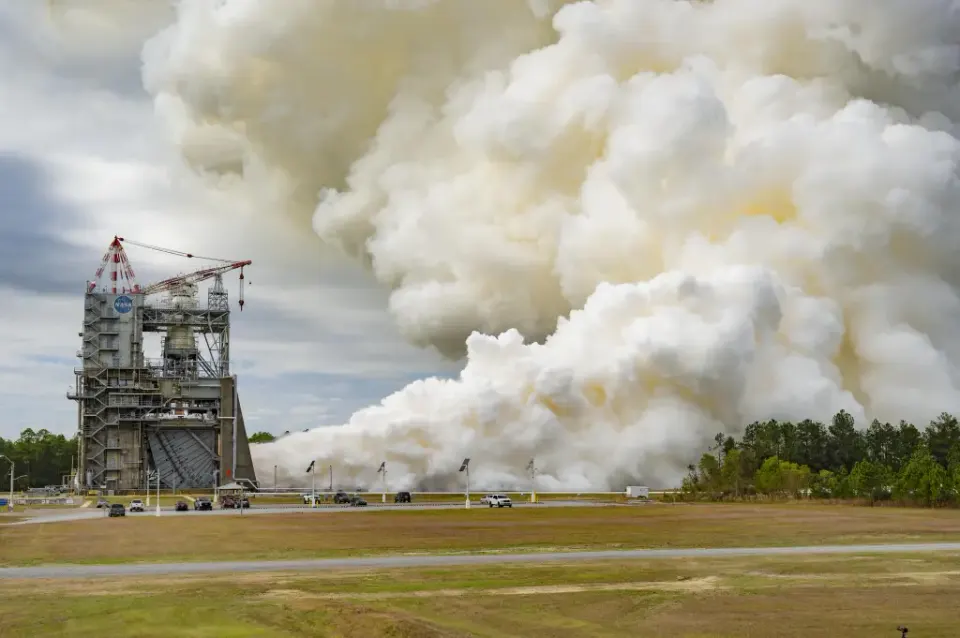
- NASA hot-fired RS-25 engine No. 10001 on Nov. 18 at Stennis Space Center in Mississippi.
- The developmental engine ran for its full planned duration of 200 seconds, or three minutes and 20 seconds.
- Four RS-25 engines together produce up to 2 million pounds of thrust to help launch each SLS rocket.
- NASA plans Artemis IV, a Moon landing mission, for 2028.
On Nov. 18, NASA test-fired RS-25 engine No. 10001 for the full time it had planned: 200 seconds, or three minutes and 20 seconds. The test took place on the Fred Haise Test Stand at NASA's Stennis Space Center near Bay St. Louis, Mississippi. In a hot-fire test, the engine is held in place on the ground and ignited so engineers can see how it performs. This is a developmental engine that will never fly. According to NASA, the test gives the agency and its prime contractor, L3Harris Technologies, data they can use to improve the performance and reliability of RS-25 engines for future Artemis missions.
Each Artemis launch uses four RS-25 engines. Together they produce up to 2 million pounds of thrust to help lift the Space Launch System, or SLS, rocket. NASA says every RS-25 is tested at Stennis and shown to be flightworthy before it is used. The tests are run by operators from NASA, L3Harris and Nova Space Solutions.
The engine work supports missions such as Artemis IV, which NASA plans as a Moon landing mission in 2028. On that flight, SLS is scheduled to carry astronauts aboard the Orion spacecraft from NASA's Kennedy Space Center in Florida. The agency calls the mission a key step toward exploring the lunar South Pole and keeping people on the Moon's surface for the long term. NASA says it will also add to the groundwork for the first crewed mission to Mars.
Why it matters
NASA says this kind of testing gives it and L3Harris Technologies key data for making RS-25 engines perform better and more reliably on future Artemis missions, including the planned Artemis IV Moon landing in 2028.
What we don't know yet
The tested engine is a developmental unit and will not be used in flight. The test is meant to produce data for engines on later Artemis missions.
Terms in this story
- RS-25
- The rocket engine model that NASA uses, four at a time, to help launch its SLS rocket on Artemis missions.
- Hot-fire test
- A ground test in which a rocket engine is held in place and ignited so engineers can see how it performs.
- SLS
- The Space Launch System, NASA's rocket that launches astronauts aboard the Orion spacecraft for Artemis missions.
Sources and verification
DexScience articles are produced with AI assistance and an automated fact-check against the linked sources. Spotted an error? Tell us and we will correct it openly.