Key points
- A team led by Peng Xu of Peking University analyzed filaments in the TNG50 cosmological simulation.
- A new shrinking cylinder algorithm refines filament centers found by the widely used DisPerSE software.
- Dark matter density rises sharply toward filament centers, mainly because dark matter halos cluster near the cores.
- Scaled by the virial radius of end nodes, density profiles looked strikingly consistent across different cosmic epochs.
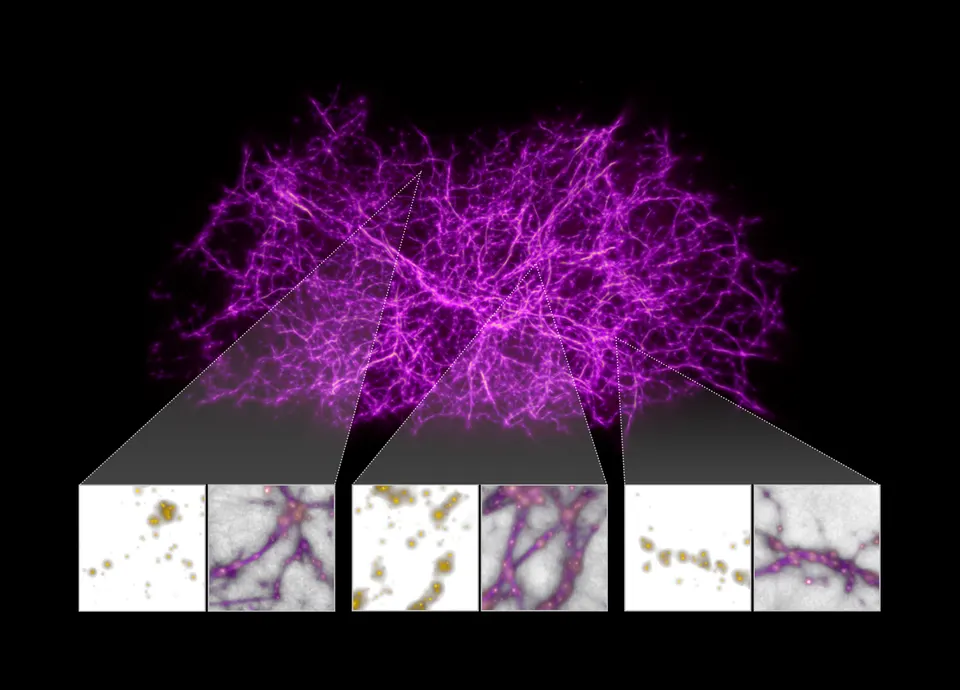
Dark matter inside the threads of the cosmic web may follow a common density pattern, according to a simulation study led by Peng Xu of Peking University. The team, publishing in The Astrophysical Journal Letters, found that filament density profiles in the TNG50 cosmological simulation looked strikingly alike once scaled to the size of the nodes at each filament's ends, even at different cosmic epochs.
The cosmic web is the huge network of filaments that holds most stars, galaxies and galaxy clusters, with vast voids in between. Researchers disagree about how dark matter is spread inside these filaments, partly because pinning down a filament's center is harder than it sounds. DisPerSE, a software package commonly used for this job, works from a smoothed map of dark matter. That smoothing can shift centers slightly away from the true density peaks and distort the picture near the core.
To fix this, the team added what they call a shrinking cylinder algorithm. Starting from the DisPerSE estimate, it lines up a large cylinder along a filament segment and finds the center of mass of the raw dark matter inside. It then repeats the step with smaller and smaller cylinders until the filament's spine settles in place. With this correction, dark matter density climbs steeply toward filament centers, a feature the standard approach can wash out. The climb comes mostly from dark matter halos, compact clumps of dark matter, gathering near the cores.
The researchers say the consistent profiles resemble scaling patterns already known in dark matter halos. That suggests filaments, like halos, may grow through a self-similar process.
Why it matters
The results suggest dark matter filaments may grow in a self-similar way, as halos do. They also show that a small change to a common analysis method can change what researchers conclude about filament structure.
What we don't know yet
The findings come from a single cosmological simulation, TNG50, and are described as hints rather than a settled result. AAS Nova notes that understanding these structures still has a long way to go.
Terms in this story
- Cosmic web
- The large-scale network of filaments, nodes and voids along which matter in the universe is arranged.
- Dark matter halo
- A gravitationally bound clump of dark matter, often hosting galaxies or galaxy clusters.
- Virial radius
- A measure of the outer boundary of a gravitationally bound structure such as a halo or cluster.
Sources and verification
DexScience articles are produced with AI assistance and an automated fact-check against the linked sources. Spotted an error? Tell us and we will correct it openly.