Key points
- The test case is J0514-4002E, a pulsar spinning about every 5.6 ms that orbits a candidate black hole in roughly 7 days.
- The analysis sets an upper limit of κ ≤ 3.95 at 95% confidence on the coupling strength.
- Estimates of κ come out as 0.82 ± 1.67 or 0.75 ± 1.54, depending on the Hubble constant used.
- The authors project that κ = 3 could be excluded or detected at 3σ by 2031 and at 5σ by 2036.
Some theorists have proposed that black holes could gain mass simply because the universe is expanding. A new preprint describes a way to test that idea with pulsars, the spinning stellar remnants whose radio pulses arrive with clock-like regularity. Because pulsar timing records span decades rather than billions of years, the authors say biases are easier to control than in earlier methods. The work, posted on arXiv, has not yet been peer-reviewed.
The idea is called cosmologically coupled black holes. In some recent solutions of general relativity, a black hole's mass grows with the cosmic scale factor, a measure of how far the universe has stretched, raised to a power called kappa (κ). It has been argued elsewhere that a value of 3 would connect black hole interiors filled with energized vacuum to the accelerating expansion of the cosmos.
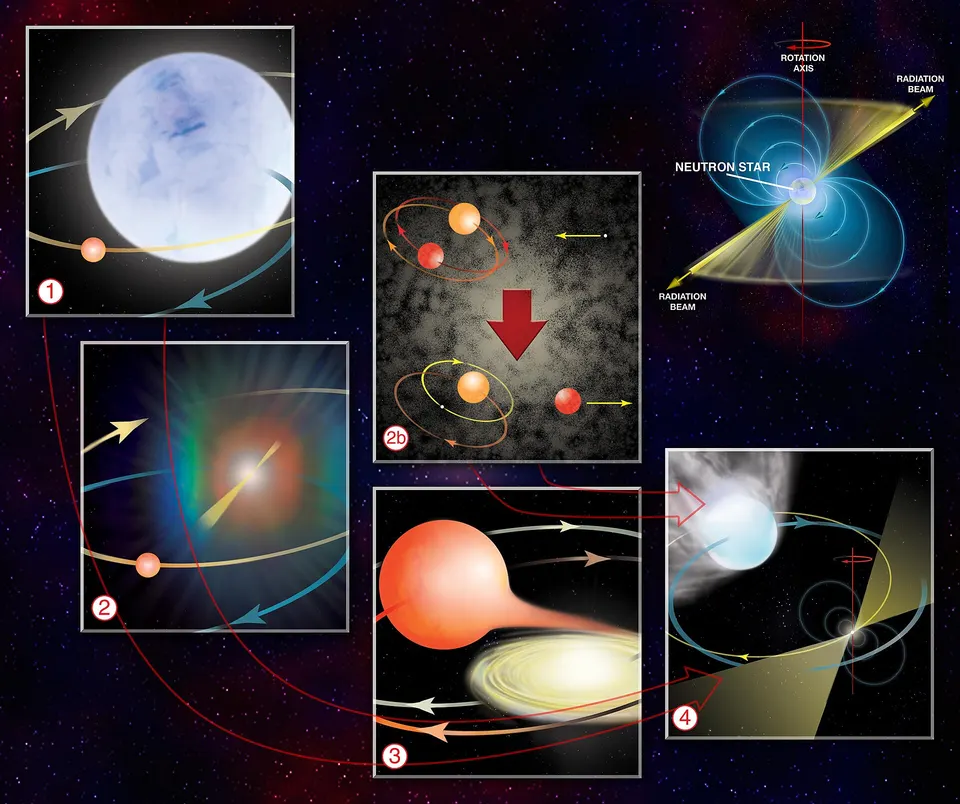
The team studied J0514-4002E, a candidate black hole and pulsar pair in a globular cluster, assuming the companion is a coupled black hole. The pulsar spins about every 5.6 milliseconds and orbits in about 7 days. Subtracting the change in spin period from the change in orbital period cancels effects of the system's motion, leaving one unknown: how fast the pulsar is naturally slowing down.
Setting that slowdown to zero, its lowest possible value, gives κ ≤ 3.95 at 95% confidence. Estimating it from similar millisecond pulsars yields κ = 0.82 ± 1.67 or 0.75 ± 1.54, depending on the Hubble constant adopted. Assuming timing precision improves with a longer observing baseline in the typical way, κ = 3 could be excluded or detected for this companion of 2.35 (+0.20/−0.18) solar masses at 3σ by 2031 and at 5σ by 2036.
Why it matters
The method relies on measurements gathered over decades instead of gigayears, which the authors say keeps biases well controlled. With more timing, it could rule in or rule out the κ = 3 value that has been linked to cosmic acceleration.
What we don't know yet
This is a preprint that has not been peer-reviewed. The analysis assumes that the companion is a cosmologically coupled black hole, though the system is only a candidate black hole-pulsar pair. The current uncertainties on κ are large, and a decisive test depends on years of further timing.
Terms in this story
- Pulsar
- A rapidly spinning neutron star that sweeps beams of radio waves across space, so its pulses arrive at very regular intervals.
- Scale factor
- A number that tracks how much the universe has expanded compared with some reference time.
- Hubble constant
- The present-day rate at which the universe is expanding.
Sources and verification
DexScience articles are produced with AI assistance and an automated fact-check against the linked sources. Spotted an error? Tell us and we will correct it openly.