Key points
- binaryfog returns black hole binary spectra roughly a million times faster than direct computation, according to the preprint.
- Swapping a power-law black hole description for binaryfog's realistic model cut dark sector phase transition preference from 2.8σ to 1.5σ.
- Using updated astrophysical priors based on galaxy surveys, the phase transition preference was a marginal 1.7σ.
- If binaries take longer than about 6.5 Gyr to merge, support for a phase transition rises above 3σ under the updated priors.
A new software tool could help astronomers work out whether a faint gravitational-wave hum picked up by pulsar timing arrays comes from pairs of giant black holes or from exotic physics in the early universe. The tool, called binaryfog, is described in a preprint posted to arXiv, which means it has not yet been peer-reviewed. When the authors swapped a simple description of the black hole signal for a realistic population model, the apparent support for new physics mostly weakened.
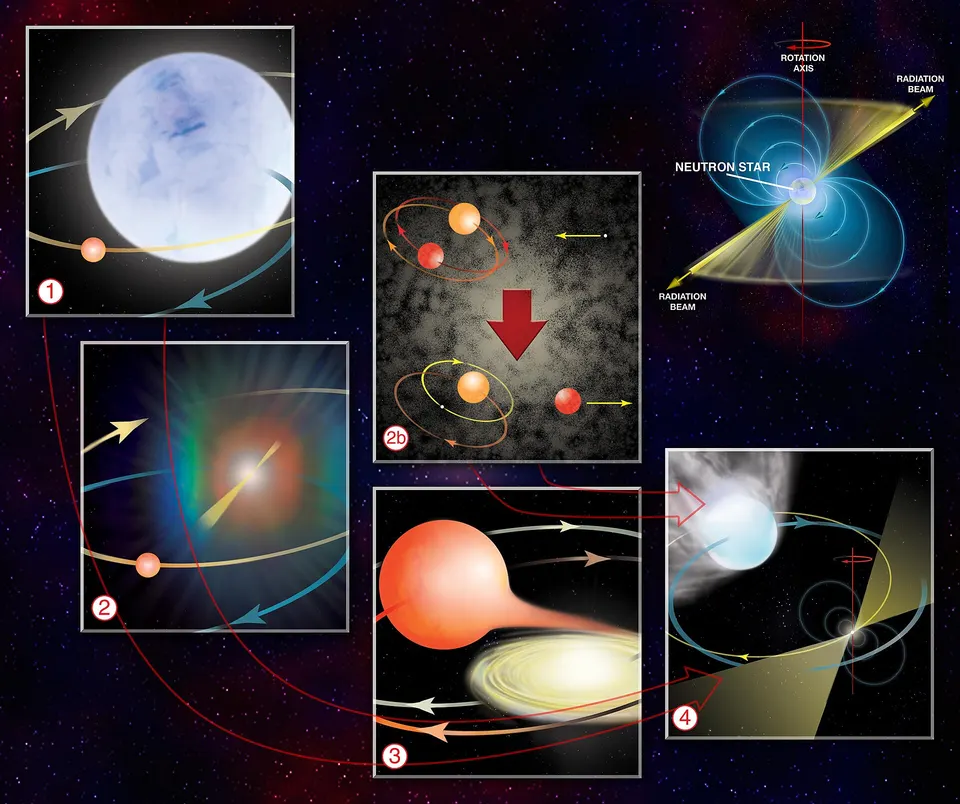
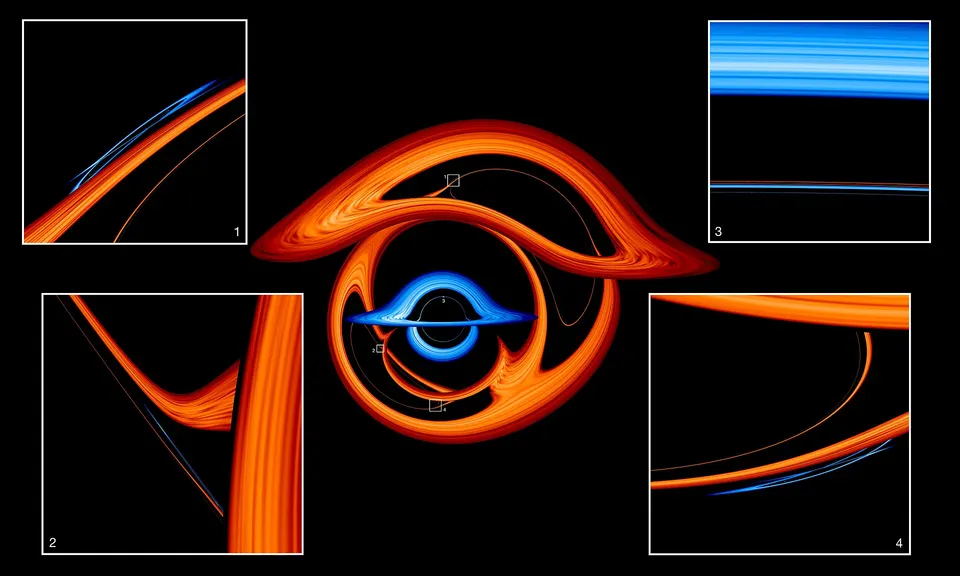
Pulsar timing arrays track the steady ticks of pulsars, which are rapidly spinning neutron stars, looking for tiny timing shifts caused by passing gravitational waves. These arrays have found evidence for a background of such waves at nanohertz frequencies. Supermassive black hole binaries spiraling toward each other probably produce at least part of it. But calculating their combined signal from realistic population models is very slow. binaryfog is a surrogate, or fast stand-in, for up-to-date population models that the NANOGrav collaboration also uses. The team says it runs about a million times faster than direct calculation, which makes the comparison practical.
The team put four frequently debated new-physics ideas to the test: a phase transition in a hidden dark sector, cosmic superstrings, gravitational waves left over from inflation, and so-called domain walls. In each fit, they accounted for six astrophysical parameters describing the black hole population. When they replaced the widely used power-law description of the black hole signal with binaryfog's realistic population model, the preference for a phase transition fell from 2.8σ to 1.5σ. The other three candidates showed a similar trend.
The authors also recommend a refreshed set of astrophysical priors, drawn from galaxy surveys published since 2014. With current pulsar timing data, those priors still give only a marginal 1.7σ preference for a phase transition.
There is a catch. If black hole binaries alone explain the signal, the data favor pairs that coalesce within roughly 2 Gyr (billion years) of their host galaxies merging, so some efficient process must carry them through the final parsec of separation. Should the binaries take more than about 6.5 Gyr to merge, support for a phase transition climbs above 3σ under the updated priors.
The researchers say binaryfog can help settle these open questions, because it lets others explore how updated priors and a realistic black hole population model change the outcome of new-physics searches with pulsar timing arrays.
Why it matters
Slow modeling has made it hard to tell black hole binaries apart from early-universe sources. The authors say binaryfog lets researchers test how realistic populations and updated priors affect searches for new physics with pulsar timing arrays.
What we don't know yet
The work is a preprint that has not been peer-reviewed. The conclusions depend on how quickly black hole binaries merge after their host galaxies do, and that question remains open.
Terms in this story
- Pulsar timing array
- A network of pulsars whose highly regular radio pulses are monitored for tiny timing shifts caused by passing gravitational waves.
- Phase transition
- An abrupt change in the state of matter or fields, which in the early universe could have produced gravitational waves.
- Prior
- A probability distribution describing what researchers assume about a model's parameters before fitting the data.
Sources and verification
DexScience articles are produced with AI assistance and an automated fact-check against the linked sources. Spotted an error? Tell us and we will correct it openly.