Key points
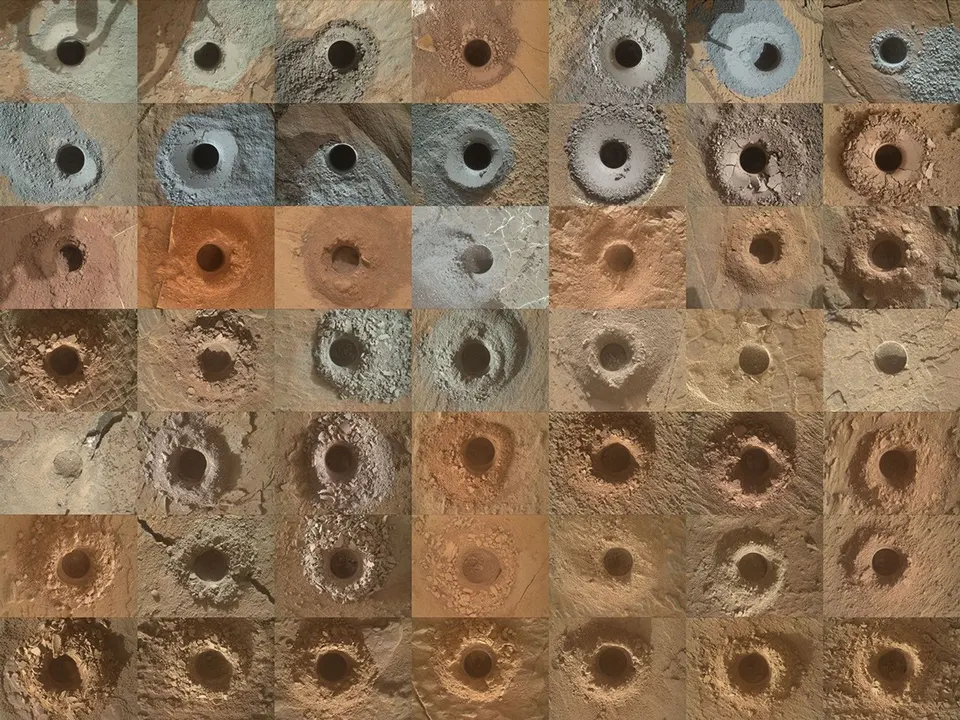
- NASA released a collage of 49 drill holes made by its Curiosity Mars rover as of November 2026.
- Each hole marks one rock sample taken from the Martian surface.
- Every hole measures 0.63 inches (16 millimeters) across.
- The pictures came from the Mars Hand Lens Imager (MAHLI), a camera at the end of Curiosity's robotic arm.
NASA has published a single image showing 49 holes that its Curiosity Mars rover has drilled into Martian rock as of November 2026. Each circle in the mosaic stands for one sample the rover collected from the planet's surface. That makes the image a visual record of the rover's sampling work so far. The collage is catalogued in NASA's Photojournal as PIA26802.
The drill sits at the tip of Curiosity's robotic arm. According to NASA, it turns rock into powder and drops that material into instruments inside the rover's body, which work out what the rock is made of. Every hole in the collage is 0.63 inches (16 millimeters) wide.
The close-up views come from the Mars Hand Lens Imager, or MAHLI, a camera also mounted at the end of the arm. Malin Space Science Systems in San Diego built the camera.
NASA's Jet Propulsion Laboratory, which Caltech manages in Pasadena, California, built Curiosity and leads the mission for NASA's Science Mission Directorate in Washington. The mission is part of the agency's Mars Exploration Program. The release presents the collage as an image only. It does not describe what the 49 samples revealed.
Why it matters
Each hole in the collage marks one rock sample that Curiosity collected from the Martian surface, so the image shows at a glance how much drilling the rover has done as of November 2026.
What we don't know yet
The release is an image showcase. It reports no new scientific findings from the drilled samples.
Terms in this story
- MAHLI
- The Mars Hand Lens Imager, a close-up camera on the end of Curiosity's robotic arm.
- Collage
- A single image put together from many separate pictures.
Sources and verification
DexScience articles are produced with AI assistance and an automated fact-check against the linked sources. Spotted an error? Tell us and we will correct it openly.