Key points
- JWST's MIRI instrument studied seven irradiated planet-forming disks, called proplyds, in the region NGC 1977.
- The disk nearest the B1V star 42 Orionis, KCFF#1, trails a dusty tail thousands of astronomical units long.
- KCFF#1 lacks clear molecular or atomic hydrogen emission, which suggests the disk is at an advanced stage of dispersal.
- The other six disks show molecular hydrogen at two temperatures: 500–700 K and 1000–1500 K.
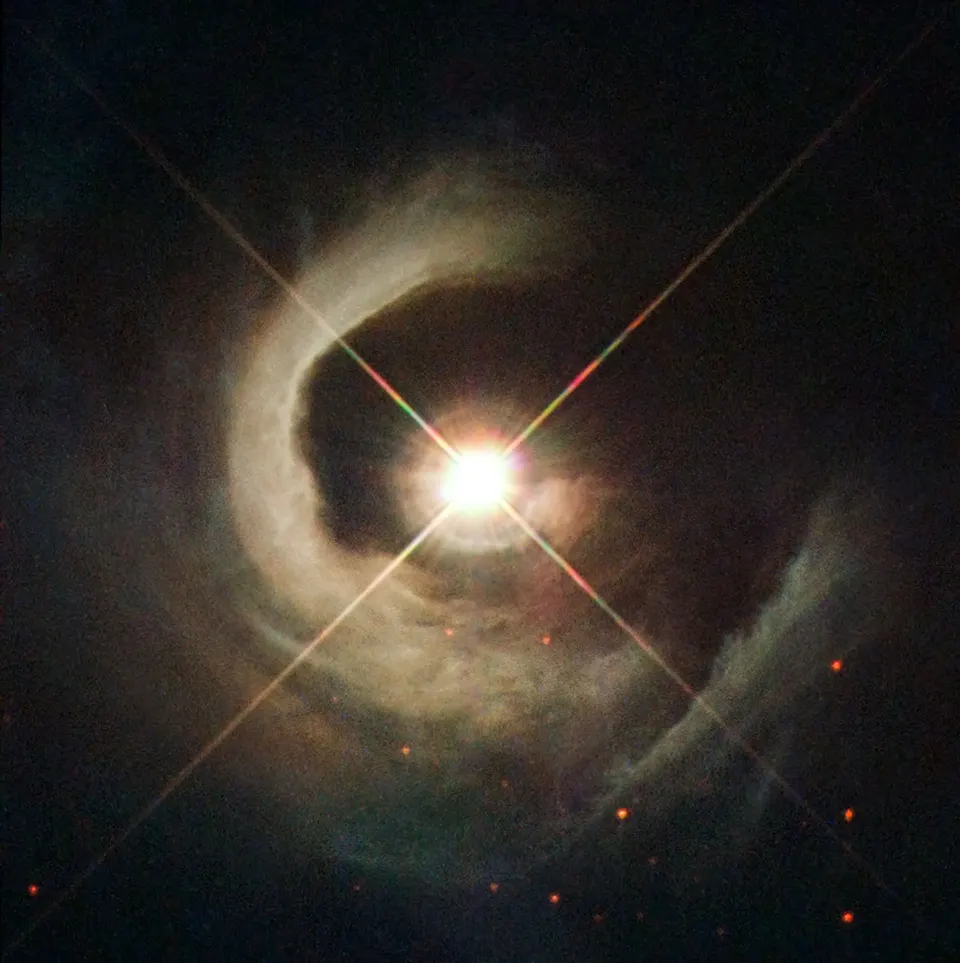
Astronomers using the James Webb Space Telescope have found a young planet-forming disk that a nearby massive star is stripping so strongly that the disk drags a tail of dust thousands of astronomical units long. The disk, called KCFF#1, lies closest to the B-type star 42 Orionis in the region NGC 1977. A team led by Alice S. Booth reports the finding in The Astronomical Journal.
The researchers used Medium Resolution Spectroscopy on JWST's MIRI instrument to observe seven proplyds. These are disks around newborn stars that glow because outside radiation is striking them. Here, 42 Orionis bathes them in far-ultraviolet light of 10³–10⁵ G0. KCFF#1 shows no clear signal from molecular or atomic hydrogen. The team reads this as a sign that the disk is far along in being dispersed.
The other six disks gave off molecular hydrogen at two temperatures, 500–700 K and 1000–1500 K. The team says this emission likely comes from two places: the disk's molecular layer and a wind of gas boiled off by ultraviolet heating. The researchers also compared two disks with similar host stars. KCFF#2, the one nearer 42 Orionis, was dominated by mass loss driven from outside. The more distant KCFF#6 showed roughly equal contributions from accretion, meaning material falling onto its star, and from external mass loss.
Massive stars are thought to change how disks evolve, and with them the planets that form inside. NGC 1977 offers a middle ground between the harsh Orion Nebula Cluster and gentler nearby regions. According to the authors, this kind of in-between environment has had fewer observations to pin it down.
Why it matters
The study shows that JWST/MIRI can measure how a star's surroundings affect disk evolution, and NGC 1977 links the strongly irradiated disks of the Orion Nebula Cluster with the more local population.
What we don't know yet
The authors acknowledge that their sample is small, with only seven disks observed.
Terms in this story
- Proplyd
- A disk of gas and dust around a young star that glows because radiation from a nearby massive star is lighting it up and eroding it.
- Astronomical unit
- The average distance between Earth and the Sun, used as a yardstick for distances within star systems.
- Photoevaporative wind
- A flow of gas driven off a disk when intense radiation heats it enough to escape.
Sources and verification
DexScience articles are produced with AI assistance and an automated fact-check against the linked sources. Spotted an error? Tell us and we will correct it openly.