Key points
- NGC 4394 lies about 55 million light-years away in the constellation Coma Berenices.
- It belongs to the Virgo Cluster, a group of more than 1,000 galaxies and the closest galaxy cluster to us.
- Astronomers estimate 65 percent of nearby spiral galaxies have a central bar of stars.
- NGC 4394 was one of 40 galaxies in a Hubble program studying how star formation ends in clusters.
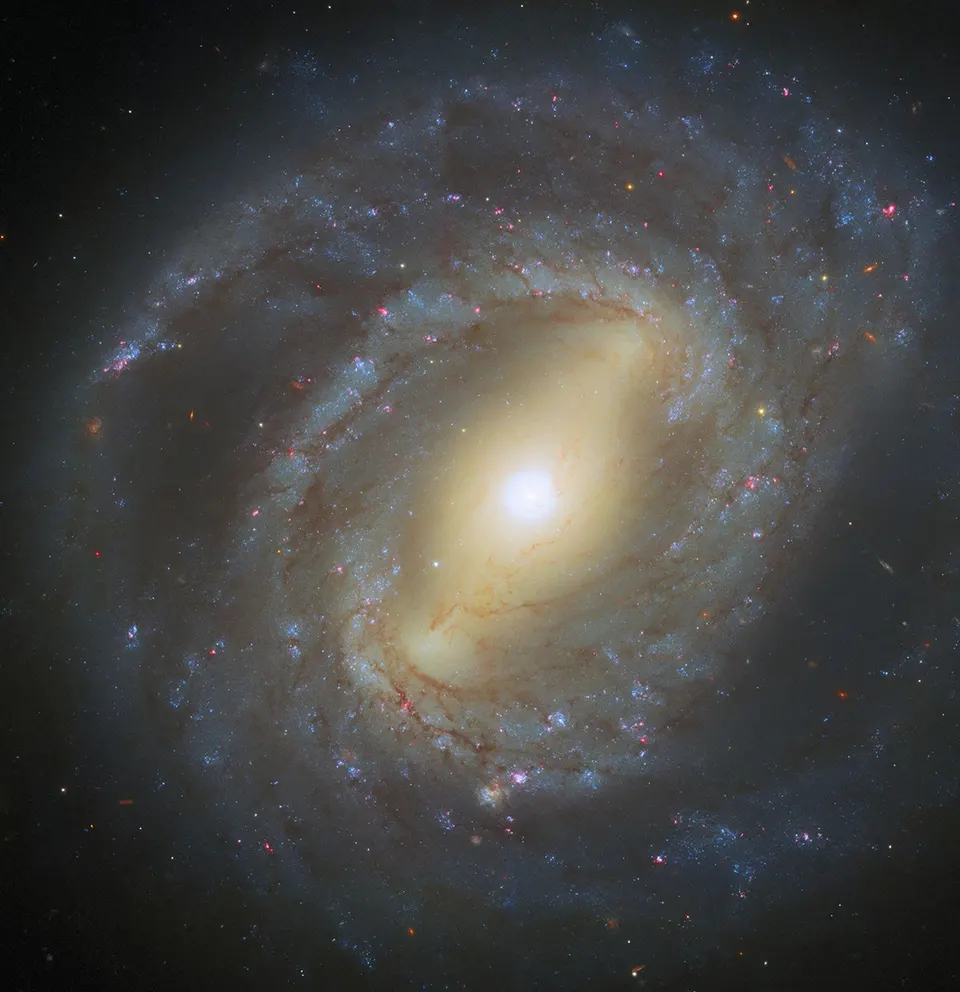
NASA has released a new Hubble Space Telescope image of NGC 4394, a spiral galaxy with a straight bar of stars across its middle. The galaxy sits about 55 million light-years away in the constellation Coma Berenices. It is one of more than 1,000 galaxies in the Virgo Cluster, the galaxy cluster closest to us. Seen face-on, its spiral arms and bar look much like astronomers think the Milky Way would look from a similar angle.
Such bars are common: astronomers estimate that 65 percent of nearby spiral galaxies have one. Most explanations say a galaxy's disk of stars becomes unstable, perhaps because of gravitational tugs from passing galaxies or interactions between stars. That instability stretches the stars' circular orbits into long ovals. Bars are more common today than they were several billion years ago. Research suggests this may not last, though, because bars that grow massive can become unstable themselves.
NGC 4394 and the Milky Way may share one more trait: a LINER, or low-ionization nuclear emission-line region. This is a zone near a galaxy's center whose light shows signs of certain ionized or neutral elements. Researchers don't yet know exactly how LINERs form, but hungry supermassive black holes or intense star formation probably play a part.
Hubble has observed this patch of sky before. An image released a decade ago came from a program focused on the neighboring galaxy Messier 85. The new view also uses Wide Field Camera 3 data from a recent program that compares how star formation shuts down in crowded clusters and in isolated galaxies. In that program, researchers worked out the ages of individual star clusters in 40 galaxies, NGC 4394 among them.
Why it matters
NGC 4394 looks a lot like our own galaxy might from outside. It has a prominent stellar bar and may contain a LINER, both features that astronomers are still working to explain.
What we don't know yet
Scientists are still debating how galactic bars form, and they do not yet know exactly how LINERs form. NGC 4394 and the Milky Way might both contain a LINER, but this is not confirmed.
Terms in this story
- Galactic bar
- A straight, elongated band of stars that runs across the center of some spiral galaxies.
- LINER
- A low-ionization nuclear emission-line region, an area near a galaxy's center whose light shows signs of certain ionized or neutral elements.
- Virgo Cluster
- A large group of more than 1,000 galaxies held together by gravity.
Sources and verification
DexScience articles are produced with AI assistance and an automated fact-check against the linked sources. Spotted an error? Tell us and we will correct it openly.