Key points
- Quasar J1504+6252 is seen just 630 million years after the Big Bang, 40 million years earlier than Euclid's previous record.
- At redshift 8.13, it is the first quasar identified beyond a redshift of 8.
- Webb observations show that its black hole has a mass of approximately 360 million Suns.
- Euclid has found 12 new quasars beyond redshift 7. That more than doubles the number previously known at that distance.
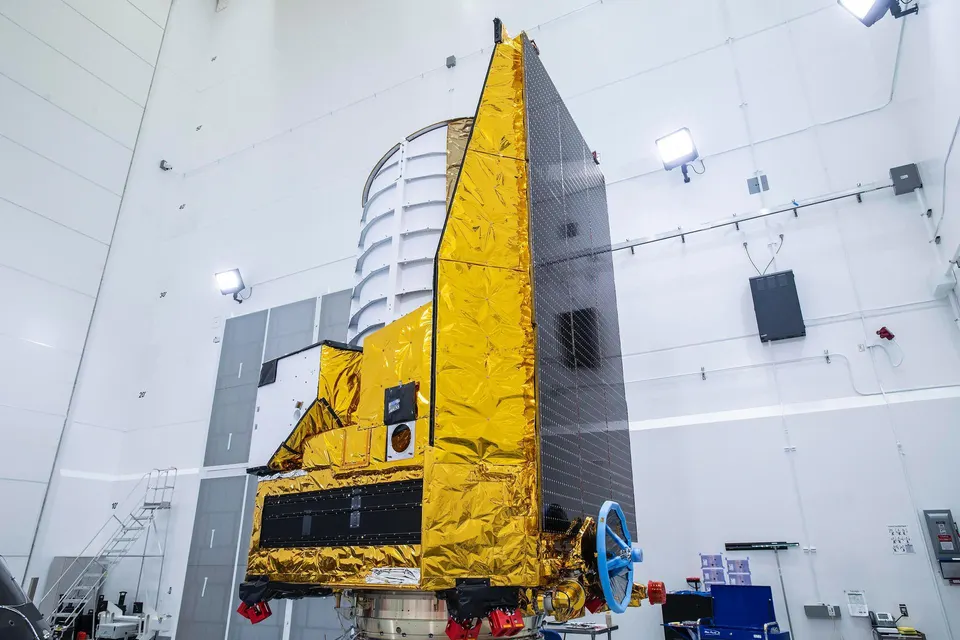
The European Space Agency's Euclid space telescope has found the most distant quasar known so far, according to ESA. Its light left a blazing galactic core just 630 million years after the Big Bang. The object, formally named J1504+6252, beats Euclid's own previous record by another 40 million years. That earlier record was announced only a few months ago. A team led by J. Wolf describes the discovery in the journal Astronomy & Astrophysics, in a paper published on 24 November 2026.
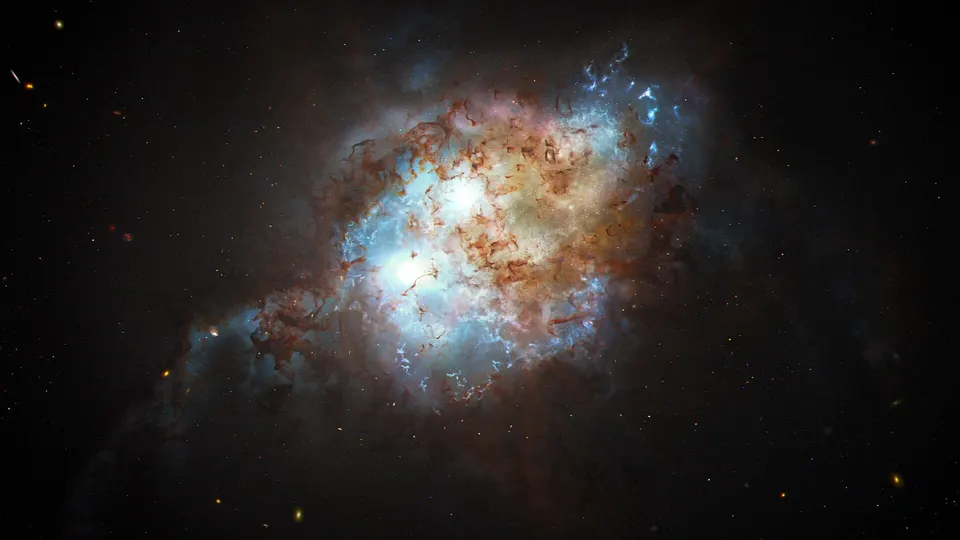
A quasar is the very bright center of a galaxy. It shines because gas falls into a supermassive black hole, and that process gives off huge amounts of energy. ESA notes that this stage is short in a galaxy's life. While it lasts, the core can be brighter than the rest of the galaxy combined.
The new object is the first quasar found beyond a redshift of 8. Its redshift is 8.13. Redshift measures how much the expansion of the universe has stretched light toward longer, redder wavelengths, so higher values mean objects that are farther away and seen at earlier times. A redshift of 8.13 shows the cosmos as it was roughly 13.1 billion years ago, when the universe was only 5% of its present age.
Finding it took patience. Euclid picked the quasar out from millions of objects in about 18 months of its data. Other telescopes on the ground and in space then checked what it was: the W.M. Keck Observatory, the Large Binocular Telescope Observatory, the NASA/ESA Hubble Space Telescope and, finally, the NASA/ESA/CSA James Webb Space Telescope. Webb's observations show that the black hole at the quasar's heart has a mass of approximately 360 million Suns.
That mass is where the puzzle begins. ESA says that, unlike other distant quasars, this one takes in material relatively slowly. To be this heavy so soon after the Big Bang, it must have built up its mass in bursts of extremely fast growth at a very early time. According to the agency, this puts pressure on models of early black hole formation and growth.
The finding also shows that Euclid is good at finding quasars. The telescope launched in 2023 to study the dark universe. ESA says its mix of very sensitive infrared imaging and very wide sky coverage is what makes it able to find rare, very distant objects. In 1.5 years, Euclid has announced 31 ancient quasars. Twelve of them lie beyond redshift 7, which more than doubles the number known that far away. Earlier surveys needed 15 years to reach that redshift 7 mark. At redshift 8, quasars are so rare that ESA expects at most a few tens across Euclid's entire survey.
The quasar is nicknamed Dún Aonghasa, after a prehistoric fort on a cliff top on Inis Mór, at Ireland's Atlantic edge, where the land meets the open ocean. ESA says the name fits an object that sits at the current limit of quasar observations and points toward even earlier times still to be explored. That early era matters because it is when the first stars and galaxies appeared and filled a dark universe with light.
Why it matters
The quasar gives a view of the first billion years of cosmic history, when the first stars and galaxies appeared. Its huge, slowly feeding black hole puts pressure on models of how early black holes formed and grew.
What we don't know yet
The quasar's slow feeding means it must have grown in extremely rapid early bursts, and ESA says this puts pressure on models of early black hole formation and growth. Quasars at redshift 8 are so rare that ESA expects at most a few tens in Euclid's entire survey.
Terms in this story
- Quasar
- A very bright galaxy core that shines because gas falls into a supermassive black hole and releases huge amounts of energy.
- Redshift
- How much the expansion of the universe has stretched an object's light toward redder wavelengths; higher values mean the object is farther away and seen earlier in cosmic history.
- Supermassive black hole
- A black hole millions to billions of times as massive as the Sun, found at the centers of galaxies.
Sources and verification
DexScience articles are produced with AI assistance and an automated fact-check against the linked sources. Spotted an error? Tell us and we will correct it openly.