Key points
- The study examines eight galaxies at redshifts of about 7 to 9, observed with JWST's NIRSpec instrument.
- The galaxies show low oxygen abundances, 12+log(O/H) = 7.50-7.90, and C/O ratios of 0.10-0.32.
- Models with lower C/O and denser gas place purely star-forming galaxies in regions usually classed as composite or AGN-like.
- Strong He II emission remains unexplained by the updated models.
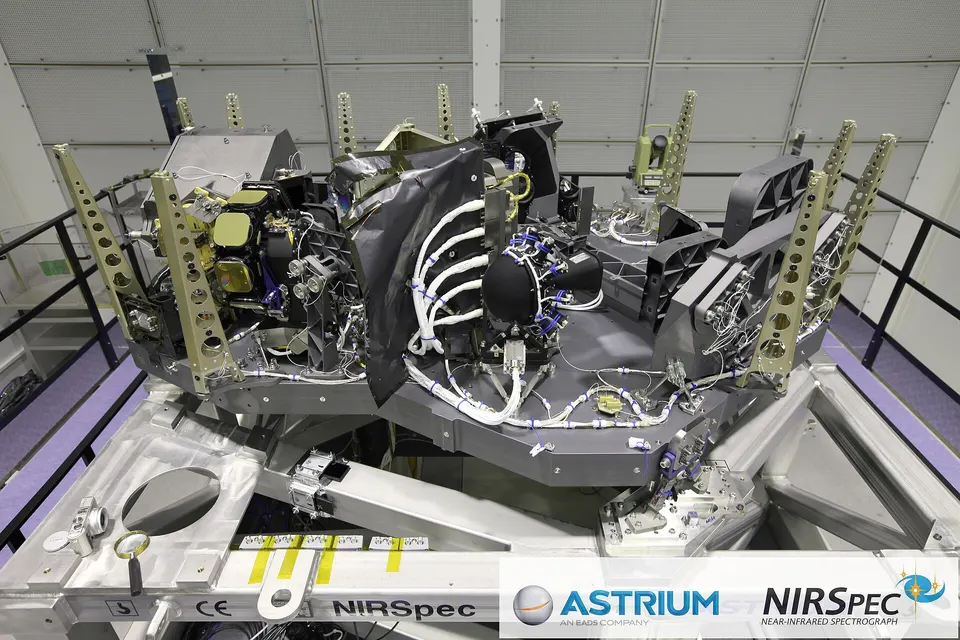
Astronomers often treat certain ultraviolet emission lines as fingerprints of an active galactic nucleus, or AGN. A new analysis suggests that, in some of the earliest galaxies, landing in the parts of standard diagnostic charts usually linked to AGN is not enough on its own to show that one is present. The study, posted to arXiv and not yet peer-reviewed, looks at eight galaxies from the epoch of reionization, at redshifts of roughly 7 to 9. It uses deep spectra from JWST's NIRSpec instrument collected by the Carbon-3 plus Oxygen survey.
The epoch of reionization is the era when light from the first galaxies stripped electrons from the hydrogen filling the young universe. The galaxies studied here proved chemically primitive: their oxygen abundances span 12+log(O/H) = 7.50-7.90, and their carbon-to-oxygen ratios are low, at C/O = 0.10-0.32. Their gas is also packed tightly, with electron densities measured from carbon lines of (1.9-4.9)×10^4 cm^-3.
To see how these conditions affect standard diagnostic charts, the researchers ran Cloudy photoionization models powered by BPASS and BC03 stellar populations. When they lowered C/O and raised gas density, models of purely star-forming galaxies drifted into areas conventionally labeled composite or AGN-like. Landing in those areas, the team concludes, does not by itself show that these particular galaxies host an AGN.
Some puzzles remain. Strong helium emission, the He II line, is not reproduced by the revised models. The authors argue that UV diagnostic boundaries should be redrawn to reflect the chemistry and gas conditions typical of reionization-era galaxies.
Why it matters
Rest-frame UV lines are key probes of ionizing radiation, chemical makeup and gas conditions in distant galaxies, and the authors say the results show a need for diagnostic boundaries suited to reionization-era galaxies.
What we don't know yet
The work is a preprint that has not been peer-reviewed, covers only eight galaxies, and its updated models fail to reproduce the strong He II emission observed.
Terms in this story
- Active galactic nucleus (AGN)
- A compact, very bright region at a galaxy's center powered by material falling onto a supermassive black hole.
- Photoionization model
- A computer simulation of how starlight or other radiation strips electrons from gas and makes it glow at particular wavelengths.
- Redshift
- The stretching of light to longer wavelengths as the universe expands, used as a measure of how distant and early an object is.
Sources and verification
DexScience articles are produced with AI assistance and an automated fact-check against the linked sources. Spotted an error? Tell us and we will correct it openly.