Key points
- The dual quasar lies at redshift 2.37, about 2.8 billion years after the Big Bang.
- Its surrounding hot gas was detected at 6 sigma through the thermal Sunyaev-Zel'dovich effect.
- The gas holds 9.7 x 10^60 erg, 3.6 times that expected from all hot gas in a 10^13 solar-mass dark matter halo.
- That energy is at least 0.6% of the quasar's total lifetime energy output.
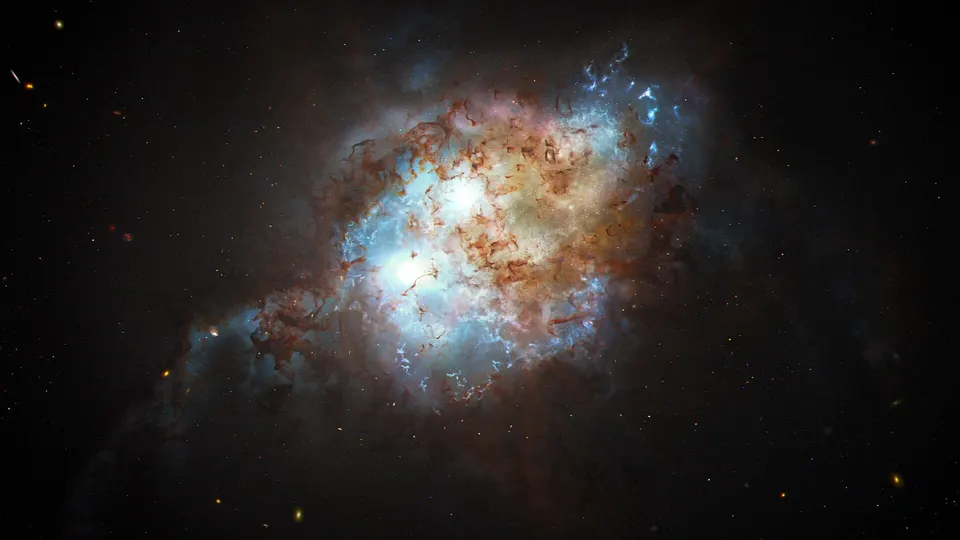
Astronomers have spotted a pair of actively feeding supermassive black holes, known as a dual quasar, wrapped in a bubble of hot gas that carries far more energy than its surroundings should provide. The system sits at redshift 2.37, meaning we see it as it was about 2.8 billion years after the Big Bang. According to the paper's arXiv listing, the work was published online in Nature Astronomy on 18 Nov 2026.
Gas this hot and thin is very hard to see directly. So the team relied on the thermal Sunyaev-Zel'dovich (tSZ) effect, a small dip in millimeter-wavelength light. The dip happens when hot electrons scatter light from the cosmic microwave background, the faint afterglow of the Big Bang. The signal came through at 6 sigma, and it points to 9.7 x 10^60 erg of thermal energy. That is 3.6 times what all the hot gas in a dark matter halo of 10^13 solar masses would be expected to hold, and at least 0.6% of the energy the quasar puts out over its lifetime.
The researchers also report evidence of hot gas on larger scales, from 100 to 600 kiloparsecs, which may likewise come from quasar outflows. They argue the extra energy is more than enough to shut down star formation and heat the gas between galaxies, which in their view implies that quasar-driven winds have a significant impact on their surroundings.
Such feedback could plausibly explain why the brightest galaxies are so much rarer across the observable universe than fainter ones, the team says. In their view, the finding adds support to the leading theory of how galaxies evolve.
Why it matters
Galaxy formation models rely on quasars strongly affecting their surroundings. The measured energy is more than enough to halt star formation and heat intergalactic gas, which the authors say implies that quasar-driven winds have a significant impact on their surroundings.
What we don't know yet
The result comes from a single dual quasar system. The authors say only that the hot gas on larger scales may come from quasar outflows, so its origin is still tentative.
Terms in this story
- Quasar
- A very bright galactic core powered by a supermassive black hole that is actively pulling in matter.
- Thermal Sunyaev-Zel'dovich effect
- A slight change in cosmic microwave background light caused by hot electrons scattering it, which lets astronomers measure the energy in hot, diffuse gas.
- Redshift
- The stretching of light from distant objects to longer wavelengths, which astronomers use to work out how far back in time they are looking.
Sources and verification
DexScience articles are produced with AI assistance and an automated fact-check against the linked sources. Spotted an error? Tell us and we will correct it openly.