Key points
- Hera's early image shows Dimorphos's shadow blocking sunlight across part of Didymos's rocky surface.
- Dimorphos is 151 m across; Didymos has a 730-m diameter, and the moonlet orbits about a kilometer away.
- The picture came from Hera's monochrome Asteroid Framing Camera, which serves both navigation and science.
- ESA planned to share Hera's first close-up images of Dimorphos in a livestream on 25 November.
The European Space Agency's Hera mission has photographed a solar eclipse taking place far from Earth. In an early view of the Didymos binary asteroid system released by ESA, the small moonlet Dimorphos throws its shadow onto part of its larger parent, Didymos, cutting off sunlight to that patch of rocky ground.
Asteroids with small moons can have eclipses much like the ones seen from Earth, explains Patrick Michel, Hera Principal Investigator and Director of Research at CNRS / Observatoire de la Côte d'Azur. He notes that the pair obeys the same celestial mechanics as Earth and the Moon, only on a far smaller scale and with much weaker gravity. In principle, he says, a person on Didymos could watch such an eclipse, though staying put would be hard because the asteroid's gravity is so low and it spins very fast.
According to ESA, the shadow covers a sizable stretch of Didymos because the two bodies sit so close together: Dimorphos, just 151 m across, orbits about a kilometer from the 730-m-wide Didymos. Hera captured the scene with its monochrome Asteroid Framing Camera, which handles both navigation and science imaging.
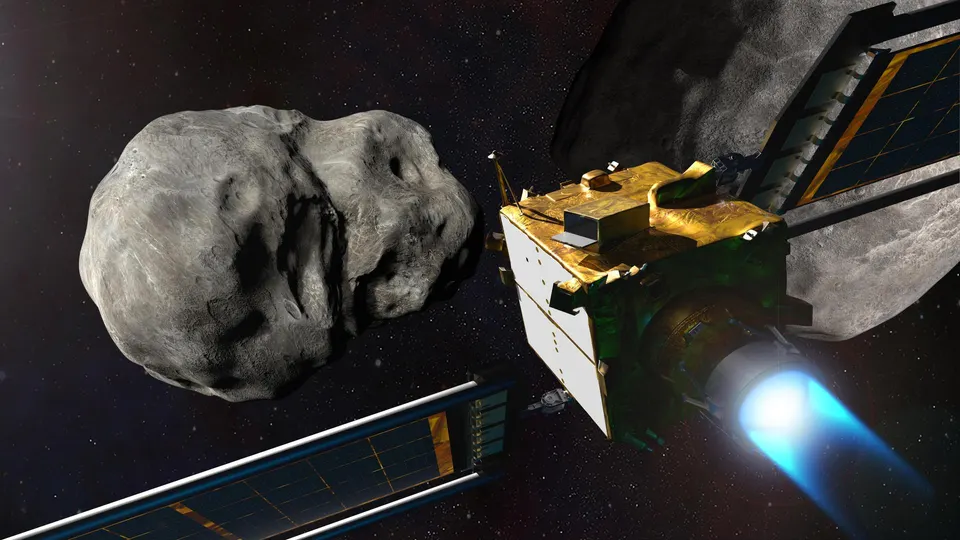
In 2022, NASA's DART spacecraft deliberately struck Dimorphos to change its orbit around Didymos. Hera has now arrived to study the aftermath up close, gathering data that ESA says could help turn that experiment into a well-understood and possibly repeatable way to defend Earth. The agency planned to share Hera's first close-up images of Dimorphos in a livestream on 25 November.
Why it matters
Hera is gathering the close-up data ESA says is needed to turn DART's 2022 impact into a well-understood planetary defense technique that could potentially be repeated.
What we don't know yet
This is an early image. ESA planned to release Hera's first close-up images of Dimorphos later, and the detailed study of the DART impact site is still ahead.
Terms in this story
- Binary asteroid
- A pair of asteroids bound by gravity, with the smaller one orbiting the larger.
- Planetary defense
- Efforts to detect hazardous asteroids and develop ways to keep them from hitting Earth.
Sources and verification
DexScience articles are produced with AI assistance and an automated fact-check against the linked sources. Spotted an error? Tell us and we will correct it openly.