Key points
- ESA's Hera spacecraft has arrived at the Didymos–Dimorphos binary asteroid after a two-year trip through deep space.
- The first close-up images will be shown live on 25 November, 19:45 to 20:30 CET, on ESA WebTV and YouTube.
- DART's 26 September 2022 impact shortened the orbit of 151-m Dimorphos around 780-m Didymos by about 33 minutes.
- Early in the new year, Hera plans to release two shoebox-sized CubeSats that will fly closer to the asteroids.
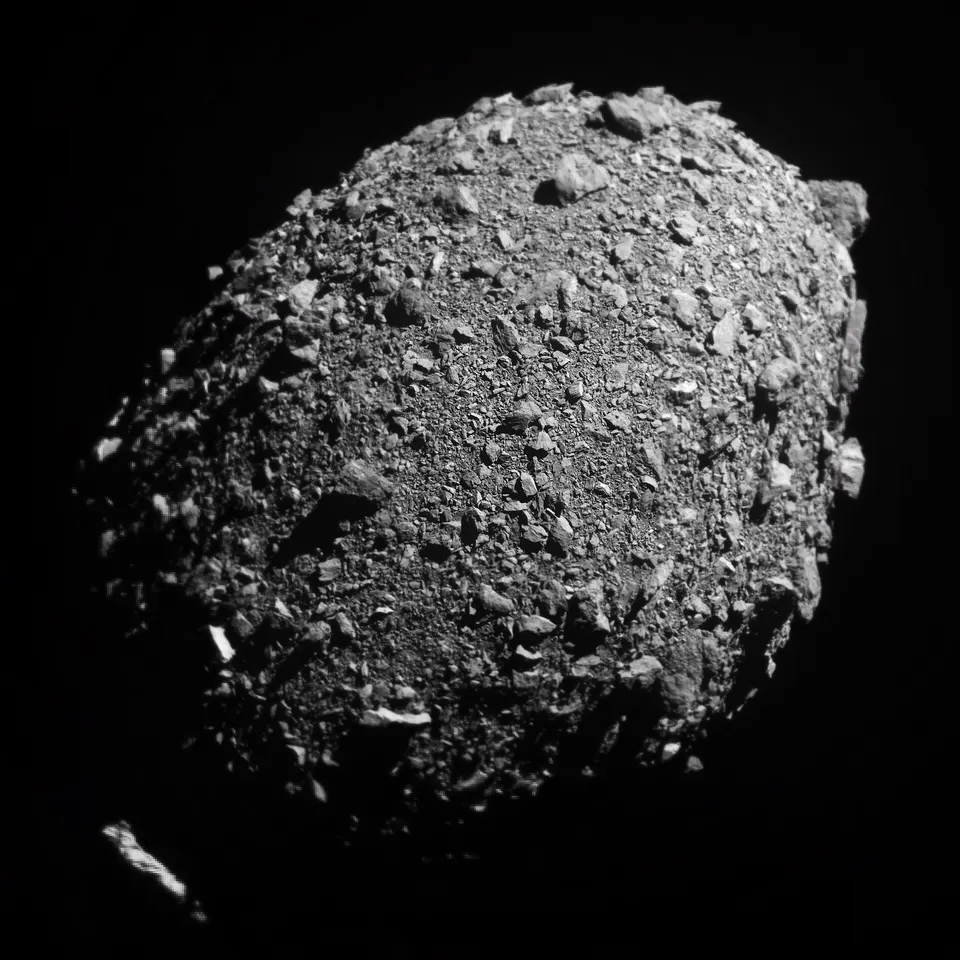
The European Space Agency's Hera spacecraft has reached Dimorphos, the small asteroid that NASA's DART probe deliberately rammed in 2022. On Wednesday 25 November, the mission team plans to show its first close-up pictures of the altered asteroid in a public livestream. According to ESA, the broadcast runs from 19:45 to 20:30 CET on ESA WebTV and the agency's YouTube channel.
DART struck on 26 September 2022 and threw millions of tons of debris into space. Telescopes on Earth saw the resulting brightening, and their observations confirmed that Dimorphos's orbit had changed. The 151-m-diameter asteroid circles a larger, 780-m-diameter companion called Didymos, and its orbit had become about 33 minutes shorter. Hera arrived at the pair after two years of travel through deep space.
Hera will gather the close-up data scientists need to understand the kinetic impact method, which means nudging an asteroid by hitting it. The goal is to make it a reliable technique that could be used again if needed. Patrick Michel, Hera's principal investigator and Director of Research at CNRS / Observatoire de la Côte d'Azur, says the mission wants to learn how the impact changed Dimorphos, how much mass the asteroid has, and which of its properties explain how it reacted to the hit.
The unveiling will take place in the dinosaur hall of Berlin's Museum für Naturkunde. ESA mission scientist Michael Kueppers says the images are only the beginning. Over the coming months, Hera will move closer to the asteroids. Early next year, it will release two shoebox-sized CubeSats that can take more risks and fly closer than the main spacecraft.
Why it matters
ESA says Hera's close-up study is needed to turn the kinetic impact approach, used in humankind's first planetary defense test, into a well-understood way of protecting Earth from asteroids.
What we don't know yet
ESA has not released the images yet; they will be shown on 25 November. Answers to the mission's main questions, including the asteroid's mass, are still to come. ESA says next week's unveiling is only the start of Hera's exploration.
Terms in this story
- Kinetic impact
- A way of changing an asteroid's path by deliberately crashing a spacecraft into it.
- Binary asteroid
- A pair of asteroids bound by gravity, with a smaller one orbiting a larger one.
- CubeSat
- A small, low-cost spacecraft built from standard box-shaped units.
Sources and verification
DexScience articles are produced with AI assistance and an automated fact-check against the linked sources. Spotted an error? Tell us and we will correct it openly.