Key points
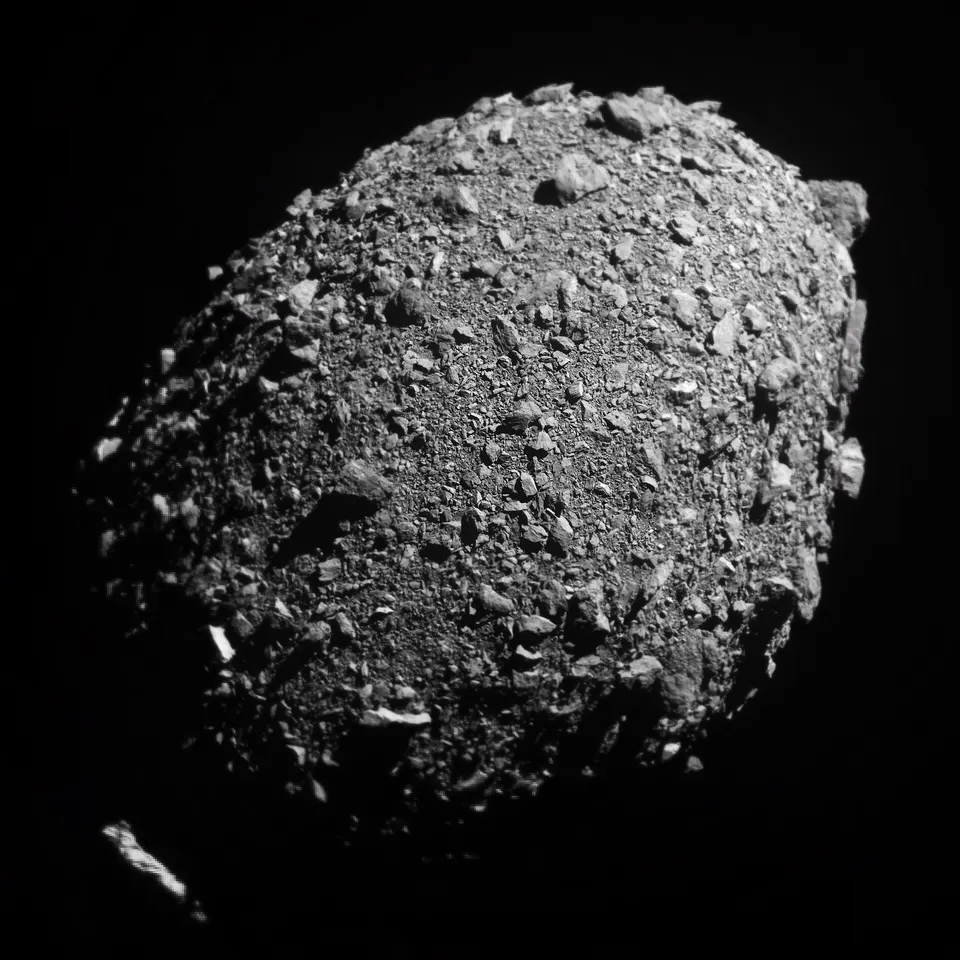
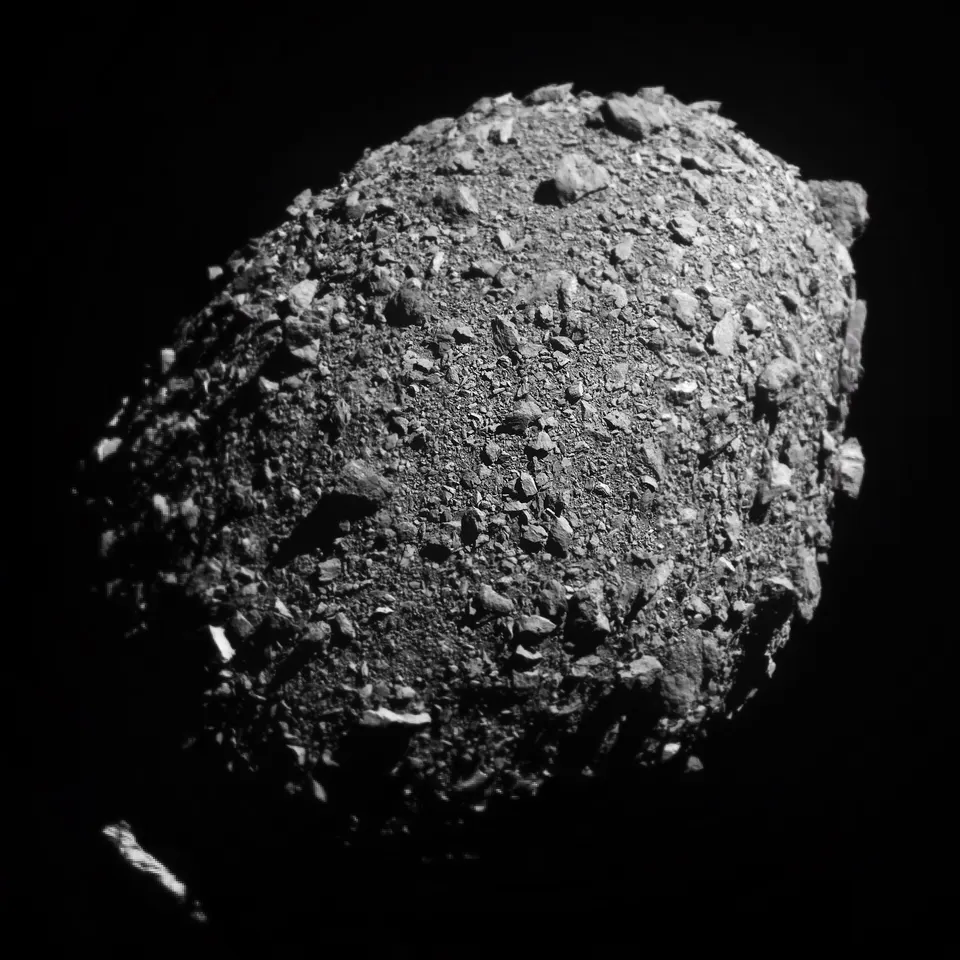
- ESA's Hera found a crater the size of a sports stadium that stretches across the entire width of Dimorphos.
- The DART impact left Dimorphos tumbling chaotically, while its other boulder fields look unchanged since 2022.
- Hundreds of orbiting boulders, each just a few meters across, surround Dimorphos and its larger partner Didymos.
- Hera plans to approach to around 13 km in December and release two CubeSats in January 2027.
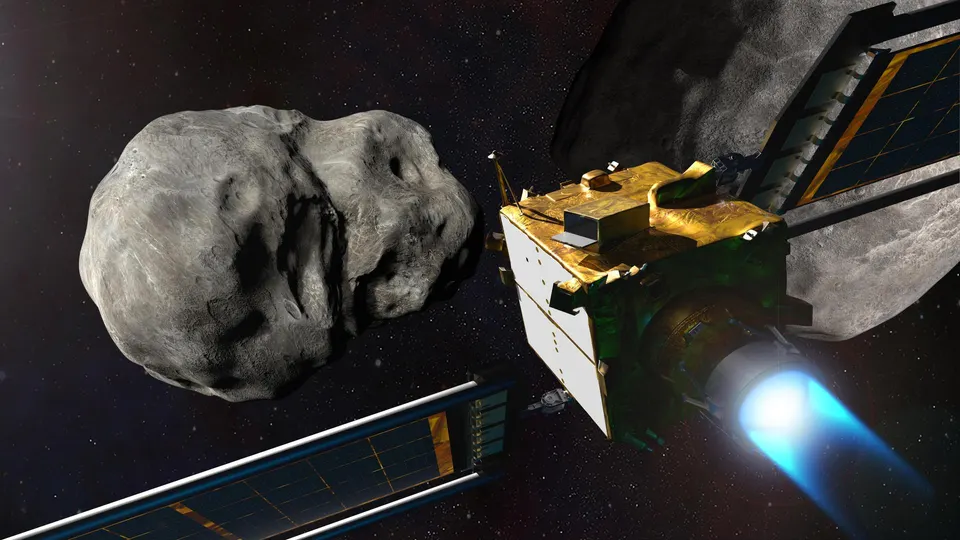
The European Space Agency's Hera spacecraft has taken its first close look at Dimorphos, the small asteroid that NASA's DART spacecraft deliberately struck in 2022. The impact clearly changed it. According to ESA, a crater roughly the size of a sports stadium has flattened the side DART hit, and the moonlet is now tumbling chaotically. Hera also spotted hundreds of boulders that nobody knew about, orbiting the asteroid pair.
Dimorphos is 151 meters across and circles a larger asteroid, Didymos, which is 730 meters wide. The two travel around the Sun together and are currently 193.5 million km from Earth. When DART collided with Dimorphos on 26 September 2022, it shortened the moonlet's orbit by 33 minutes, far more than predicted. Telescopes on Earth could measure that shift, but they couldn't show what the collision had done to the asteroid itself.
Researchers had argued over three possibilities: that DART left a crater, that it changed the asteroid's shape, or that Dimorphos came through unaltered. Patrick Michel, Hera's principal investigator and Director of Research at CNRS / Observatoire de la Côte d'Azur, says the answer surprised the team, because in a sense all three turned out to be true at once. The face DART struck has been flattened into a crater that spans the asteroid's full width, which counts as both a crater and a change of shape. Away from the impact site, though, there is no sign of major change. The boulder fields on Dimorphos's other regions look the same as they did in DART's 2022 images.
Michael Kueppers, ESA's Hera mission scientist, says it became obvious that the moonlet was tumbling wildly as more images came in. He describes the swarm of boulders, each just a few meters across, as another big surprise. The team will need to account for those objects as the spacecraft moves in closer over the coming weeks.
The small-car-sized spacecraft has been observing with three instruments. The monochrome Asteroid Framing Camera takes black-and-white images. Hyperscout H captures 25 separate colors at once. JAXA's Thermal Infrared Imager, TIRI, measures surface temperatures. Hera is flying about 25-30 km from the pair and firing its thrusters to hold what ESA calls rectangular orbits at an average speed of just 12 cm/s, because the two asteroids have extremely weak gravity.
ESA says these images are only the start of the investigation. In December, Hera is scheduled to close to around 13 km and return progressively sharper pictures. In January 2027, it plans to release two shoebox-sized CubeSats that will go closer still. Juventas, a CubeSat headed by Luxembourg, carries a low-frequency radar to peer inside an asteroid, and it is ultimately meant to try touching down. Milani, headed by Italy, will examine what asteroids are made of and the dust around them.
Ian Carnelli, who manages the Hera mission, presented the first pictures of Dimorphos in Berlin, surrounded by the dinosaur displays of the Museum für Naturkunde. He pointed to the asteroid impact 66 million years ago as a reminder of why planetary defense matters. In his view, DART showed that an asteroid's orbit can be changed, and Hera is now showing what that did to the asteroid. Together, he says, the two missions move asteroid deflection closer to being a dependable way to protect Earth. Eighteen ESA States joined forces to build Hera and its CubeSats, with Germany's OHB heading the group.
Why it matters
According to ESA, DART showed that an asteroid can be pushed off course, and Hera reveals what that push did to the asteroid. Understanding why the technique worked is needed before deflection can be relied on to protect Earth.
What we don't know yet
These are early images, taken from about 25-30 km away. ESA says sharper views from closer range and the CubeSat measurements, including radar soundings of the interior, are still to come. The newly found boulders are something the team must work around as Hera moves closer.
Terms in this story
- Planetary defense
- Efforts to find and, if needed, deflect asteroids or comets that could strike Earth.
- CubeSat
- A small, standardized spacecraft, here about the size of a shoebox, that can be released from a larger mission.
- Binary asteroid
- A pair of asteroids bound by gravity and orbiting each other; here, the small moonlet Dimorphos orbits the larger Didymos.
Sources and verification
DexScience articles are produced with AI assistance and an automated fact-check against the linked sources. Spotted an error? Tell us and we will correct it openly.