Key points
- Above about 0.9 of its melting temperature, Fe-rich (Fe,Mg)O shows superionic onset and premelting along grain boundaries.
- The effects are significant in (FexMg1-x)O with x > 0.8 under core-mantle boundary conditions.
- The material becomes elastically softer, transports elements faster and has ultra-low viscosity.
- The authors propose this may help form and evolve some ultra-low velocity zones.
Earth's rocky mantle meets its liquid iron core at the core-mantle boundary, and experiments show that reactions there produce an iron-rich oxide called (Fe,Mg)O. A new study in Nature Communications reports that this oxide behaves unusually as it nears its melting point, with possible consequences for the deep Earth. The journal has published the peer-reviewed paper early, before final edits.
The researchers report that above roughly 0.9 times its melting temperature, Fe-rich (Fe,Mg)O starts to become superionic, a state in which some atoms move almost freely through a solid framework. The boundaries between its crystal grains also begin to premelt, meaning they soften before the bulk of the material melts. The effects are significant when iron strongly outweighs magnesium (x > 0.8) under core-mantle boundary conditions. Under those conditions, the oxide becomes elastically softer, lets elements move through it faster and has very low viscosity, so it flows easily.
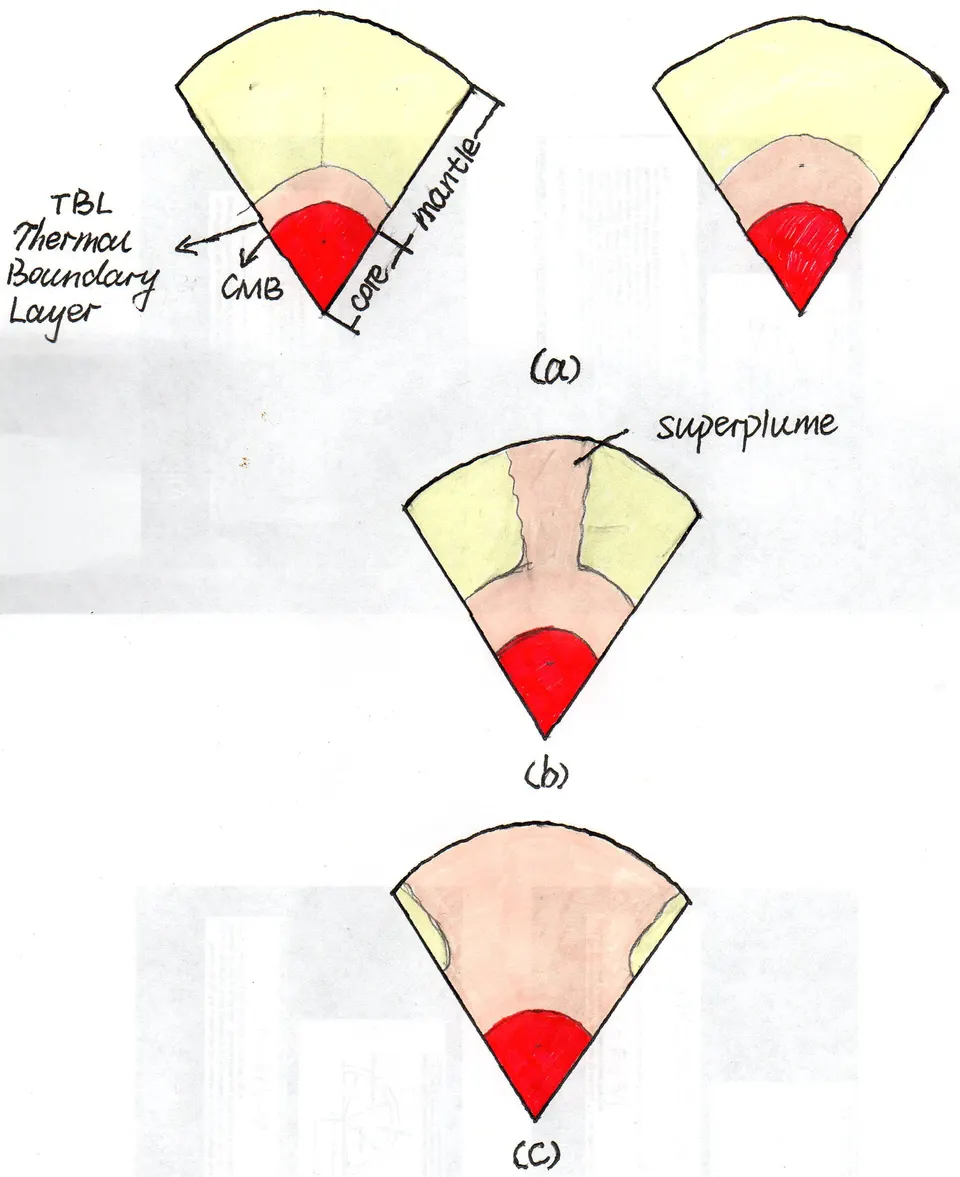
According to the team, faster diffusion may speed up reactions between core and mantle and allow iron-rich material to pile up at the base of the mantle. That material could potentially build a dense layer there. Mantle flow or heat-driven buoyancy could then deform connected, easily flowing pockets of the oxide and push them toward shallower depths.
The authors suggest this process may help create and reshape some ultra-low velocity zones, patches above the core where seismic waves slow sharply. They say the scenario fits the layered structure and low viscosity inferred for some of these zones. It also hints that the oxide could play a part in exchanging material and heat between the core and the mantle.
Why it matters
According to the authors, interactions between the core and mantle are key to understanding how Earth's interior moves and evolves. This oxide could help carry material and heat between the two.
What we don't know yet
The link to ultra-low velocity zones is a proposed scenario and is stated with hedged language, and the authors say it is consistent with only some of these zones. The paper is an early version that will be replaced by a final Version of Record.
Terms in this story
- Superionic
- A state of matter in which some atoms flow almost like a liquid through a solid crystal framework.
- Premelting
- Softening or partial melting that begins at the boundaries between crystal grains before the whole material reaches its melting point.
- Ultra-low velocity zones (ULVZs)
- Patches at the base of the mantle where seismic waves travel much more slowly than in the surrounding rock.
Sources and verification
DexScience articles are produced with AI assistance and an automated fact-check against the linked sources. Spotted an error? Tell us and we will correct it openly.