Key points
- The study focuses on sinkhole collapse in evaporite karst along the Dead Sea in Jordan.
- It examines scaling, meaning how sinkhole numbers relate to sinkhole size.
- It also estimates exceedance probability, the chance that a collapse is bigger than a given size.
- The peer-reviewed paper appeared in Natural Hazards and Earth System Sciences on 13 November 2026.
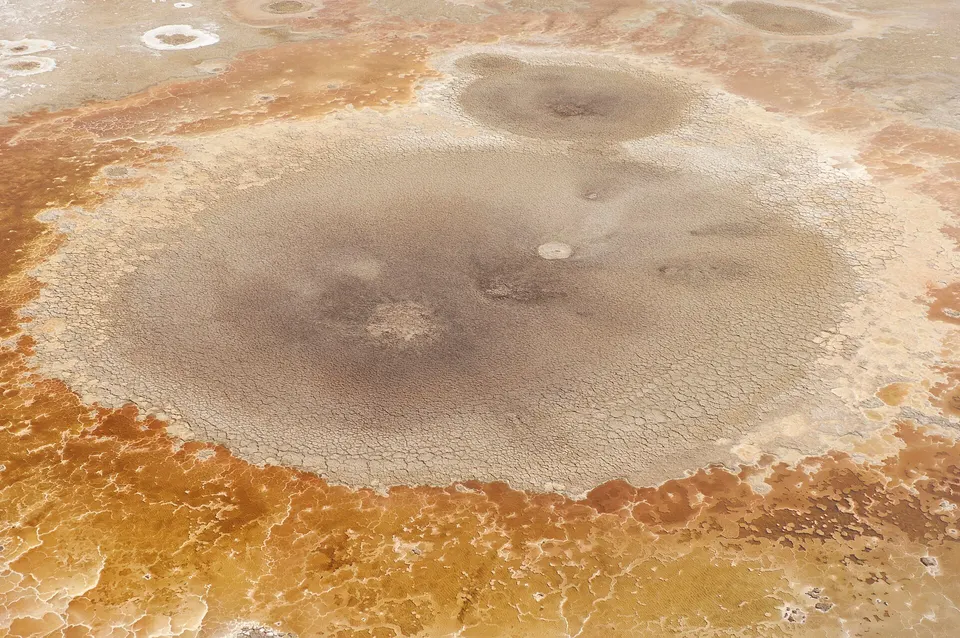
Researchers have studied how often sinkholes of different sizes collapse along the Dead Sea in Jordan. Their results appear in the peer-reviewed journal Natural Hazards and Earth System Sciences, published on November 13, 2026. The work looks at sinkholes in evaporite karst, which is ground made of salt-rich rock that water can dissolve.
Sinkholes form when water dissolves soluble rock below the surface and leaves hollow spaces, until the ground above gives way. Salt and similar evaporite minerals dissolve much more easily than ordinary rock, so this kind of terrain can change quickly.
The paper's title points to two statistical ideas. The first is scaling, which describes how the number of sinkholes changes with their size, for example whether small collapses greatly outnumber large ones. The second is exceedance probability, the chance that any given collapse will be larger than a particular size. Working out both lets researchers describe the sinkhole hazard in terms of probabilities rather than single events.
The material DexScience reviewed for this report did not include the paper's abstract or its numerical findings. For that reason, this brief does not report specific sinkhole counts, sizes or probabilities. Readers who want the details can find the full paper under DOI 10.5194/nhess-26-5791-2026.
Why it matters
The study puts sinkhole collapse along Jordan's Dead Sea shore in terms of size statistics and the probability of exceeding a given size. That is a quantitative way to describe the hazard.
What we don't know yet
The source material we received contained only the paper's title, its publication details and its reference list. It did not include the abstract or any results, so specific findings such as sinkhole counts, size ranges and probability values could not be checked and are left out.
Terms in this story
- Evaporite karst
- A landscape built on salt-rich rock, left behind when water evaporated, that dissolves and can form caves and sinkholes.
- Exceedance probability
- The chance that an event, here a sinkhole collapse, will be larger than a given size.
- Scaling
- How the number of events changes with their size.
Sources and verification
DexScience articles are produced with AI assistance and an automated fact-check against the linked sources. Spotted an error? Tell us and we will correct it openly.