Key points
- The study, published in Nature Communications, links dust source composition measured from orbit to atmospheric acidity and nitrate.
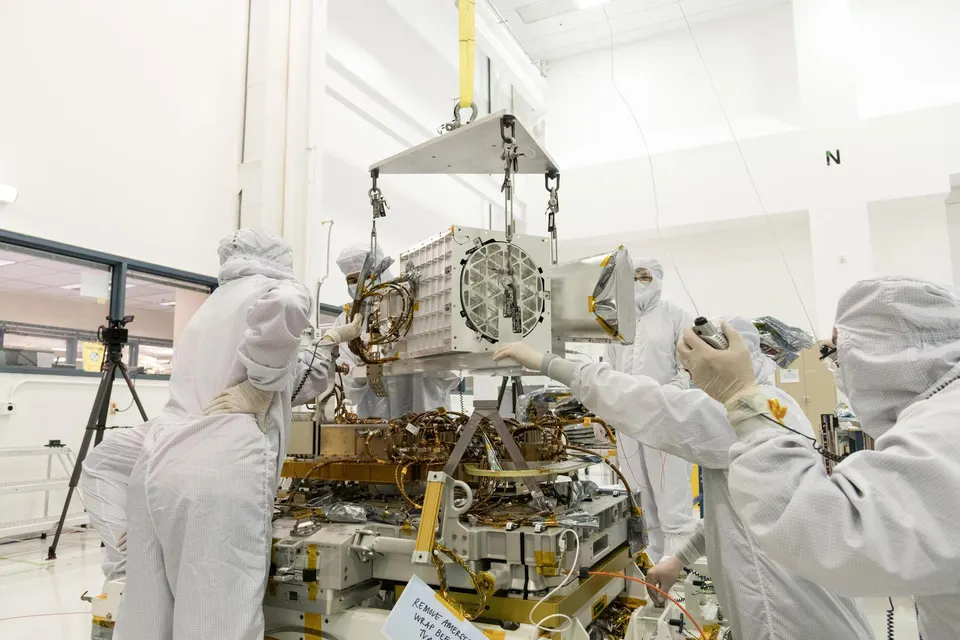
- Four authors received support from the NASA EMIT project, funded through NASA's Earth Venture Instrument program.
- Some of the work took place at the Jet Propulsion Laboratory, California Institute of Technology, under a NASA contract.
- The team used the MareNostrum supercomputer, with technical support from the Barcelona Supercomputing Center.
Researchers have used spectroscopy from orbit to connect the composition of the regions where dust comes from to two features of atmospheric chemistry: how acidic the air is and how much nitrate it contains. That link is the central claim in the title of the peer-reviewed study, published in Nature Communications. Several of the authors received support from NASA's EMIT project.
Spectroscopy breaks light into many separate wavelengths, and different materials absorb and reflect light in their own telltale patterns. When wind lifts dust off the ground, the particles travel into the atmosphere, where they can react with other chemicals in the air.
The paper credits a wide group of supporters. NASA's EMIT effort, funded through the agency's Earth Venture Instrument program, supported four of the authors. Other backing came from the U.S. Department of Energy, the BIOTA project, NASA's Modeling, Analysis and Prediction Program and the Integrated Modeling Virtual Institute. Some of the work took place at the Jet Propulsion Laboratory, California Institute of Technology, under a NASA contract. The authors also thank the Barcelona Supercomputing Center, which provided technical support and time on the MareNostrum supercomputer through the Red Española de Supercomputación.
The source material DexScience reviewed does not describe the study's methods or results in detail. So the strength of the link, which features of the dust sources matter most and where the dust was traced remain for readers to find in the full paper.
Why it matters
According to the paper's title, the work ties what orbital instruments can see on the ground to the chemistry of the air, linking dust sources to atmospheric acidity and nitrate.
What we don't know yet
The material available to DexScience was limited to the paper's title and acknowledgements, so we could not report the study's specific findings, methods, regions studied or uncertainties.
Terms in this story
- Spectroscopy
- A technique that splits light into its component wavelengths to identify materials by the patterns they absorb and reflect.
- Nitrate
- A nitrogen- and oxygen-containing chemical compound that can form in the atmosphere and attach to airborne particles.
- Atmospheric acidity
- How acidic the air and the particles and droplets in it are, which affects the chemical reactions that take place there.
Sources and verification
DexScience articles are produced with AI assistance and an automated fact-check against the linked sources. Spotted an error? Tell us and we will correct it openly.