Key points
- Scientists say the 2026 bloom may cover more ground than any flowering desert observed since satellite monitoring began.
- Storm fronts fed by an atmospheric river brought heavy July rain to a long stretch of Chile.
- Landsat 8 imaged the desert on September 14 and Landsat 9 imaged it on October 24.
- A 2019 study identified 13 Atacama Desert blooms between 1981 and 2015.
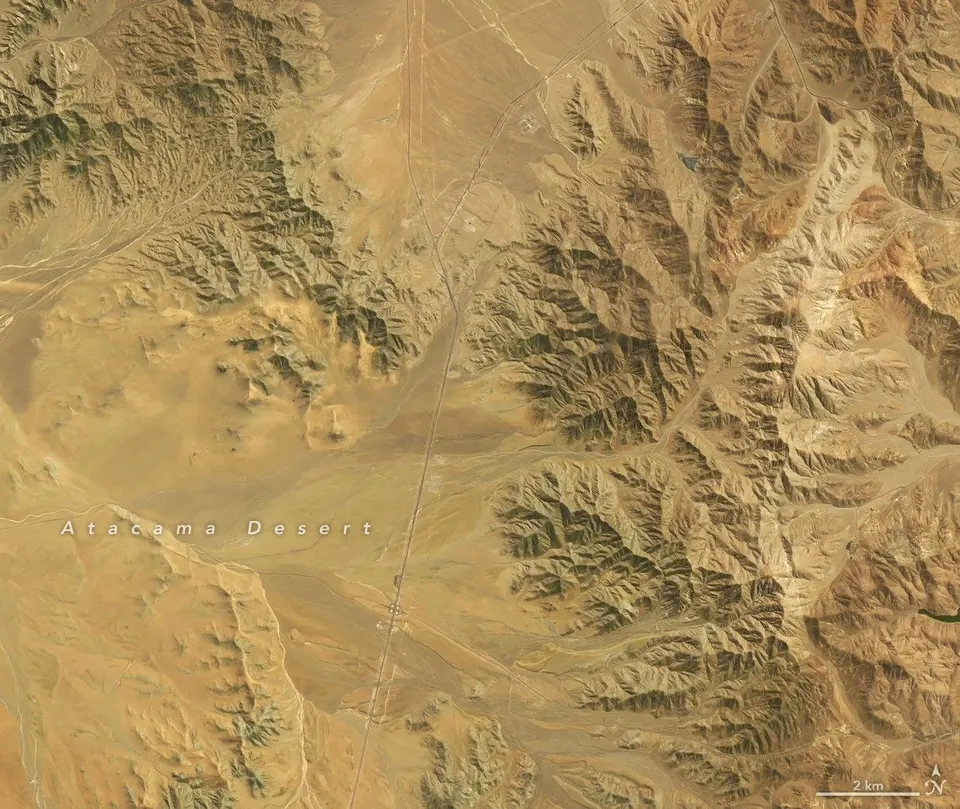
Parts of Chile's Atacama Desert, usually among the driest places on the planet, turned red-purple, green and white during the 2026 southern spring, according to NASA's Earth Observatory. Scientists say this flowering desert, known locally as the desierto florido, may have spread wider than any other seen since satellites began watching.
The flowers came from seeds that had been lying dormant in the soil until an unusually wet winter woke them. NASA ties the rain to a strengthening El Niño, a periodic warming of the tropical Pacific. It weakens the high-pressure system that normally keeps the region dry and helps push Southern Hemisphere storms toward the equator.
Starting in mid-July, storm fronts fed by an atmospheric river brought some of the heaviest July rainfall in decades to a long swath of Chile stretching between the Atacama region and Los Lagos, Chile's national weather service reports. In August, storms brought rare snow to parts of the desert.
Landsat 8 photographed the bloom on September 14, and Landsat 9 followed on October 24. About 30 kilometers (20 miles) southwest of Copiapó, the October images show huge red-purple patches of pata de guanaco. Roberto Chávez of Pontificia Universidad Católica de Valparaíso, who specializes in remote sensing, says these are most likely Cistanthe longiscapa or another Cistanthe species. In September, hillsides farther southwest showed green-and-white blooms of suspiros, probably Nolana baccata, according to his colleague Andres Moreira-Muñoz, who studies plant geography.
Using NASA's long-term vegetation record, a 2019 study counted 13 Atacama blooms between 1981 and 2015. Moreira-Muñoz says the 2026 event looks like the most significant yet in extent, intensity and duration, at least since remote sensing began.
Chávez and colleagues are gathering satellite, drone and camera data in a project that aims to map how the bloom's biodiversity changes across space and over time.
Why it matters
The researchers aim to map how the bloom's biodiversity shifts across space and time so that land-use planners and conservation managers can use the results.
What we don't know yet
The comparison with past blooms is hedged: scientists say this bloom may be the most extensive of the satellite era, and Moreira-Muñoz says it appears to be the most significant since researchers began using remote sensing.
Terms in this story
- El Niño
- A recurring warming of the tropical Pacific Ocean that shifts weather patterns in many parts of the world.
- Atmospheric river
- A long, narrow band of moist air that can carry large amounts of water vapor and bring heavy rain or snow.
- Desierto florido
- Spanish for flowering desert, the name for the Atacama's occasional mass blooms after rare rains.
Sources and verification
DexScience articles are produced with AI assistance and an automated fact-check against the linked sources. Spotted an error? Tell us and we will correct it openly.