Key points
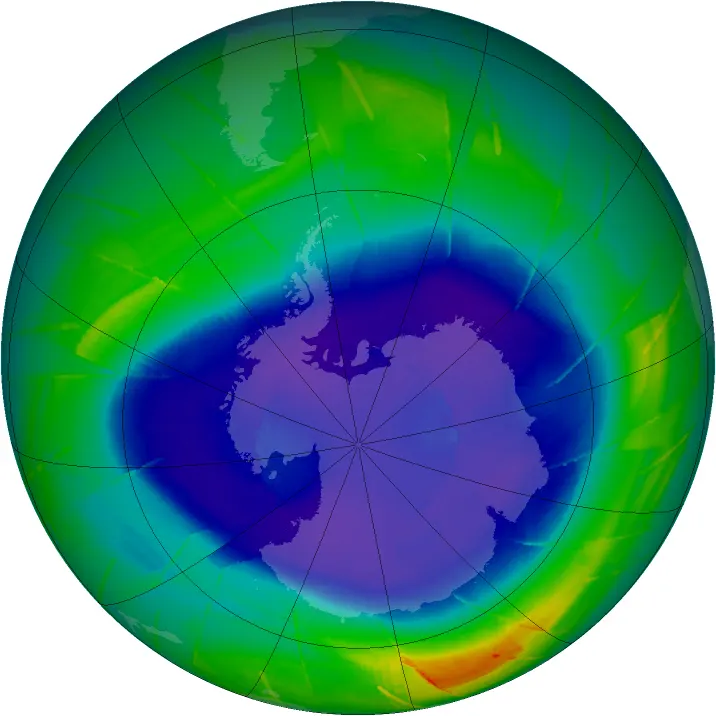
- By 20 September 2026, the Antarctic ozone hole covered 27.3 million sq km, far larger than Antarctica itself.
- That was around 6.5 million sq km, or 31%, above the 20-year average for that time of year.
- Copernicus Sentinel-5P data show the hole's depth stayed close to average despite its large area.
- ESA links the hole's size to an unusually strong, persistent polar vortex and says long-term recovery remains on track.
This year the ozone hole over Antarctica grew to one of the largest sizes recorded in 48 years, the European Space Agency reports. The finding draws on long-term atmospheric records, including measurements from the Copernicus Sentinel-5P satellite. It is a sharp reversal from 2025, when the seasonal hole was the fifth smallest since 1992. Even so, ESA stresses that the hole's size naturally rises and falls from year to year, and that the ozone layer's long-term recovery is still on course.
By 20 September 2026, the hole spanned 27.3 million square kilometers, an area far bigger than the Antarctic continent. According to ESA, that was around 6.5 million sq km, or 31%, more than the average for that point in the season over the past 20 years.
Area is only half the picture, though. Scientists judge an ozone hole both by how much of the map it covers and by how badly ozone is thinned inside it, a measure called depth. Sentinel-5P data show the depth this year stayed close to average. Put simply, the 2026 hole was unusually wide but not as severe as other large holes on record.
ESA attributes the large size to an unusually strong and long-lasting polar vortex, a band of powerful winds that circles the pole during winter. The vortex kept temperatures in the Antarctic stratosphere, the layer of atmosphere above the one where weather happens, favorable for ozone loss for an extended period. That gave the hole time to spread past its normal reach.
The hole follows a yearly rhythm. It usually starts forming in August, expands through September and is largest sometime between mid-September and mid-October. As the southern spring warms the stratosphere, ozone loss slows and the vortex weakens before finally breaking apart. Typically, by the end of December the hole has closed and ozone returns to normal levels.
Sentinel-5P, short for Sentinel-5 Precursor, launched in October 2017 as the first Copernicus satellite devoted to watching the atmosphere. Its main instrument, a multispectral imaging spectrometer named Tropomi, identifies gases by the distinct ways they interact with different wavelengths of light, allowing it to map pollutants and stratospheric ozone in fine detail. ESA notes that satellites are especially valuable over remote places like Antarctica, where ground measurements are scarce. Long, consistent records help scientists separate natural year-to-year swings from lasting trends, and check whether the ozone layer is healing as expected now that ozone-depleting substances have been phased out under the Montreal Protocol.
More missions are planned. Copernicus Sentinel-5, flying on the MetOp Second Generation A-type satellites, is set to provide long-term global measurements of atmospheric composition. The upcoming Altius mission will add detailed vertical profiles of ozone and other gases. Together, ESA says, these missions should let scientists follow the ozone layer's recovery more accurately in the decades ahead.
Why it matters
According to ESA, satellite tracking of the ozone hole shows how well international agreements such as the Montreal Protocol are working and helps protect life on Earth from ozone loss.
What we don't know yet
ESA cautions that the ozone hole's size varies naturally from year to year, so one large hole does not signal a reversal. Telling short-term swings apart from long-term trends requires consistent records built up over many years.
Terms in this story
- Polar vortex
- A large circulation of strong winds around a pole that isolates cold air during winter.
- Stratosphere
- The layer of the atmosphere above the weather layer, where most of Earth's protective ozone sits.
- Montreal Protocol
- An international agreement to phase out substances that destroy the ozone layer.
Sources and verification
DexScience articles are produced with AI assistance and an automated fact-check against the linked sources. Spotted an error? Tell us and we will correct it openly.