Key points
- Ribonucleotide reductase is the only enzyme that makes deoxynucleotides from scratch for DNA replication and repair.
- In the *E. coli* class Ia enzyme, a radical travels 32 angstroms across β and α subunits on every turnover.
- Altering pathway tyrosines changed radical transfer rates, and those rates matched how fast deoxynucleotides were made.
- The team directly observed a tryptophan cation radical, W48+•, and concluded that transfer through it limits the enzyme's speed.
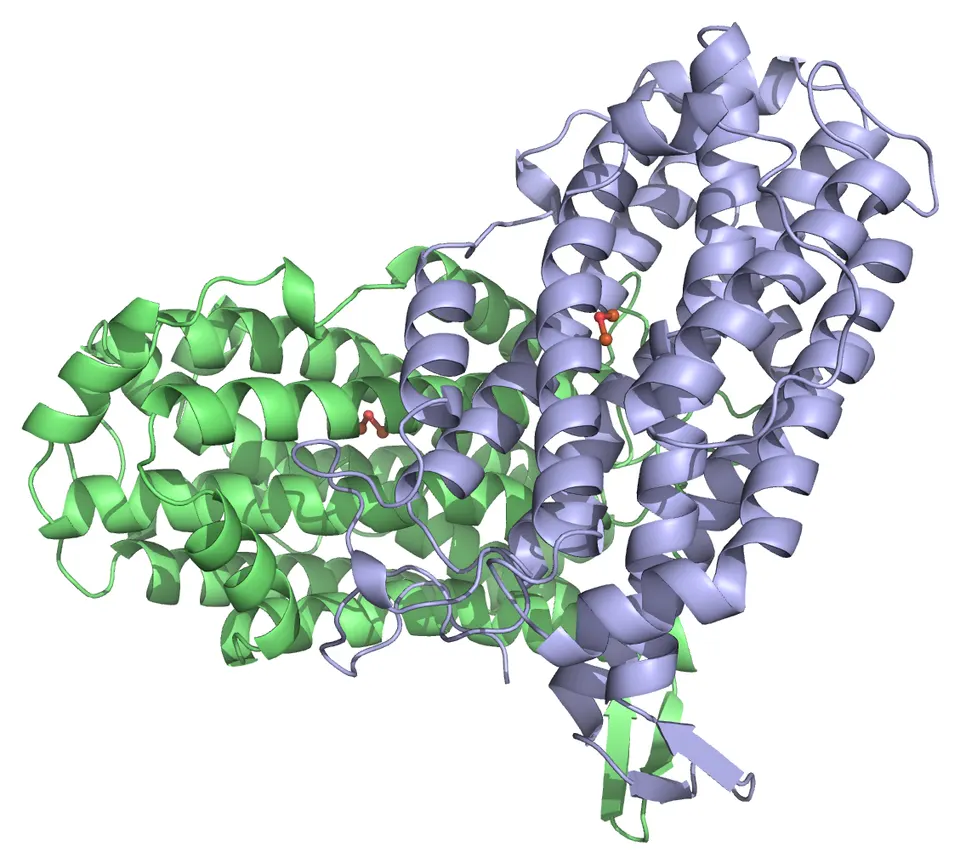
A short-lived, charged form of the amino acid tryptophan controls how fast a key enzyme in the bacterium Escherichia coli makes DNA building blocks, researchers report in Science. The enzyme, ribonucleotide reductase (RNR), is the only one that produces deoxynucleotides from scratch for copying and repairing DNA. Finding the step that limits its speed shows what controls the enzyme's activity.
Each time the E. coli class Ia enzyme completes a reaction, a radical has to move 32 angstroms along a chain of amino acids. A radical is a molecule with an unpaired electron. The chain runs from one protein subunit, called β, into another, called α, and several of its stepping stones are tyrosine residues.
To test the relay, the team swapped unnatural amino acids into the chain. These substitutes changed the reduction potentials of the pathway tyrosines, which is how readily each one gains an electron. This let the researchers change how quickly the radical moved, and the transfer rates matched the rates at which the enzyme produced deoxynucleotides. They also directly detected a tryptophan cation radical at position 48, written W48+•, and showed that it is kinetically competent. In other words, it forms and reacts fast enough to be a real stop along the route.
The authors say these results together establish that the radical's passage through W48 in the enzyme's α2β2 complex is the rate-limiting step. That step controls the overall activity of E. coli RNR.
Why it matters
RNR is the sole enzyme that makes deoxynucleotides from scratch for DNA replication and repair. Identifying the step that limits its speed shows what controls the enzyme's activity.
What we don't know yet
The findings come from the class Ia RNR of *E. coli*. The abstract does not say whether the same step limits the speed of RNRs in other classes or organisms.
Terms in this story
- Ribonucleotide reductase
- An enzyme that makes deoxynucleotides, the building blocks of DNA, from scratch.
- Radical
- A molecule or chemical group carrying an unpaired electron, which makes it highly reactive.
- Reduction potential
- A measure of how readily a chemical group gains electrons.
Sources and verification
DexScience articles are produced with AI assistance and an automated fact-check against the linked sources. Spotted an error? Tell us and we will correct it openly.