Key points
- The engineered cluster, tBu-Ti6, contains six titanium atoms and has a very low optical gap of 1.56 eV.
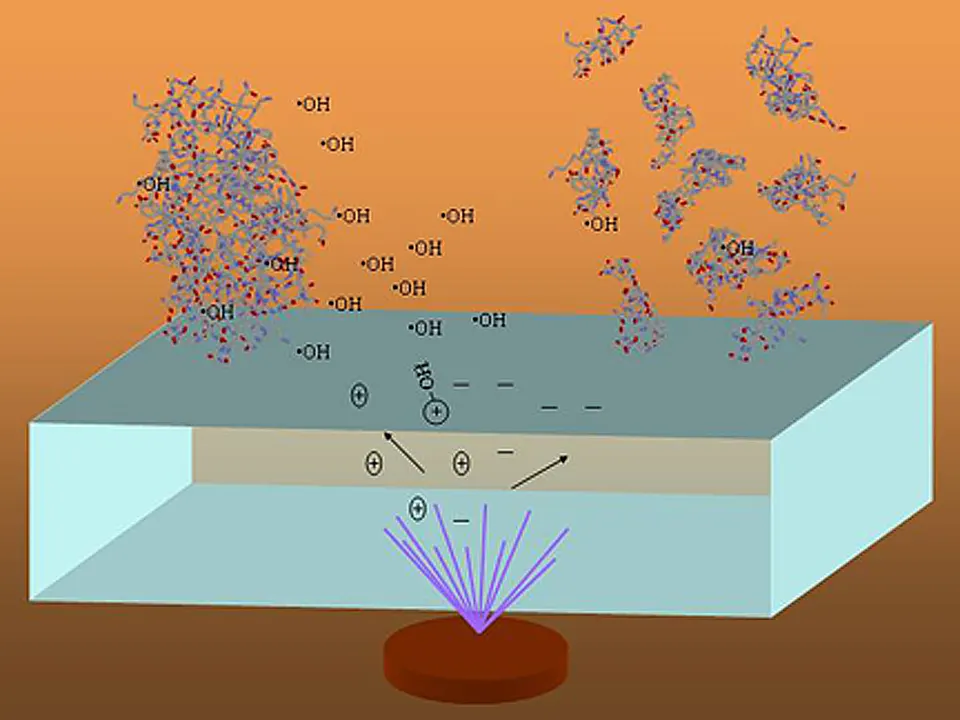
- Heated, it splits β-lactoglobulin by hydrolysis. Under light, it cleaves the protein through reactive oxygen species-driven photocatalysis.
- Cuts concentrated near negatively charged regions of the protein, which suggests the cluster recognizes its target electrostatically.
- The cluster did not decompose or dissolve in water and was reused without losing activity.
A tiny, precisely built cluster of titanium and oxygen atoms can cut and chemically modify a protein in water. Whether it is heated or exposed to light determines which of two mechanisms it uses, researchers report in a peer-reviewed paper published by Wiley-VCH. The result stands out because these clusters have limited stability in water, so they have been largely unexplored in biological chemistry.
Titanium-oxo clusters are molecule-sized relatives of titanium dioxide and serve as building blocks in many metal–organic frameworks. The team engineered a version with six titanium atoms, called tBu-Ti6. It has a very low optical gap of 1.56 eV, a property the authors describe as promising; the light-driven experiments themselves used 370 nm ultraviolet light. The researchers tested the cluster on β-lactoglobulin, a model protein. At elevated temperatures, the cluster acted as a Lewis acid and broke the protein apart by hydrolysis. Under light, it cut the protein through photocatalysis driven by reactive oxygen species.
Mass spectrometry showed that the cuts clustered near negatively charged stretches of the protein. The authors say this points to electrostatic recognition, meaning electrical charge guides the catalyst to its target. Under 370 nm illumination, the cluster also oxidized tyrosine, tryptophan and methionine residues in the intact protein, which hints at possible use for selective protein modification.
Throughout the reactions in water, the cluster kept its structure, did not decompose or dissolve, and could be reused with no loss of activity. The researchers say the findings make such clusters versatile catalysts for controlled protein modification, with potential in bioinspired catalysis.
Why it matters
Titanium-oxo clusters have been largely unexplored in biological catalysis because of their limited stability in water. A version that holds up in water and can be reused could open them up as tools for controlled protein modification.
What we don't know yet
The work was demonstrated on a single model protein, β-lactoglobulin. The authors describe the selective-modification use as potential rather than established.
Terms in this story
- Lewis acid
- A substance that accepts a pair of electrons, which can help break chemical bonds such as those that hold proteins together.
- Reactive oxygen species
- Highly reactive oxygen-containing molecules that can chemically alter or cut biological molecules.
- Optical gap
- The minimum energy of light a material must absorb to become electronically excited.
Sources and verification
DexScience articles are produced with AI assistance and an automated fact-check against the linked sources. Spotted an error? Tell us and we will correct it openly.