Key points
- Some populations of the mite *Tetranychus kanzawai* thrive on tea plants, while the generalist *Tetranychus urticae* has not been reported as a tea pest.
- The enzyme gene DOG15, which mites acquired from fungi, is required for *T. kanzawai*'s adaptation to tea.
- On tea, DOG15 mRNA and protein in adapted *T. kanzawai* reached up to 31.6 and 12.1 times *T. urticae* levels.
- Two amino acid differences made the *T. kanzawai* enzyme better at cleaving catechins.
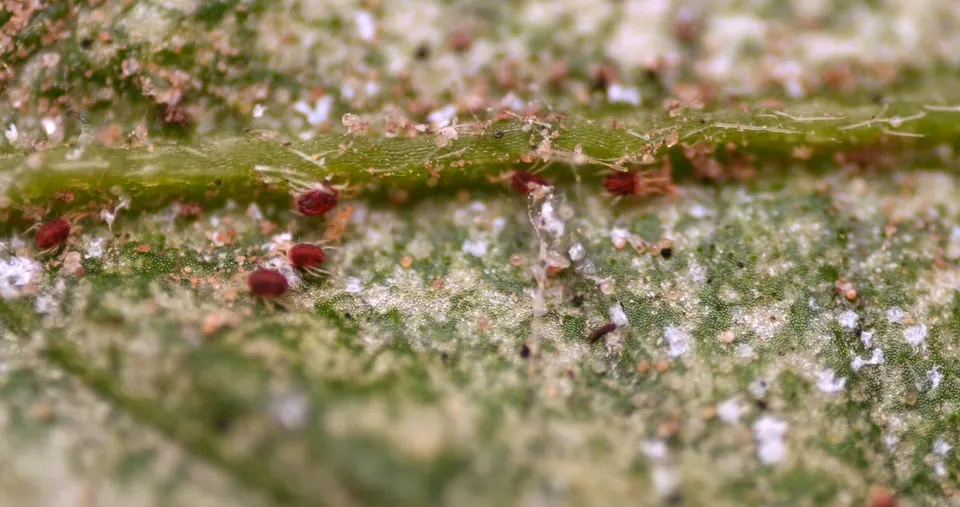
Some populations of the plant-feeding mite Tetranychus kanzawai can live on tea plants. A research team reports in eLife that a gene the mites picked up from fungi is central to that ability. The gene, DOG15, carries the instructions for an enzyme known as an intradiol ring-cleavage dioxygenase. The enzyme splits apart green tea catechins, the compounds tea plants rely on to fend off attackers.
To understand the adaptation, the researchers compared these mites with Tetranychus urticae, a related generalist that has not been reported as a tea pest. Catechins repelled and poisoned both T. urticae and T. kanzawai mites that were not adapted to tea. In the non-adapted T. kanzawai, the compounds also discouraged feeding.
Eating tea strongly switched on DOG15 in tea-adapted T. kanzawai. Its mRNA, the working copy of the gene, and its protein reached levels up to 31.6 and 12.1 times higher than in T. urticae mites fed on tea. The team also found two amino acid differences between the two species' versions of the enzyme, and these differences raised the T. kanzawai enzyme's catechin-cleaving activity. According to the authors, the changes prepared T. kanzawai, but not T. urticae, for life on tea.
Horizontal gene transfer is the movement of genes between organisms by routes other than inheritance from parents. The researchers say their findings show how a gene acquired this way can be repurposed, through changes to both the enzyme's structure and the way the gene is switched on, so that an animal can overcome a plant's chemical defenses.
Why it matters
The study shows how a gene borrowed from fungi can be reworked, through changes to its structure and to how it is switched on, so that an herbivore can get past a plant's chemical defenses.
Terms in this story
- Horizontal gene transfer
- The passing of genes between organisms, sometimes from very different groups, other than from parent to offspring.
- Catechins
- Defensive chemical compounds found in green tea plants.
- Dioxygenase
- An enzyme that adds both atoms of an oxygen molecule to the compound it acts on; DOG15 is an intradiol ring-cleavage type, which uses this reaction to cut open an aromatic ring, here in catechins.
Sources and verification
DexScience articles are produced with AI assistance and an automated fact-check against the linked sources. Spotted an error? Tell us and we will correct it openly.