Key points
- SppA sits at septal pores in *Aspergillus fumigatus* and is needed for proper cross-wall structure, the team reports.
- SppA abundance was about 67-fold lower without the transcription factor ZfpA during caspofungin treatment.
- Mutants lacking SppA showed weakened virulence in zebrafish, an effect absent in neutrophil-deficient fish.
- Only triazoles are approved as primary therapy for invasive aspergillosis; echinocandins are salvage therapy.
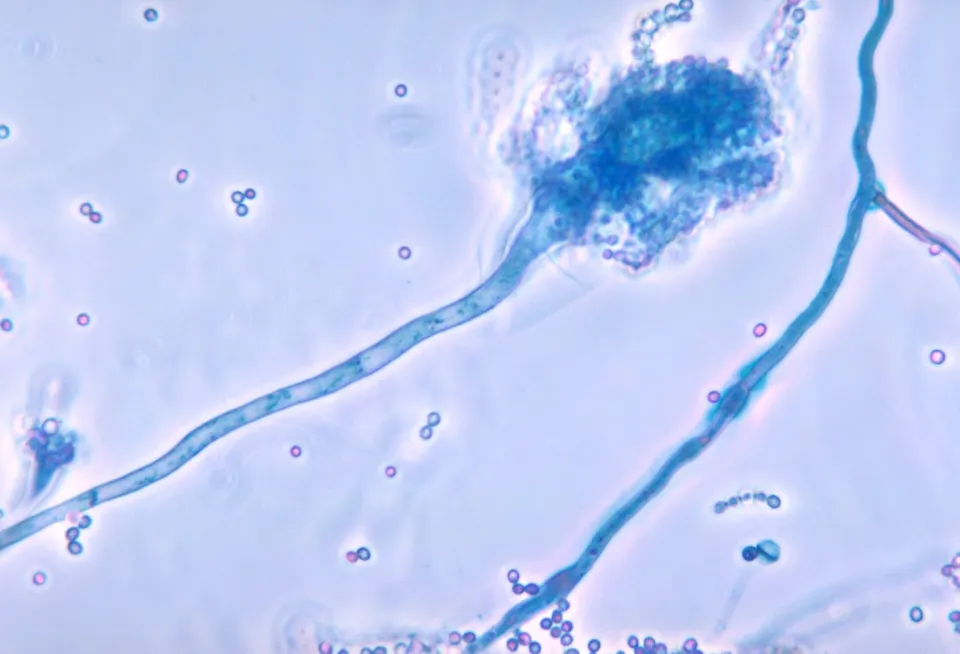
A mold that kills by invading the lungs of people with weakened immune systems depends on a single protein to seal off damaged parts of itself, researchers report in PLOS Pathogens. The protein, named SppA, sits at the pores that connect compartments inside the branching filaments, or hyphae, of Aspergillus fumigatus. When the team deleted the gene for it, the fungus formed disorganized cross-walls, took more hyphal damage, and became markedly easier for immune cells to kill.
A. fumigatus is a common environmental mold and the usual cause of invasive aspergillosis, which the authors note is estimated to claim more than one million lives each year. Only one drug class, the triazoles, is approved as primary therapy; echinocandins such as caspofungin, which block the cell wall enzyme FksA, are reserved for salvage use when azoles fail. Part of the fungus's resilience comes from plugging its septal pores when a growing tip bursts, limiting the loss of cytoplasm so a new growth axis can start.
Dante G. Calise and colleagues found SppA by screening proteins switched on by the transcription factor ZfpA during caspofungin treatment. SppA was the most strongly induced candidate, and its abundance was about 67-fold lower in fungus lacking ZfpA than in the wild type under the drug. Mutants missing SppA were more sensitive to cell wall-targeting antifungals and to other stresses.
In a zebrafish model of invasive aspergillosis, losing SppA significantly weakened the fungus, an effect that disappeared in zebrafish lacking neutrophils, the white blood cells that help control fungal infection. The mutant was also killed more readily by primary human neutrophils in the lab. The authors suggest septal pore regulation could be a target for future antifungal strategies.
Why it matters
With few antifungal drugs available and azole resistance rising, the authors argue that the machinery a mold uses to seal off its damaged compartments is a possible new target for treating invasive aspergillosis.
What we don't know yet
The work was done in fungal cultures, zebrafish and human cells in the lab, not in patients, and the paper is posted as an uncorrected proof. Senior author Nancy P. Keller is a cofounder of Terra Bioforge.
Terms in this story
- Hypha
- One of the thread-like filaments that make up the growing body of a mold, divided into compartments by cross-walls called septa.
- Echinocandin
- A class of antifungal drugs, including caspofungin and micafungin, that block an enzyme the fungus needs to build its cell wall.
- Neutrophil
- A type of white blood cell that is among the body's first responders to infection, including by fungi.
Sources and verification
DexScience articles are produced with AI assistance and an automated fact-check against the linked sources. Spotted an error? Tell us and we will correct it openly.