Key points
- Researchers mapped 22,000 kilometers (13,670 miles) of unusually straight crater edges across Pluto's surface.
- Crater rims can follow older, hidden cracks, so straight edges help reveal buried geologic features.
- Straight-edged craters around Sputnik Planitia suggest the basin may have started filling with nitrogen ice early in Pluto's history.
- The study appears in the journal JGR Planets and was highlighted by the American Geophysical Union.
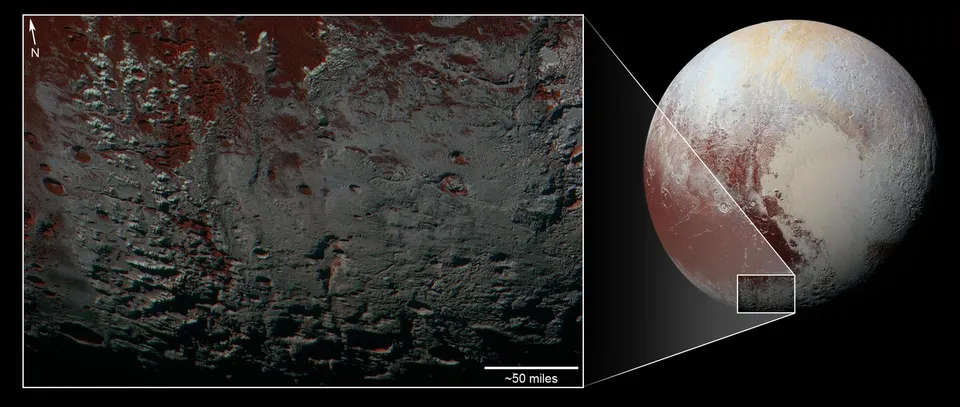
Pluto's craters may preserve a record of cracks that can't be seen directly. Researchers traced 22,000 kilometers (13,670 miles) of crater rims that run in unusually straight lines across the dwarf planet. From them, they pieced together geologic events that had been hidden in its icy crust. The work is published in the journal JGR Planets and was highlighted by the American Geophysical Union.
The method depends on how a new impact meets old damage. When an asteroid strikes, the rim of the crater it leaves can bend to follow fractures already in the ground, such as cracks left when mountains formed. So a straight stretch of rim can mark a concealed crack running underneath.
One example comes from the craters ringing Sputnik Planitia, a heart-shaped depression filled with nitrogen ice. The researchers say the straight-edged craters around it suggest that the basin may have started collecting nitrogen ice early in Pluto's history. The ice may have been supplied by ice volcanoes, which erupt icy material instead of molten rock.
In this scenario, the growing load of ice pressed down on the middle of the basin. Pluto's surface bent to carry the extra weight, and the ground around the basin cracked. Those cracks later shaped the outlines of craters that formed on top of them.
Why it matters
Straight crater edges give researchers a way to detect buried fractures and reconstruct events in Pluto's geologic past that would otherwise stay hidden.
What we don't know yet
The researchers present the early filling of Sputnik Planitia and the role of ice volcanoes as possibilities suggested by the crater evidence. They have not established them as fact.
Terms in this story
- Sputnik Planitia
- A large, heart-shaped depression on Pluto's surface that is filled with frozen nitrogen.
- Ice volcano
- A volcano that erupts icy material instead of molten rock.
Sources and verification
DexScience articles are produced with AI assistance and an automated fact-check against the linked sources. Spotted an error? Tell us and we will correct it openly.