Key points
- Europa's sodium cloud has stayed remarkably stable across more than two decades of Keck Observatory observations.
- The cloud extends as far as 30 times Europa's radius and is elongated east to west.
- Researchers say the steady sodium levels indicate a source in Europa's saltwater rather than Io's volcanoes.
- The team is using the Hubble Space Telescope in November to search Europa's atmosphere for magnesium.
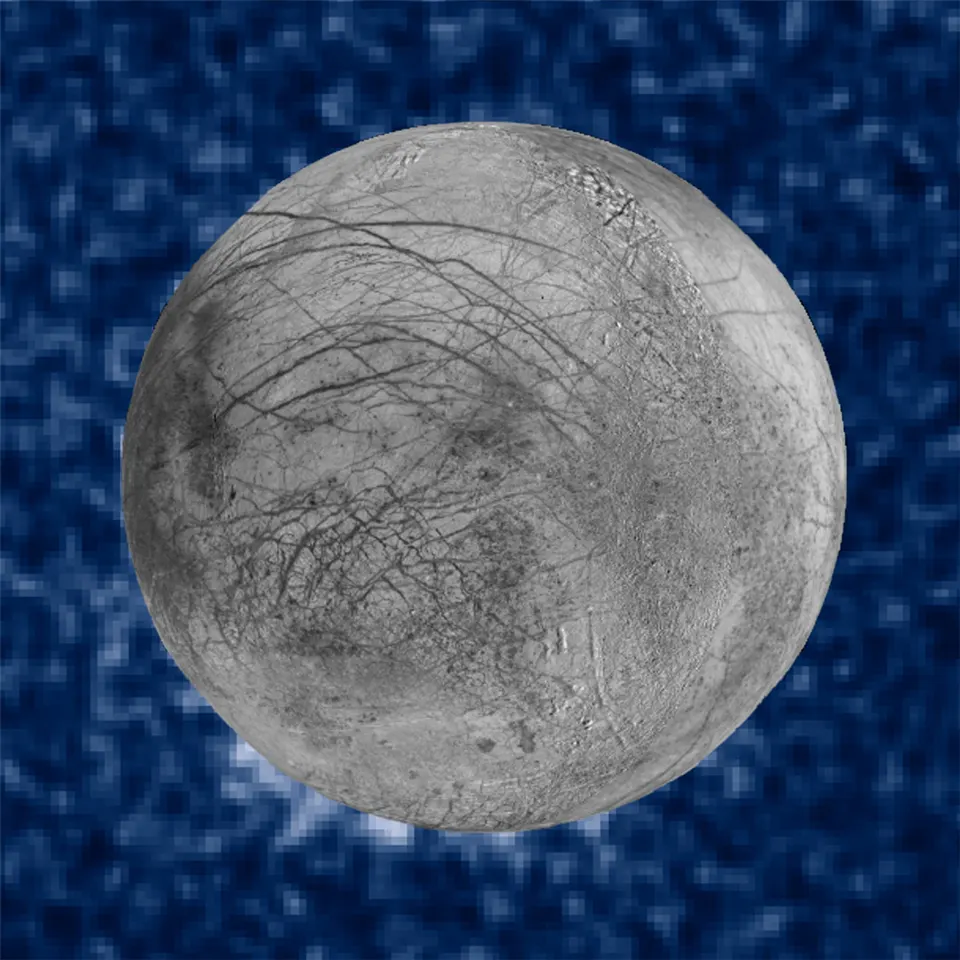
A huge, thin cloud of sodium surrounding Jupiter's moon Europa has stayed strikingly steady across more than two decades of observations from W. M. Keck Observatory in Hawaiʻi. The study was led by Boston University and published in the Journal of Geophysical Research: Space Physics. Because the cloud does not seem to respond to the volcanic activity of a neighboring moon, Io, the researchers argue the sodium comes from Europa's own salty water.
Europa is believed to hide a global ocean beneath its icy crust, which makes it a prime place to study environments that might be habitable. Sodium draws special interest because it is one of the two ingredients of sodium chloride, ordinary table salt. Working out where the sodium around Europa comes from can help scientists learn which materials from the surface, and possibly from the ocean underneath, escape into the space around the moon.
The cloud reaches out as far as 30 times Europa's radius and is stretched in the east-west direction. Its steadiness came as a surprise, the team says, because the plasma, or electrically charged gas, around Jupiter keeps changing, and because Io releases sodium into the surrounding space. Co-author Carl Schmidt, a researcher at Queen's University Belfast and Boston University, says scientists have often wondered whether Io coats Europa's surface. In his view, the stable sodium levels in the Keck data show that Europa is unaffected by Io's eruptions and that the observed sodium originates in Europa's saltwater.
To make the measurements, the team relied on Keck's High Resolution Echelle Spectrometer (HIRES). A spectrograph splits light into its component colors, letting astronomers pick out the telltale signature of a particular element; this one also keeps track of where in the sky that light came from. By turning the instrument to different orientations at several positions, the researchers could map the cloud instead of sampling a single spot. Folding in archived Keck data going back to 1999 gave them a long record of how the cloud behaves over time.
Seeing sodium right next to Europa is hard, because the moon's bright ice can drown out the weak glow of the gas. The team got around this by observing Europa while it sat in Jupiter's shadow. With no sunlight bouncing off the ice, they could detect sodium close to the moon, glowing as electrons in the surrounding environment energized the atoms. According to Keck, the work is the first to link sodium measurements high above Europa with observations very near its visible disk.
One especially useful session came on September 29, 2022, when the team watched Europa as NASA's Juno spacecraft passed behind the moon as seen from Earth. That let them compare the neutral sodium with measurements of the plasma around it. Together, the observations allowed the researchers to test expectations about the roles of Jupiter's magnetosphere and Io's volcanism.
The sodium cloud is not a direct measurement of the hidden ocean, the team notes, but knowing its origin helps build a fuller picture of Europa's chemistry. Lead author Emma Lovett, a graduate student at Boston University, says the results help refine models of what releases sodium and how radiation pressure shapes its spread. The team is now using the Hubble Space Telescope in November to look for magnesium, which has been tentatively spotted on Europa's surface but not yet in its atmosphere. Finding it, Lovett says, could offer another clue to the salts on this ocean world.
Why it matters
Europa is a major target in the search for potentially habitable environments, and tracing its sodium helps scientists understand how material may move between the moon's interior and its surroundings.
What we don't know yet
The sodium cloud does not directly measure Europa's hidden ocean. The team's next step is a search for magnesium in the atmosphere using the Hubble Space Telescope.
Terms in this story
- Spectrograph
- An instrument that spreads light into its component colors so astronomers can identify the chemical elements emitting it.
- Plasma
- A gas of electrically charged particles, like the one that fills the space around Jupiter.
- Magnetosphere
- The region around a planet that its magnetic field controls.
Sources and verification
DexScience articles are produced with AI assistance and an automated fact-check against the linked sources. Spotted an error? Tell us and we will correct it openly.