Key points
- NASA, DOE and industry experts held a major SR-1 Freedom design review at Glenn Research Center in October.
- SR-1 Freedom is targeted to launch in late 2028 and deliver the SkyFall capsule, carrying three helicopters, to Mars.
- Design changes include a shorter reactor boom, improvements in shielding and spacecraft design, and larger X-band antenna dishes.
- NASA awarded a $39.3 million contract to Johns Hopkins APL for the reactor's heat rejection system.
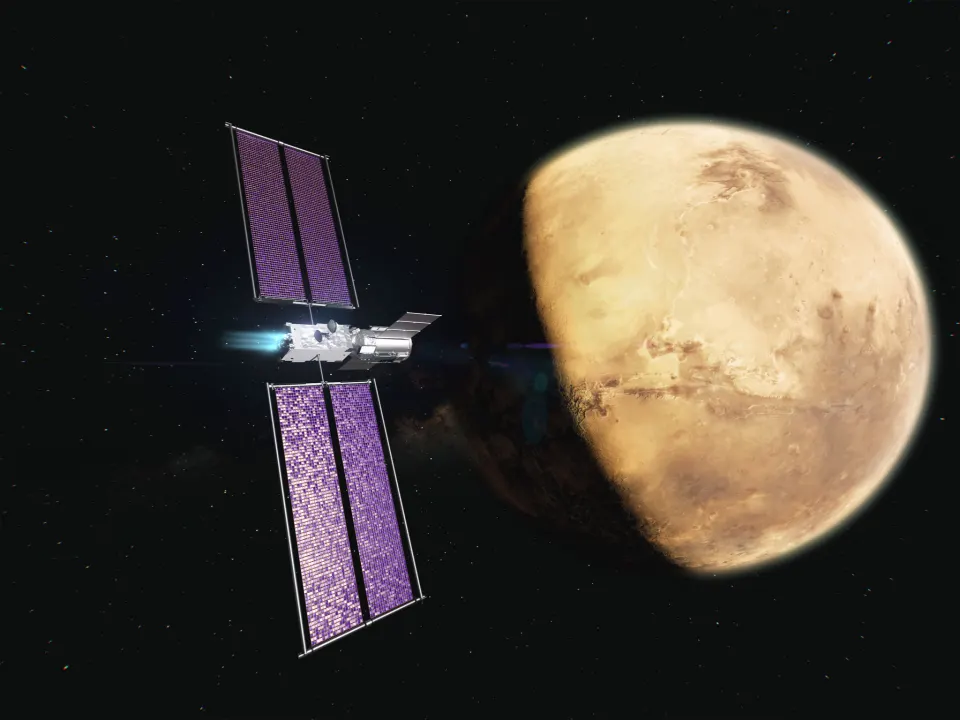
NASA has locked in several major features of Space Reactor-1 (SR-1) Freedom, a spacecraft the agency says will be the first to demonstrate nuclear electric propulsion in deep space. Specialists from NASA, the U.S. Department of Energy (DOE) and industry made the decisions at an October design review at NASA's Glenn Research Center in Cleveland. According to the agency, the review moves the mission past the early-concept stage and toward a defined design, with launch targeted for late 2028.
In nuclear electric propulsion, a fission reactor produces electricity that drives the spacecraft's thrusters. SR-1 Freedom will draw on both nuclear and solar power to bring SkyFall to Mars. SkyFall is a capsule holding three next-generation helicopters, which will investigate Martian geology and climate history and search for signs of ice below the surface.
One significant change is a shorter boom, the arm that holds the reactor away from the main body of the craft, called the Power and Propulsion Element. NASA says the shorter boom saves weight and makes assembly simpler. Improvements in shielding and spacecraft design will let the reactor sit closer to the rest of the spacecraft while still protecting its electronics and SkyFall from radiation. Larger X-band antenna dishes will send data home. NASA also gave Johns Hopkins University's Applied Physics Laboratory a $39.3 million contract to build the system that sheds the reactor's excess heat.
Under the planned flight profile, the reactor will power up only after the craft leaves Earth orbit. It will run for an initial period, then shut down, and solar arrays will take over for the cruise to Mars. Once SkyFall reaches Martian orbit, the reactor will restart to collect more performance data.
Why it matters
NASA says future missions will need far more power than current systems provide, especially where sunlight is scarce. SR-1 Freedom is meant to show how fission power could support long missions and future surface power, including for a Moon Base.
What we don't know yet
Several design features are still under evaluation, including the number of radiator panels, the nuclear power module's output power and how long the reactor will run. The 2028 launch is a target, not a fixed date.
Terms in this story
- Nuclear electric propulsion
- A way of moving a spacecraft in which a nuclear reactor generates electricity to power its thrusters.
- Fission
- The splitting of heavy atomic nuclei, which releases energy as heat.
- X-band
- A range of radio frequencies commonly used to send data between deep-space spacecraft and Earth.
Sources and verification
DexScience articles are produced with AI assistance and an automated fact-check against the linked sources. Spotted an error? Tell us and we will correct it openly.