Key points
- On 21 November, BepiColombo's orbit insertion burn ended early and the spacecraft entered safe mode, according to ESA.
- The burn achieved around 77% of the planned velocity change, but it was enough to secure orbit around Mercury.
- Engineers traced the fault to a software issue involving attitude guidance and thruster control.
- The two science orbiters are still set to separate on 9 December, and science operations are planned for April 2027.
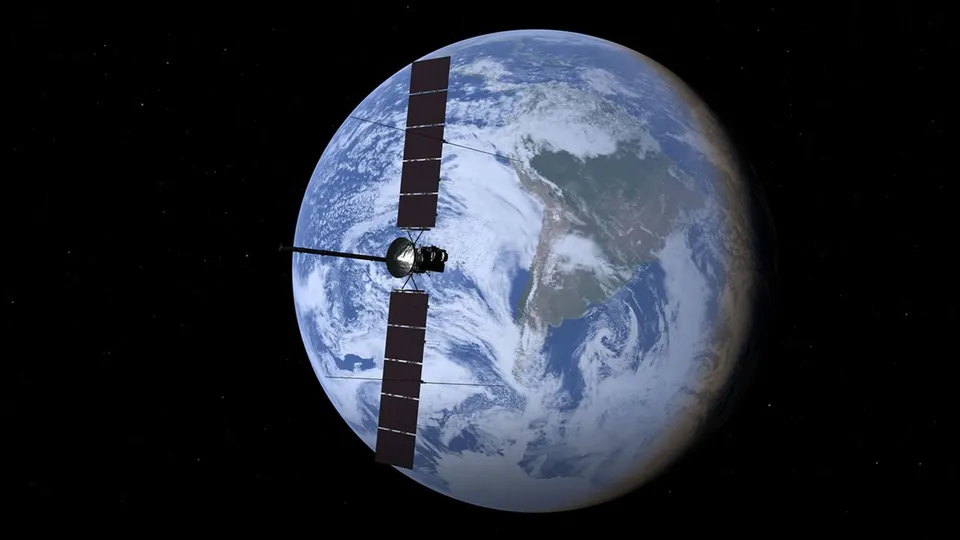
BepiColombo is in a stable orbit around Mercury, according to the European Space Agency (ESA). The engine burn meant to secure that orbit stopped early on 21 November and sent the spacecraft into safe mode. Even so, the burn delivered around 77% of the planned change in speed, and that was enough for Mercury to keep hold of the probe. ESA says the joint mission with the Japan Aerospace Exploration Agency (JAXA) is still on track to release its two science orbiters in December.
The maneuver started at 18:24 UTC. The Mercury Planetary Orbiter (MPO) fired its four axial thrusters while passing 635 km above Mercury's surface, in a burn planned to last 37 minutes. Controllers had uploaded the commands ahead of time. Turning the spacecraft into position for the burn caused a planned break in contact with Earth.
The signal returned through ESA's Estrack New Norcia deep-space antenna. Telemetry then showed the team at the European Space Operations Centre (ESOC) in Darmstadt, Germany, that the spacecraft had stopped the burn on its own. It had also switched into safe mode, a protective state that halts all nonessential activity when the spacecraft meets unexpected conditions. Ignacio Tanco, ESA's BepiColombo Flight Operations Director, says the whole team immediately turned its attention to working out what had gone wrong.
Knowing the spacecraft was alive did not tell controllers which orbit it was in. Around 01:00 local time, after detailed analysis, the Flight Dynamics team confirmed that Mercury had captured the spacecraft. ESOC staff and Airbus, the lead spacecraft manufacturer, are still investigating. They have traced the problem to software that handles attitude guidance, meaning how the spacecraft points itself, and thruster control.
BepiColombo spent eight years getting to Mercury, and much of that trip was about slowing down. Solar electric propulsion and nine planetary flybys reduced its speed relative to Mercury enough for a weak gravity capture. Frank Budnik, ESA's BepiColombo Flight Dynamics Manager, explains that this kind of capture lasts for only several orbits. The insertion burns are what turn it into a lasting orbit. ESA says this is the first time weak stability capture has been used to enter orbit around another planet. Before now, only some spacecraft headed to Earth's moon had used the technique.
Orbit insertion is a whole series of burns, not a single one. Each burn works best when the spacecraft is closest to Mercury. One hours-long firing would carry it far past that point and waste propellant through what engineers call gravity losses. After each burn, the flight dynamics team measures the resulting orbit and designs the next maneuver to match. ESA says that built-in flexibility paid off. The spacecraft is now in a 75-hour orbit instead of the planned 58-hour one. The remaining burns have already been adjusted, and no additional burns are needed.
Next, the MPO and JAXA's Mercury Magnetospheric Orbiter, called Mio, are set to separate on 9 December (10 December in Japan). Mio's sunshield, MOSIF, will stay attached to the MPO until it is ejected on 16 December. More burns should bring the MPO to its final orbit by March 2027, with science operations starting in April 2027. Geraint Jones, ESA's BepiColombo Lead Project Scientist, says the nearly 600-member science team is eager to learn about Mercury's interior, its surface and the space around the planet.
Why it matters
Without the insertion burns, BepiColombo would have stayed captured by Mercury only temporarily. ESA says the new orbit does not affect the planned separation of Mio or the MPO's ability to reach its planned science orbit.
What we don't know yet
ESA and Airbus are still investigating the anomaly. The spacecraft is in a 75-hour orbit rather than the planned 58-hour orbit, and more burns are needed to reach the final science orbit by March 2027.
Terms in this story
- Safe mode
- A protective state in which a spacecraft stops all nonessential activity after it meets unexpected conditions.
- Weak stability capture
- A way of arriving at a planet slowly enough that its gravity holds the spacecraft for a while before any big braking burn.
- Gravity loss
- Efficiency lost because an engine burn takes time while gravity is acting. The loss grows when thrust is applied away from the best point, here the closest approach to Mercury, so long burns use more propellant than several short ones.
Sources and verification
DexScience articles are produced with AI assistance and an automated fact-check against the linked sources. Spotted an error? Tell us and we will correct it openly.