Key points
- On Google's Willow processor, qubits won the magic square game 98.30% of the time, against a classical maximum of 88.89%.
- A contextuality score, χ, came out at 5.590 ± 0.008, above the classical bound of 4 and below the quantum limit of 6.
- In a multiplayer parity game with up to 71 players, the qubits stayed above the classical bound.
- Google says the tasks exposed subtle coherent errors that random-circuit benchmarks tend to miss.
Google researchers report that their superconducting quantum processors display quantum contextuality: some measurement results do not exist in advance and depend on which other compatible measurements are made alongside them. The company says the effect let its qubits outperform classical strategies in tasks spanning up to 105 qubits. It described the work in a blog post. The study itself is published in Science.
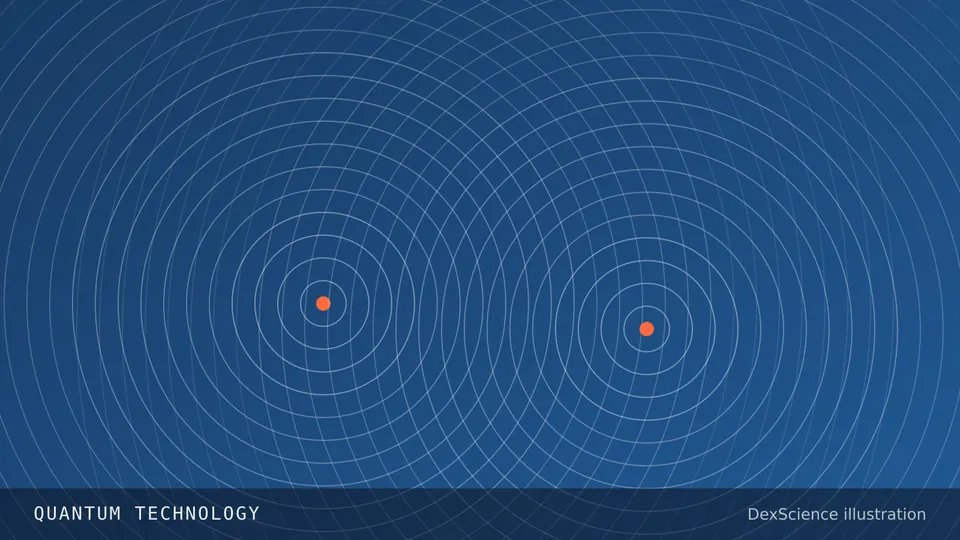
The main test was the magic square game. Two players, Alice and Bob, each fill in part of a 3×3 grid with +1s and −1s. Alice gets a row, which must multiply to +1. Bob gets a column, which must multiply to −1. They score a win only when both write down the same value in the cell their row and column share. No grid can satisfy both rules, so a strategy agreed in advance wins at most 88.89% of the time. On Google's Willow processor, the two players shared two entangled Bell pairs instead. Across all nine variants of the game, each played 100,000 times, they won 98.30% of rounds (0.9830 ± 0.0001).
The team also gave contextuality a number. In a test where any classical scheme scores at most 4 and quantum mechanics allows up to 6, the processor reached 5.590 ± 0.008. In a parity game for up to 71 players, the qubits stayed above the classical limit. They also solved a shallow-circuit problem laid out on qubit grids as large as 105, succeeding more often than not.
Google says a growing body of theory suggests contextuality, more than entanglement, may be what lets some quantum algorithms outperform classical ones. The company adds that these tasks turned up subtle errors that standard random-circuit tests tend to average away, so they could also serve as a hardware benchmark.
Why it matters
According to Google, contextuality had mostly been shown in systems of just a few particles. Showing that it persists across many qubits bears on what actually gives quantum computers their edge.
What we don't know yet
This account comes from the company's own blog post. Google notes that noise grows with every qubit added, so its lead over classical strategies shrinks as the multiplayer game gets larger.
Terms in this story
- Quantum contextuality
- The property that a quantum measurement's outcome can depend on which other compatible measurements are made with it, so values cannot all be fixed in advance.
- Bell pair
- Two qubits that are entangled, so measurements on them are correlated more strongly than any classical arrangement allows.
- Qubit
- The basic unit of information in a quantum computer, which can exist in a combination of 0 and 1.
Sources and verification
DexScience articles are produced with AI assistance and an automated fact-check against the linked sources. Spotted an error? Tell us and we will correct it openly.