Key points
- Each qubit's value is set by which of two neighboring wells holds a single rubidium atom.
- The atom's spin acts as an extra control, letting researchers choose which atoms tunnel between wells.
- The team built an entangled cluster state of up to 123 atoms.
- An outside expert says the state's fidelity is not yet great and still needs improvement.
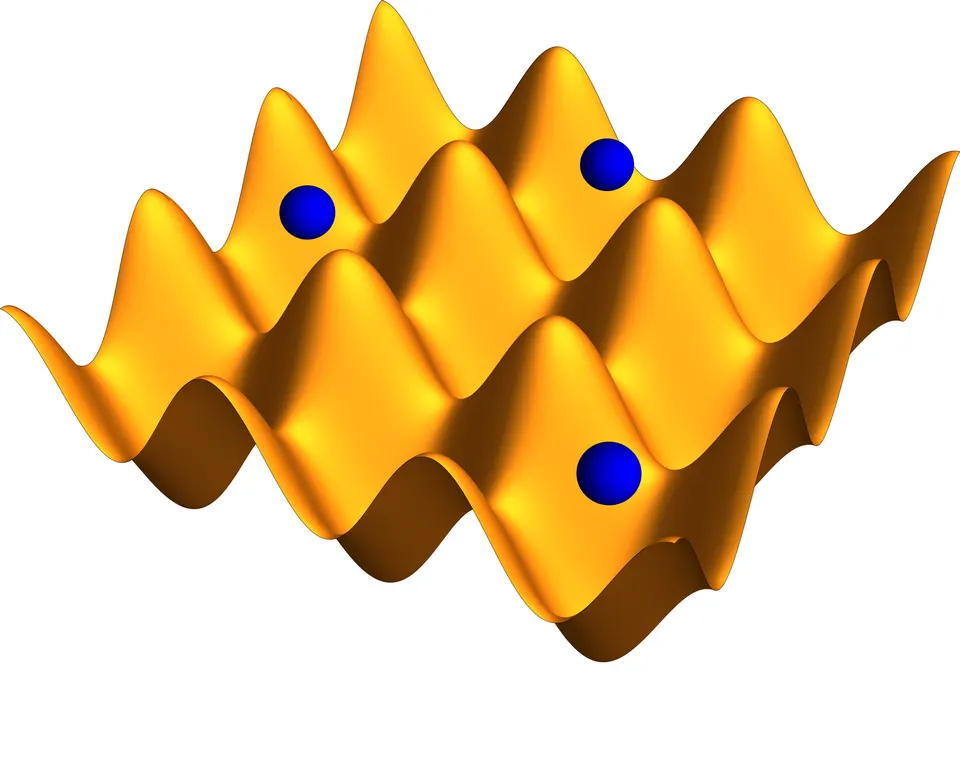
Physicists led by Jian-Wei Pan at the University of Science and Technology of China have carried out simple quantum computations with ultracold rubidium atoms held in an optical lattice, a grid of trapping sites made from laser light. According to a Focus article in the American Physical Society's magazine Physics, the twist is that each quantum bit, or qubit, records its value in where its atom sits, not in the atom's spin.
Every site in the lattice has two wells. An atom in the left well stands for 0, one in the right stands for 1, and an atom can also occupy both at once in a quantum superposition. The spin becomes a control knob. A magnetic-field gradient acts differently on the two spin states, so by tuning it the team can select which atoms undergo resonant tunneling, hopping between wells of equal depth. This tackles a known problem with densely packed lattices: a laser aimed at one atom or small group tends to disturb the neighbors.
With this scheme, the researchers entangled adjacent rows and assembled a linked cluster of up to 123 atoms. Such a cluster is the starting point for measurement-based quantum computing, where a calculation proceeds by measuring individual qubits one by one. The team ran versions of several one- and two-qubit operations and read out results with a quantum gas microscope.
Immanuel Bloch of the Max-Planck Institute of Quantum Optics described the work as a new approach to quantum computing. He also cautioned that the cluster's fidelity is not yet great and said improving it is the next task. Konrad Viebahn of ETH Zurich called it a milestone for lattice-based quantum computing.
Why it matters
Neutral atoms can be packed densely in optical lattices, and the article says this proof-of-principle approach could lead to a scalable architecture for quantum information processing.
What we don't know yet
This is a proof-of-principle experiment. According to Immanuel Bloch, the created cluster state's fidelity, meaning how closely it matches the ideal target state, is not yet great and must be improved.
Terms in this story
- Optical lattice
- A regular array of trapping sites created where intersecting laser beams interfere, used to hold individual atoms in place.
- Cluster state
- A group of qubits linked by quantum entanglement that serves as the resource for measurement-based quantum computing.
- Resonant tunneling
- A quantum effect in which a particle passes between two wells of equal depth and can end up in both at once.
Sources and verification
DexScience articles are produced with AI assistance and an automated fact-check against the linked sources. Spotted an error? Tell us and we will correct it openly.