Key points
- The study looks at Rydberg atoms held in arrays of optical tweezers, a platform used for quantum simulation.
- As spin-phonon coupling grows, excitation spreading shifts from ballistic to Bloch-like oscillations, then to Anderson-like localization.
- The researchers attribute these effects to quantum fluctuations in the phonon field, the quantized vibrations of the atoms.
- The coupling also leaves the atoms' positions in squeezed, highly correlated, non-classical motional states.
In arrays of atoms trapped by laser beams, an excitation can hop from atom to atom. Researchers now report that the tiny quantum jitter in the atoms' own motion can stop that spread. The work appears in a peer-reviewed journal from IOP Publishing, and it shows that the atoms' own motion can strongly shape how excitations move in these quantum simulators.
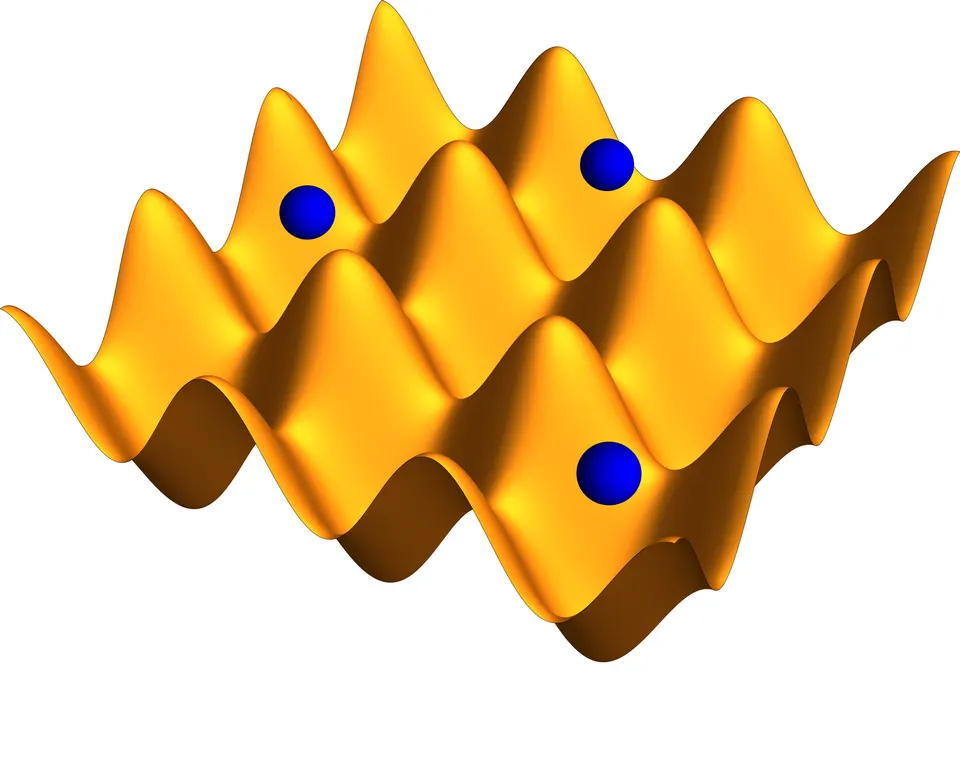
The study looks at Rydberg atoms, which are atoms with one electron pushed into a very high-energy orbit. That makes them strongly interacting, and they sit in optical tweezers, which are tightly focused laser traps. Dipole interactions between the atoms help excitations spread. But the same interactions tie each atom's internal state, described as a spin, to its motion. In quantum terms, that motion comes in quantized vibrations called phonons.
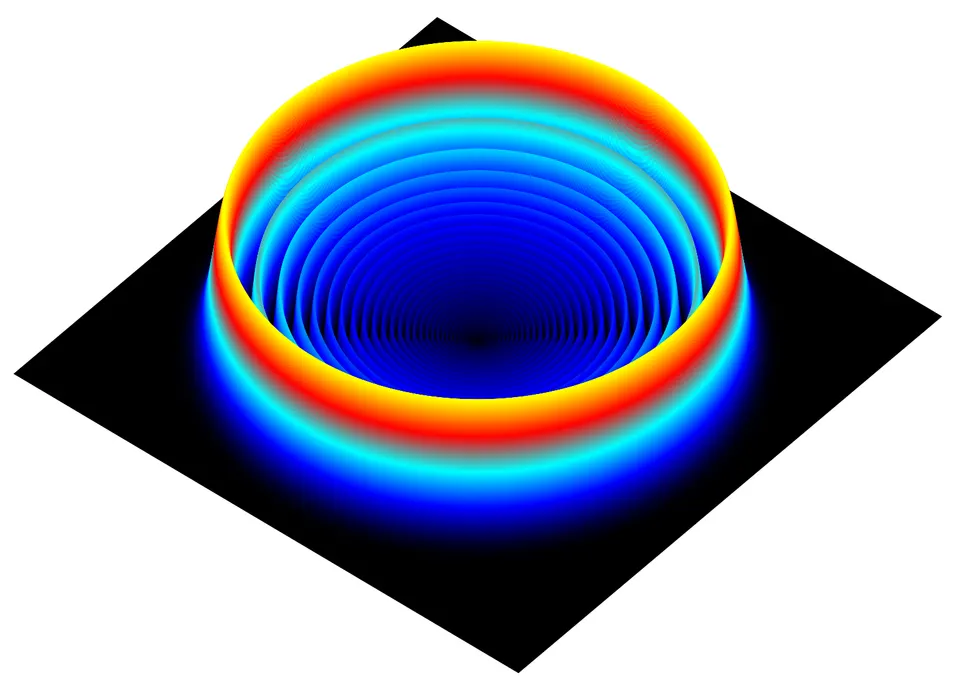
The authors find that as this spin-phonon link grows stronger, a growing cluster of excited atoms behaves differently. At first it expands steadily. Next it swings back and forth in Bloch-like oscillations. Finally it stalls in Anderson-like localization. They explain this by recasting the cluster as a single particle on a lattice. The average phonon effect tilts the lattice, which produces the oscillations. Quantum fluctuations in the phonons add a random local landscape that pins the particle in place.
The coupling also squeezes the atoms' positions into correlated, non-classical states. Depending on the shape of the dipolar interaction, the atoms' oscillations become correlated, either in step or out of step.
Why it matters
Atom-tweezer arrays of Rydberg atoms serve as quantum simulators. This work shows that quantum fluctuations in the atoms' motion can reshape how excitations spread across them, even causing that spread to localize.
What we don't know yet
The source describes a mapping of the cluster dynamics onto a single-particle lattice model and does not mention experimental tests of the predicted localization or squeezing.
Terms in this story
- Rydberg atom
- An atom with one electron excited to a very high energy level, which makes it interact strongly with nearby atoms.
- Phonon
- A quantized unit of vibrational motion, here the jiggling of trapped atoms.
- Anderson localization
- An effect in which random disorder stops a wave or particle from spreading, trapping it in one region.
Sources and verification
DexScience articles are produced with AI assistance and an automated fact-check against the linked sources. Spotted an error? Tell us and we will correct it openly.