Key points
- Researchers introduced directional codes, a qLDPC code family compatible with square-grid and, in some cases, hexagonal-grid hardware.
- The codes use the iSWAP gate to measure long-range stabilizers through local interactions only, with no added connectivity.
- At a physical error rate of p = 10^-3, the best family matched the rotated toric code's logical error rate.
- That family needed only a quarter to a third of the physical qubits to encode a given number of logical qubits.
Researchers have designed a family of quantum error-correcting codes, called directional codes, meant to suit the flat, grid-like layouts typical of superconducting quantum chips. In simulations at a physical error rate of p = 10^-3, the best version matched the logical error rate of a widely studied code, the rotated toric code, while needing only a quarter to a third as many physical qubits to hold the same number of logical qubits. The work appears in Nature Communications as an accepted paper released ahead of its final version.
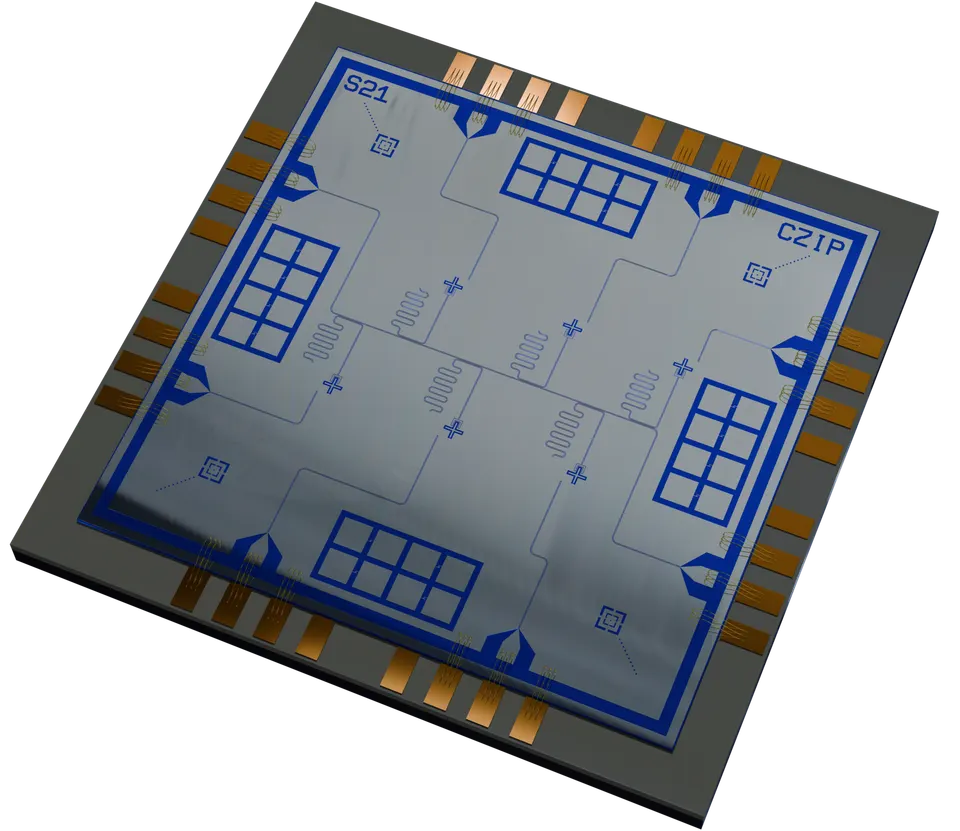
Quantum bits are easily disturbed by noise. Error correction spreads one protected logical qubit across many physical qubits. A promising class of schemes, quantum low-density parity-check (qLDPC) codes, often relies on checks that link distant qubits. Superconducting chips usually connect each qubit only to its nearest neighbors on a two-dimensional surface, and that limits which of these codes can run efficiently.
The team's workaround relies on the iSWAP gate, a two-qubit operation. Using it, they measure long-range stabilizers, the repeated parity checks that reveal errors, through purely local interactions and without adding any connections. The codes are compatible with square grids and, in some cases, with hexagonal grids.
To evaluate the idea, the researchers used a circuit-level noise model inspired by superconducting hardware, rather than a physical device. They compared directional codes with the rotated toric code and with bivariate bicycle codes.
Why it matters
Large, useful quantum computers will need error correction. Codes that protect information with fewer physical qubits on hardware with only local connections could make that more practical on superconducting platforms.
What we don't know yet
The results come from simulations using a noise model inspired by superconducting hardware, not from experiments on a real device. The published version is an early release that may still be edited before the final Version of Record.
Terms in this story
- logical qubit
- A protected unit of quantum information stored across many physical qubits so that errors can be detected and corrected.
- qLDPC code
- A quantum low-density parity-check code, a type of error-correcting scheme in which each check involves only a few qubits.
- stabilizer
- A repeated measurement that checks a group of qubits for signs of error without destroying the stored information.
Sources and verification
DexScience articles are produced with AI assistance and an automated fact-check against the linked sources. Spotted an error? Tell us and we will correct it openly.