Key points
- VYD222 (pemivibart) was re-engineered from ADG20, which had lost potency against Omicron BA.2 and later variants.
- Crystal structures with prototype and BA.5 receptor-binding domains were solved at 3.00 and 2.70 angstroms.
- Neutralization of recent variants KP.3.1.1, XEC, LP.8.1 and XFG ranged from 190 to 239 ng/ml.
- Deep mutational scanning suggests escape mutations would also compromise the virus's receptor binding.
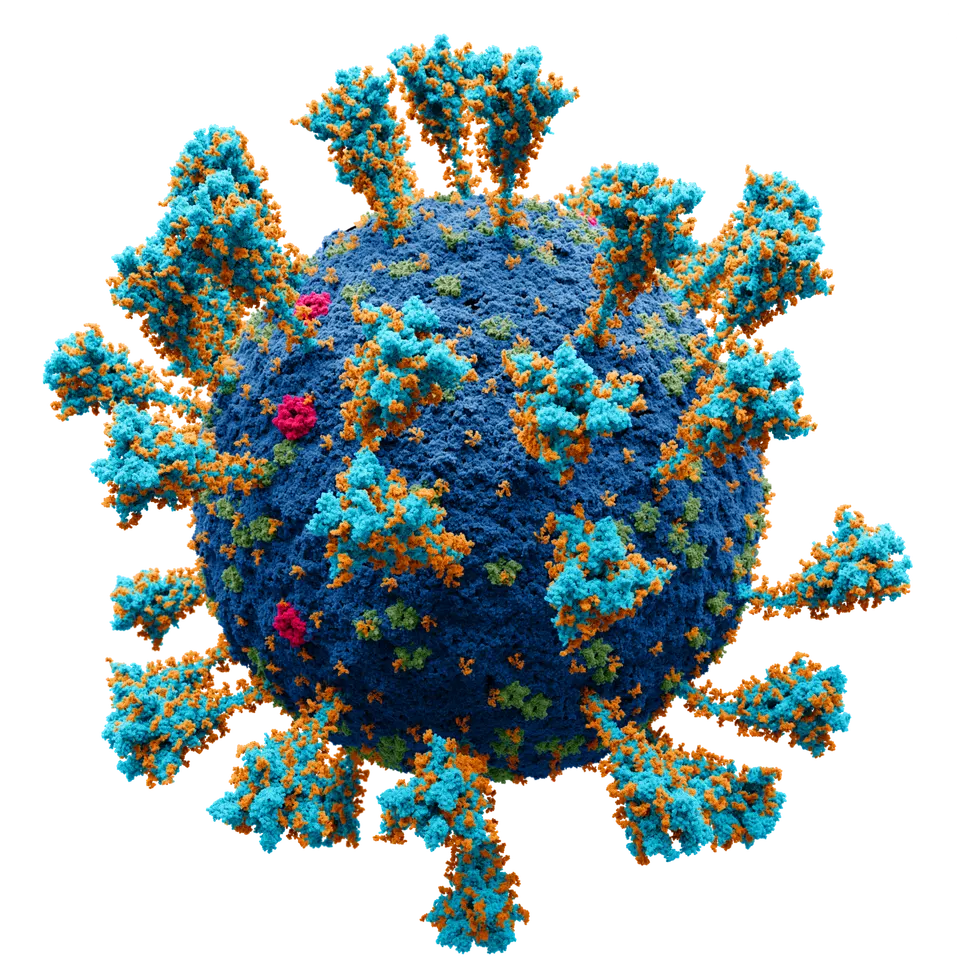
Researchers have mapped, atom by atom, why the only monoclonal antibody currently authorized against SARS-CoV-2 in the United States has held up against variants that defeated its predecessors. Writing in PLOS Pathogens, a team led by Meng Yuan and Ian A. Wilson reports X-ray crystal structures of VYD222 (pemivibart) bound to the virus's receptor-binding domain — the part of the spike protein the virus uses to latch onto human cells. VYD222 was re-engineered from an earlier antibody, ADG20 (adintrevimab), which lost potency against Omicron BA.2 and its descendants.
The structures, solved at resolutions of 3.00 and 2.70 angstroms for VYD222 with the prototype and Omicron BA.5 receptor-binding domains, show the antibody gripping a corner of that domain away from the ridge region, with an epitope that overlaps the receptor binding site at one end and extends into a conserved patch known as the CR3022 site. Curiously, many of the changes that separate ADG20 from VYD222 sit in a second shell behind the residues that actually touch the virus. In laboratory tests against pseudoviruses — harmless stand-ins carrying the spike protein — the antibody neutralized early variants at concentrations of 6.6 to 121.4 ng/ml and recent ones including KP.3.1.1, XEC, LP.8.1 and XFG at 239, 235, 190 and 209 ng/ml.
The team also ran deep mutational scanning, a method that tests large libraries of mutations at once, and found the virus's room to escape VYD222 is hemmed in: mutations that would shake off the antibody tend to also break the structure or the virus's ability to bind its receptor.
VYD222 received Emergency Use Authorization in March 2024 for preventing symptomatic COVID-19 in people aged 12 and older weighing more than 40 kg who are moderately to severely immunocompromised and unlikely to respond well to vaccination. The researchers say the findings offer guidance for assessing future variants as they emerge.
Why it matters
Most antibody drugs for COVID-19 have been rendered ineffective by viral evolution, leaving immunocompromised people with few preventive options; understanding why one antibody has endured could guide the design of future treatments for fast-changing pathogens.
What we don't know yet
The neutralization results come from laboratory pseudovirus assays, not from people infected with the newest variants; several authors were employees of Invivyd, which makes the antibody and part-funded the work, and the paper is posted as an uncorrected proof.
Terms in this story
- Monoclonal antibody
- A lab-made antibody designed to recognize one specific target, such as a protein on a virus.
- Receptor-binding domain (RBD)
- The section of the coronavirus spike protein that attaches to a receptor on human cells.
- Deep mutational scanning
- A technique that tests thousands of possible mutations at once to see which ones change a protein's behavior.
Sources and verification
DexScience articles are produced with AI assistance and an automated fact-check against the linked sources. Spotted an error? Tell us and we will correct it openly.