Key points
- Puncak Jaya's glaciers spanned roughly 4.31 square kilometers in 1988, shrinking to roughly 0.09 square kilometers by September 2025.
- At the East Northwall Firn monitoring site, ice measured 32 meters thick in 2010 and just 4 meters in 2023.
- The ice at that monitoring site was gone by November 2024.
- Recent satellite studies suggest the main ice areas could disappear around 2030, while BMKG estimates suggest it could happen much sooner.
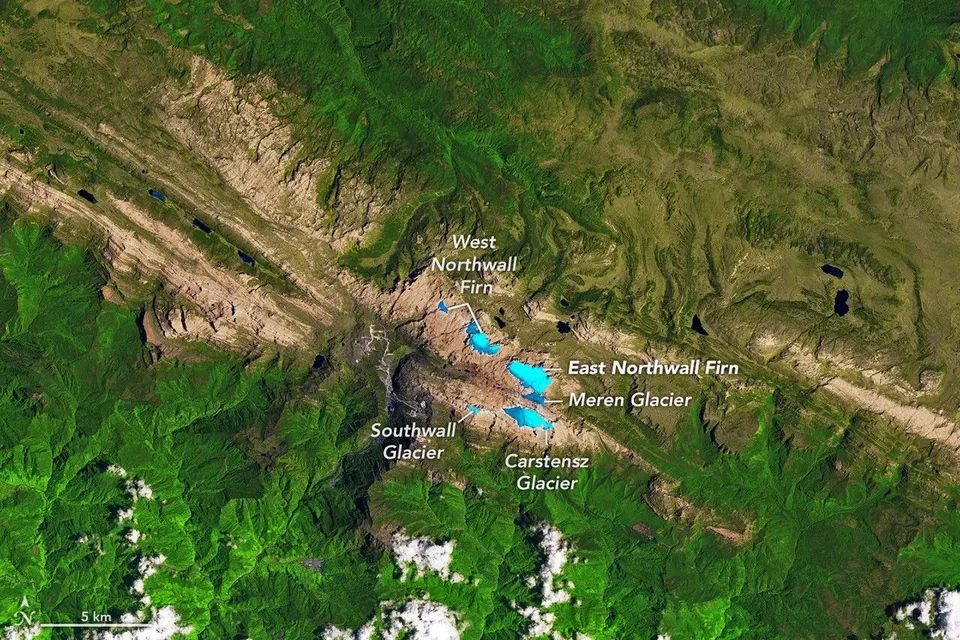
The ice near the summit of Puncak Jaya, in Indonesia's Sudirman Range on the island of New Guinea, has broken into patches too small and thin to flow, NASA Earth Observatory reports. That matters because a glacier, by the usual definition, must be thick enough to creep downhill under its own weight. According to Donaldi Permana, a climate scientist at Indonesia's Agency for Meteorology, Climatology, and Geophysics (BMKG), the remnants have effectively stopped working as active glaciers.
Landsat images from 1988 and 2026 show the change. Permana puts the 1988 glacier area at roughly 4.31 square kilometers, or 1.66 square miles. By September 2025, satellite and aerial data showed just 0.09 square kilometers, or 0.03 square miles, of ice left, roughly 2 percent of the earlier extent. At the main monitoring site, the East Northwall Firn, the ice was 32 meters, or 105 feet, thick in 2010. By 2023 only 4 meters, or 13 feet, was left, and by November 2024 it had vanished.
El Niño years have been especially damaging. Warmer air lifts the freezing level above the summit, so rain falls instead of snow, leaving darker surfaces that soak up more heat. During the 2015-2016 El Niño, the ice shed some 5.3 meters, or 17 feet, of thickness within one year, about five times its usual pace.
Recent satellite studies suggest the main ice areas could disappear around 2030. Permana noted that BMKG estimates suggest the ice could vanish well before that, with the current El Niño speeding its loss. A December aerial survey should give an estimate for 2026.
Why it matters
Scientists have called tropical glaciers like these high-altitude canaries in the coal mine, because they sit close to the warmest conditions in which ice can last year-round.
What we don't know yet
The 2026 ice extent has not yet been measured; an aerial survey planned for December should provide an estimate. Projections of when the ice will vanish differ, from around 2030 in recent satellite studies to much sooner in BMKG estimates.
Terms in this story
- Glacier
- A body of ice thick enough to flow downhill under its own weight, with an area where snow builds up faster than it melts.
- El Niño
- A recurring climate pattern of unusual warming in the tropical Pacific that shifts weather around the world.
- Firn
- Compacted snow that has survived at least one melt season and is partway to becoming glacier ice.
Sources and verification
DexScience articles are produced with AI assistance and an automated fact-check against the linked sources. Spotted an error? Tell us and we will correct it openly.