Key points
- Researchers used a 30-kilometer fiber-optic array crossing the Alpine Fault as a seismic sensor.
- They found up to six fault cores about 10 meters wide inside a 200-meter-wide low-velocity zone.
- The main fault core appears to continue for about 180 kilometers, crossing a major segment boundary.
- Large earthquakes are expected on the Alpine Fault in the coming decades.
Researchers turned a 30-kilometer fiber-optic cable crossing New Zealand's Alpine Fault into a long line of seismic sensors. The data gave them a closer look inside the fault. The team reports in Science Advances that it found up to six thin fault cores, each roughly 10 meters wide. These cores sit inside a band of slower, weakened rock about 200 meters across, which the team interprets as the fault's inner damage zone.
The technique is called distributed acoustic sensing, or DAS. It works by detecting the tiny stretching and squeezing of an optical fiber as seismic waves pass through it. The researchers used DAS to record fault-zone guided waves from local earthquakes. These are vibrations that get trapped inside a fault's softer rock and travel along it. Numerical modeling and passive seismic imaging supported their interpretation.
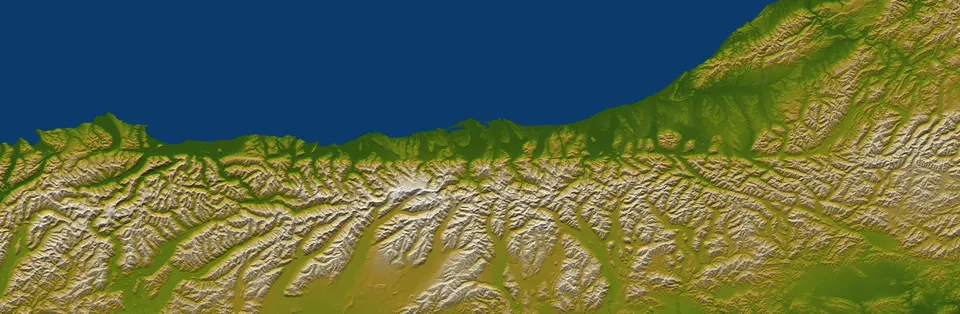
The Alpine Fault takes up much of the motion between the Australian and Pacific plates in southern New Zealand. Large earthquakes are expected from it in the coming decades. How the next rupture unfolds, and how strongly the ground shakes, is expected to depend heavily on two things: whether the fault's main slip zones are continuous and how wide the fault is. The team found that the principal core appears to persist for about 180 kilometers. It runs between the Central and South Westland segments and crosses a sharp boundary where the fault's shape and motion change.
The authors note that the width of the damage zone matches empirical scaling for faults that have moved large distances. They say DAS can resolve fault structure at scales that were previously out of reach. That helps constrain whether a future rupture could span several fault segments.
Why it matters
According to the researchers, whether the Alpine Fault's slip zones are continuous and how wide the fault is could strongly shape how its next large earthquake ruptures and how hard the ground shakes. The findings bear on whether a rupture could span several segments.
What we don't know yet
The fault cores and damage zone are interpretations of seismic wave observations supported by modeling, not direct views of the rock. The 180-kilometer continuity is inferred from guided waves recorded on a 30-kilometer fiber array, supported by modeling and seismic imaging, rather than traced directly along the whole fault.
Terms in this story
- Distributed acoustic sensing (DAS)
- A method that uses an optical fiber as thousands of closely spaced sensors by detecting tiny strains caused by passing vibrations.
- Fault-zone guided waves
- Seismic waves that become trapped in the low-velocity, damaged rock of a fault zone and are channeled along it.
- Fault core
- The narrow central part of a fault where most of the slip is concentrated.
Sources and verification
DexScience articles are produced with AI assistance and an automated fact-check against the linked sources. Spotted an error? Tell us and we will correct it openly.