Key points
- In MIROC6 simulations, North Atlantic sea surface temperatures explained about 13% of longer-term Kuroshio temperature variance.
- Tropical Pacific temperatures explained only 4% of that Kuroshio variance in the same kind of experiment.
- Gulf Stream warmth led Kuroshio warmth by up to 4 years. Constraining North Pacific temperatures barely affected the Gulf Stream.
- In a non-eddying model setup, the link nearly vanished, explaining only 0.49% of the variance.
Two warm ocean currents on opposite sides of the Northern Hemisphere may be linked through the atmosphere above the Arctic. In climate model experiments reported in Nature Geoscience, researchers found that sea surface temperatures in the Atlantic's Gulf Stream region help shape slow temperature swings in the Pacific's Kuroshio region years later. The team suggests this route has contributed to the recent exceptional warming of the North Pacific.
The researchers used the MIROC6 climate model. First they ran it for 100 years under pre-industrial conditions. The ocean detail was fine enough to partly represent swirling eddies, a setup known as eddy-permitting resolution. Then, in two sets of 10 runs each, they made sea surface temperatures in either the North Atlantic or the North Pacific follow the values from that first run. The rest of the climate system could still change freely. If the Kuroshio in these runs tracked the original simulation, that would point to an influence from whichever region was held in place.
The influence ran mainly in one direction. When the Atlantic was held, Kuroshio temperatures showed a significant but modest correlation with the original run (r = 0.36). When the Pacific was held, the Gulf Stream barely responded (r = 0.010). In the original run, Gulf Stream warmth led Kuroshio warmth by up to 4 years. The Gulf Stream's influence accounted for about 13% of Kuroshio variability on timescales longer than year-to-year (interannual) swings. The tropical Pacific accounted for 4%.
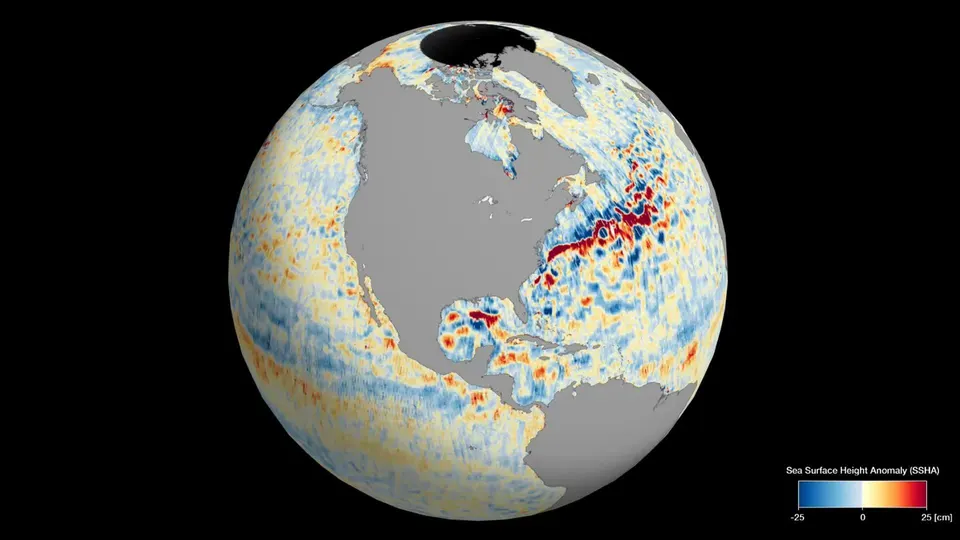
The proposed mechanism works through atmospheric circulation that resembles the Northern Hemisphere Annular Mode, a pattern of wind variability that circles the Arctic. In the simulations, sea level anomalies formed in the central North Pacific and traveled slowly westward, behaving like wind-driven ocean waves called Rossby waves. Over periods of up to 5 years, higher sea levels built up east of Japan. That pushed the Kuroshio Extension northward, and the shifted current carried warm water with it. A simple wind-driven wave model reproduced the simulated sea level changes well in the Kuroshio Extension, though not everywhere. The authors say the mismatch may reflect additional processes.
The link depends on ocean detail. In a coarser, non-eddying version of the model, it nearly disappeared, and North Atlantic temperatures explained only 0.49% of Kuroshio variance. Across the whole mid-latitude North Pacific, as opposed to the Kuroshio region alone, the tropical Pacific's influence was larger than the North Atlantic's: 17% compared with 10%.
Why it matters
The authors say interactions between the Kuroshio and the Gulf Stream could be a major source of seasonal-to-decadal predictability for Northern Hemisphere climate. They also note that current climate models tend to underestimate predictability in mid-latitude regions.
What we don't know yet
The findings come from model simulations, and the link weakened sharply in a non-eddying model setup. A simple wave model did not fully match the simulated sea level changes everywhere, which suggests other processes are also involved.
Terms in this story
- Kuroshio Extension
- The eastward continuation of the warm Kuroshio current after it leaves the coast of Japan and flows into the open North Pacific.
- Rossby waves
- Very slow, large ocean waves that travel westward and can shift currents and sea levels over several years.
- Northern Hemisphere Annular Mode
- A large-scale pattern of variation in air pressure and winds that circles the Arctic.
Sources and verification
DexScience articles are produced with AI assistance and an automated fact-check against the linked sources. Spotted an error? Tell us and we will correct it openly.