Key points
- Greenhouse gas forcing outweighed internal variability in strengthening the NPMM's recent influence on ENSO, the modeling study reports.
- Aerosol and natural forcings had minimal impact on the strengthened connection, according to the researchers.
- Warmer background sea surface in the subtropical North Pacific amplifies NPMM-triggered westerly wind bursts that help ENSO develop.
- The authors suggest the findings could open opportunities to extend ENSO prediction lead times.
A new modeling study finds that rising greenhouse gases are the main reason a North Pacific climate pattern has gained more influence over the El Niño cycle in recent decades. The researchers report that greenhouse forcing outweighed the climate system's own natural swings, while aerosols and natural forcings had very little effect. The work was published in a peer-reviewed journal from IOP Publishing.
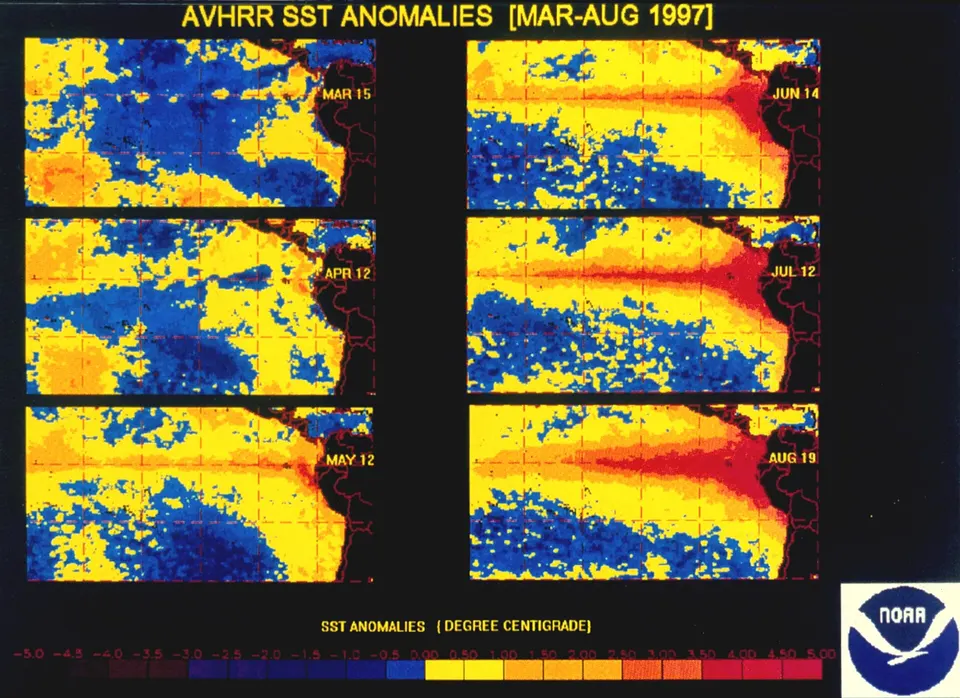
The pattern is called the North Pacific Meridional Mode (NPMM). It is a key trigger, from outside the tropics, of El Niño–Southern Oscillation (ENSO) events. ENSO is the recurring warming and cooling of the tropical Pacific Ocean that shifts weather patterns far beyond the region. The NPMM's effect on ENSO has grown markedly, but it was unclear whether outside influences or internal variability were responsible.
To find out, the team analyzed simulations from several models in the Detection and Attribution Model Intercomparison Project and ran a set of extra numerical experiments. They found that greenhouse gases raise the average sea surface temperature in the subtropical North Pacific. This warmer baseline strengthens a feedback that links wind, evaporation and sea surface temperature. That feedback amplifies bursts of westerly winds over the western tropical Pacific that the NPMM sets off, which in turn helps ENSO events develop. In sensitivity tests, greenhouse-driven warming in the subtropical North Pacific made the atmosphere respond more strongly to the NPMM.
The authors say the results show that human-caused forcing plays an important role in how conditions outside the tropics affect ENSO. They suggest this could create opportunities to forecast ENSO events further in advance.
Why it matters
The researchers say the NPMM's stronger influence offers a way to improve ENSO predictability, and their findings suggest it could help extend how far ahead ENSO can be forecast.
What we don't know yet
The conclusions come from climate model simulations and numerical experiments rather than direct observation. The authors present longer ENSO prediction lead times as a possible opportunity, not as a result they have shown.
Terms in this story
- El Niño–Southern Oscillation (ENSO)
- A recurring cycle of warming and cooling in the tropical Pacific Ocean, linked to changes in the atmosphere, that affects weather around the world.
- North Pacific Meridional Mode (NPMM)
- A pattern of linked wind and sea surface temperature changes in the subtropical North Pacific that can help set off ENSO events.
- Westerly wind bursts
- Short spells of unusually strong winds blowing from west to east over the tropical Pacific.
Sources and verification
DexScience articles are produced with AI assistance and an automated fact-check against the linked sources. Spotted an error? Tell us and we will correct it openly.