Key points
- Nanodiamond inclusions stabilized soft-lattice halide perovskites, researchers report in Science.
- Cells of 0.09 square centimeters reached a certified power conversion efficiency of 27.6%.
- Minimodules of 16.1 square centimeters achieved 24.3% efficiency.
- Devices kept 80% of initial efficiency after 5000 hours of operation at 85°C.
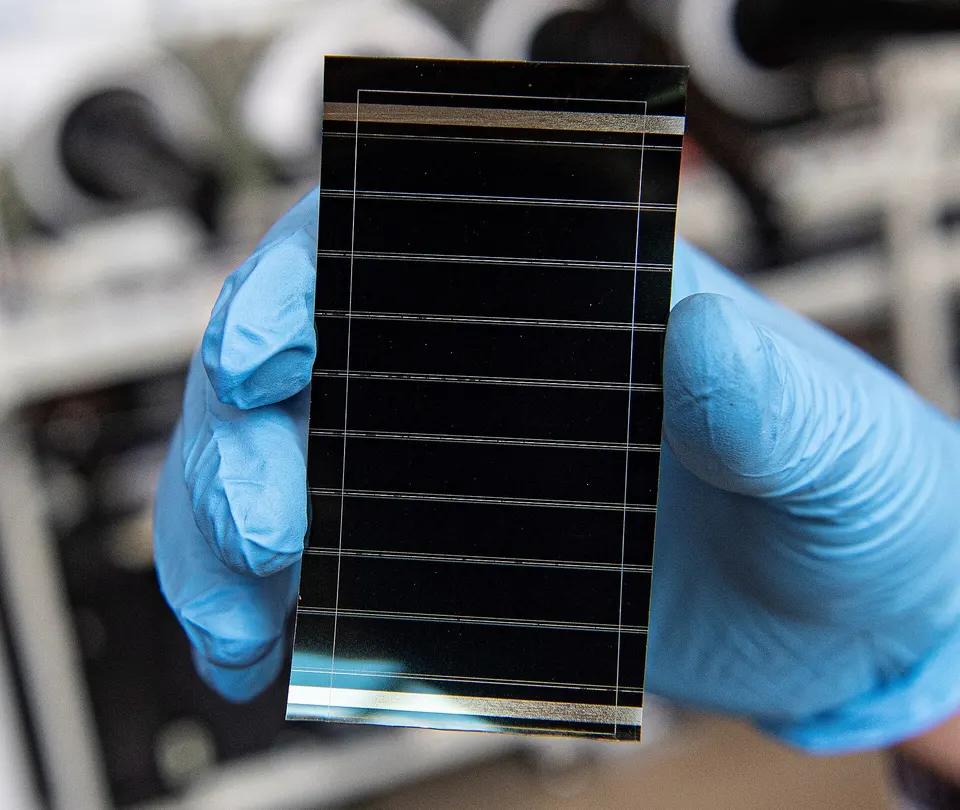
Mixing rigid nanodiamond particles into halide perovskites can stabilize these promising solar materials, a research team reports in the journal Science. Cells built from the stabilized material reached a certified power conversion efficiency of 27.6%. They also kept 80% of their starting efficiency after 5000 hours of operation at 85°C.
The researchers say halide perovskites face a built-in trade-off. Their soft, flexible crystal lattice helps them perform well, but it also makes them less stable during use. Perovskites are a family of crystalline materials that absorb sunlight efficiently and can be made into thin films. According to the team, the nanodiamonds pull internal elastic stress out of the crystal interiors and pass it to the grain boundaries, the seams where tiny crystals meet. There the stress is spread out and dissipated instead of building up. The inclusions also kept neighboring grains from sliding past one another. This limited distortion of the lattice and reduced the formation of defects over long periods of operation.
The 27.6% result came from small cells measuring 0.09 square centimeters. Larger minimodules covering 16.1 square centimeters reached 24.3%. The heat test held the devices at their maximum power point, the operating condition where a cell delivers its peak output. In a separate test, devices went through 5000 hours of day-night cycles with changing light intensity and retained 98% of their initial efficiency.
Why it matters
The softness that makes halide perovskites good at harvesting sunlight also limits how long they last. This study reports a way to stabilize that soft lattice while keeping efficiency high.
What we don't know yet
The abstract reports results only for small cells and for minimodules up to 16.1 square centimeters. It does not describe how the approach performs at larger scales.
Terms in this story
- Halide perovskite
- A type of crystalline semiconductor, built from metal and halide ions, that is widely studied for solar cells.
- Grain boundary
- The interface where two of the tiny crystals that make up a polycrystalline film meet.
- Power conversion efficiency
- The share of incoming light energy that a solar cell turns into electrical energy.
Sources and verification
DexScience articles are produced with AI assistance and an automated fact-check against the linked sources. Spotted an error? Tell us and we will correct it openly.